Sunday, April 19, 2015

The National Mass Care Exercise, June 7-11, 2015, Austin, TX

After 3 years of holding the National Mass Care Exercise in Tallahassee we're holding the 2015 Exercise in Austin, courtesy of the Great State of Texas. Planning is already underway for Missouri to host the Exercise in 2016 and we are looking for a state in the FEMA Region 5 area (the MidWest) to play as host for 2017. After action reports on the previous Exercise are available on the State of Florida Mass Care website.

We have been working on planning the Texas Exercise since last August. Because of my record of putting on 3 successive exercises with no budget or staff, I was asked to help out with the planning for this year's exercise. I agreed because I'm all about training up the rest of the country in state mass care coordination so that they will be ready to come to Tallahassee and help me when the Cat 5 hits Miami.

The site selected at Camp Mabry National Guard base for the Shelter & Feeding Task Forces.
The National Hurricane Conference also happened to be in Austin this year so we took advantage of the fact that a number of key out-of-state planners (including myself) were attending the NHC to hold some meetings and on-site visits with our Texas partners (or podnuhs, as they say in the Lone Star State). We visited the State Operations Center (SOC), housed in a 1953 era underground bunker as well as Camp Mabry, the location selected to house the 3 mass care task forces that will be established and operated during the exercise.

Texas Division of Emergency Management &Texas National Guard show
State, VOAD and FEMA visitors the Camp Mabry site.
A major purpose of the current and former Exercises was to continue development of the mass care task force concept. The basis for the structure and function of a mass care task force was outlined in a White Paper in December 2013. The White Paper summarized the lessons learned from the 2012 and 2013 exercises, and the concept outlined in the White Paper was validated in the 2014 exercise.

Two major issues that were not resolved in the previous exercises, and will be a particular focus of the 2015 exercise, are coordination between the task forces and the linkage between the task forces and the state operations center. Camp Mabry, the location of the mass care task forces, is at some distance from the SOC and this will provide some challenges in maintaining a common situation awareness at both locations.


A state establishes mass care task forces when the size of the disaster overwhelms their ability to coordinate an effective response. In 2004 we tried to meet the demand for additional mass care coordination by drafting state workers for the job. This solution was less than satisfactory. In big disasters we need augmentation by skilled emergency managers and mass care subject matter experts. The only way to get these people is to bring them in from out of state. How do we organize and employ these additional personnel? We establish mass care task forces.


These task forces will be much more effective if the incoming people are trained and exercised on a common mass care task force structure and function. That's the process that we started in Florida, will continue in Texas this year and carry forward in Missouri next year.

Plus, the exercise will be a lot of fun. All the cool people will be there. I'm looking forward to it.


Monday, March 02, 2015

How I came to write a war novel

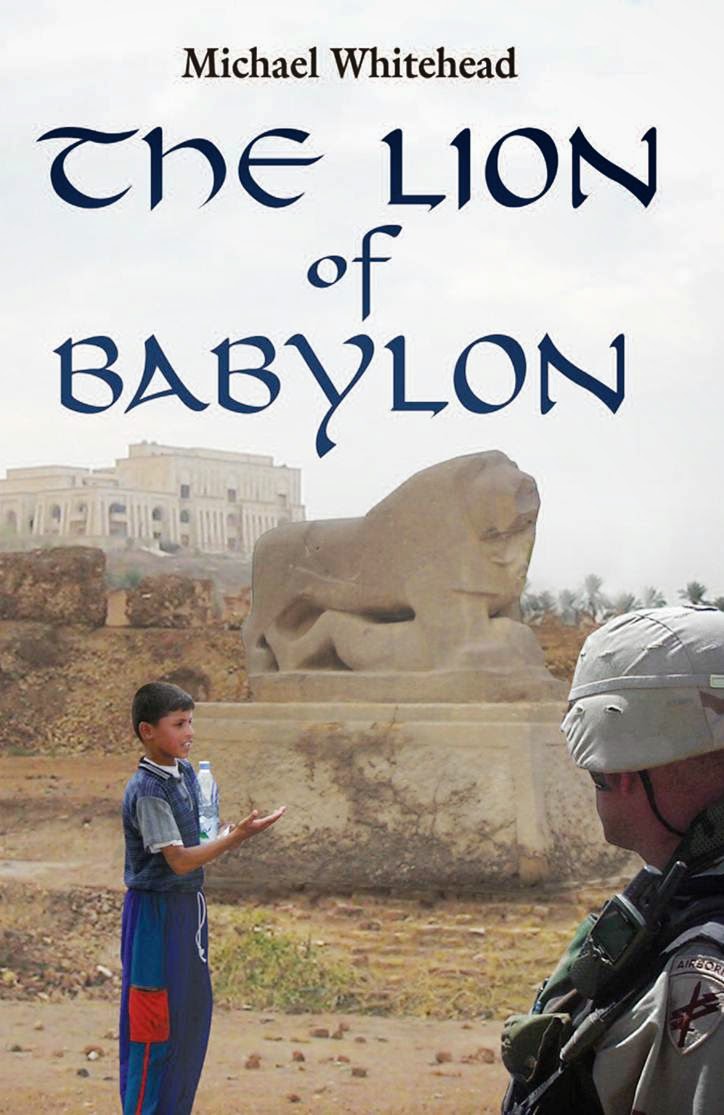
I wrote a novel about the war called The Lion of Babylon and the book has just been published. I thought that I would take the time to say how I came to write this novel.
The Lion of Babylon, a novel by Michael Whitehead

After training and preparing for a war for 26 years in the Active Army and Reserves I concluded that I would never see combat. I remember the moment that I reached this conclusion. The week of July 4th in 2001 I stood on Daytona Beach with my family and gazed at the thousands enjoying the sand, surf and sun. I was struck at how fortunate we were (me, my family, all of those people on that beach). Our nation was at peace and the Cold War, with the threat of thermonuclear destruction, had fizzled to a halt a dozen years before. The Clinton Administration had just concluded eight years of turning guns to butter. I was going to finish my time as a soldier and move on to doing something else with my weekends once a month.

Two months later came 9/11 and our world changed. Since I was a member of the Armed Forces of the United States at the time my life changed a little bit more than others.

All my life I've had the ambition to write and publish a novel. In 1994, at the age of 41, I decided that that I was going to do it. I took an FSU Continuing Education Class with Pam Ball (author of the novel Lava) called "Novel Writing" (or something like that). When the class ended I banded together with some of my classmates and formed a writers group. We started writing, meeting and critiquing each other's stuff. I remember Judge Terry Lewis was a member of our group and he was working on what would become his first novel Conflict of Interest. Over two years I wrote an 80,000 word novel called Every Man was Free, a dystopian tale about the survivors of a plague searching for a vaccine. Nobody would publish it.

I wondered if maybe my ambition would be only half fulfilled. I would complete the writing part without getting to the published part.

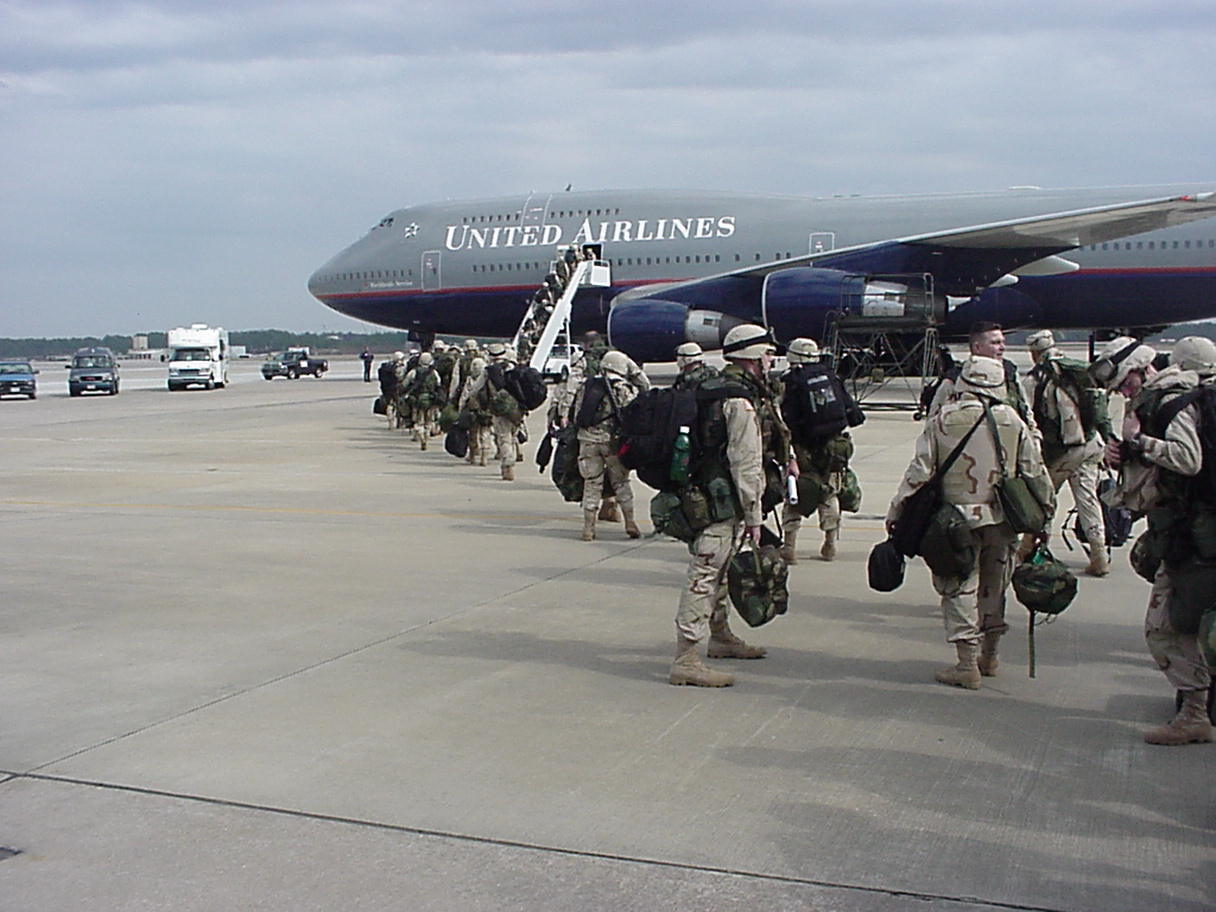
Eight years later, as I sat and sweltered in the Iraqi desert, I told myself that there had to be a novel somewhere in that experience. Since I had little entertainment to fill my free time I wrote long email stories to my family and friends. These emails were forwarded, as they are wont to be, and soon I had dozens of strangers contacting me and saying how much they enjoyed my stories. A lady said that I should make them into a book. So I did. An Army friend who served with me in Iraq, Craig Trebilcock, wrote a novel about Iraq called One Weekend a Month and published it using a Print on Demand publisher called Booklocker.com.  He said that he had a good experience with them. In August 2006 I used them to publish my memoir on my Iraq war experience, Messages from Babylon.

I returned home from Iraq in April 2004, returned to work in May and, according to my notes, started working on a novel about the war in June of 2004. I can be precise about the date because I started a Journal and the opening entries were in June. Whenever I had problems with the novel (and that was too often) I would return to this Journal, which was a Word document named "Notes." I still have it. It's 61 pages long.

I started the Journal because I had an Idea but I didn't have a Story. The Idea came to me in Iraq: if we had the foresight to see the death of a fellow soldier, what would we do with the information? Could we change the outcome? What if our actions resulted in a worse outcome?

This is a philosophical Fate vs Free Will discussion that doesn't need a war to lend it context. At least, it doesn't for most people, but the concept came to me often when I was in Iraq. Most of the time we lived and slept on (relatively) protected compounds. When we got in vehicles to leave the compound the relative danger increased. The level of increase in the danger depended on where we were going.

Back here in the (relative) safety of the United States we get in a car and leave the relative safety of our home for the greater danger of the highway. In Iraq things were different. Before I left the compound I received a briefing on where the Bad Guys were blowing up and killing people the day before, loaded not one but two weapons and got in vehicles with other armed people. I still remember the harsh, metallic sounds of everyone around me chambering a round. And then when we left the compound we scanned our environment because we knew that there were people out there, somewhere, who wanted to kill us. This wasn't quite like getting in your car to go to work in Tallahassee.

And as I left the compound I always thought, "What would this day bring?" And after executing the same process for months on end the thought finally bounced back as, "What if you knew what the day would bring?"

There's a long, hard slog from an Idea to a Story to a string of sentences connected to paragraphs and pages and chapters and a completed novel. For the last nine years I have written and re-written this novel. I estimate that I wrote over 150,000 words and threw out 100,000. I joined another writer's work group and reconnected with Judge Lewis and Sam Staley, author of St. Nic., Inc., among other books. Over that time period I presented my work group with 3 different versions of the novel. They accepted the 3rd version, which means they either a) thought it was good, or b) decided that since I wasn't accepting their recommendations they would stop giving them, or c) they got tired of reading it.

The Story is about a young Iraqi boy who can see the future. He sees a vision that an American soldier will come and help him fulfill his lifelong dream of finding where his parents are buried. The source of the boy's power is the Lion of Babylon. Nine years ago I set up a website for the day when my novel was finally published. The site is thelionofbabylon.com. Go check it out.

Sunday, February 22, 2015

Florida is writing a State Multi-agency Reunification Plan

Last Thursday, February 19, 2015, we had our first meeting/webinar of the State Reunification Plan Work Group at the State Emergency Operations Center here in Tallahassee. Fourteen different local, state, federal, voluntary and nonprofit agencies were represented at the meeting and we identified several others that needed to be brought into the Whole of Community planning process.

Reunification is one of the four activities of mass care, along with feeding, sheltering and distribution of emergency supplies. For this reason Emergency Support Function 6, Mass Care would take the lead in coordinating reunification during a disaster and in drafting a multiagency plan.

I'm sure that this begs the question for a number of people: If we didn't have a State Reunification Plan before, then why do we need one now? One answer is ignorance, on my part as well as others. Reunification issues in a disaster often create the kinds of complex, multiagency problems that give emergency managers a headache and are difficult to write into a plan.. Another, and better, reason that we never had a plan was that there wasn't much written reference material available on multiagency reunification.

That is about to change. Fourteen months ago a national work group was established with the object of creating a Multiagency Reunification Plan Template. I was a member of this work group and I got to listen to numerous conference calls with a lot of smart people who knew much more about reunification than I did. My part in the drama was to help take this information and draft it into the Template.

The national work group finished the draft template and sent the document out to a wider audience for review and comment. We are using this draft Template here in Florida as a basis for our new Plan. By doing so, and including subject matter experts from the national work group on our Thursday call, we were able to get advice on some sticky Florida issues we encountered as well as some ideas for improving the national Template.

We will have a Reunification Workshop at the Governor's Hurricane Conference in Orlando in May in which we will talk about our progress in completing a State Reunification Plan and discuss some of the issues that I'm sure that we will encounter.

We also hope to have the Multiagency Reunification Plan Template completed and up on the National Mass Care Strategy website by this summer.

Monday, January 26, 2015

On the movie "American Sniper"

Eleven years ago next month, on February 28, 2004, I led a convoy of 2 HummVees from Al Hillah, Iraq into Kuwait. The ride took longer because one of the vehicles broke down on the way and we had to wait by the side of the road while one of our mechanics replaced a hose. Except for the mechanical problem the ride was 10 good, boring, windblown hours of staring at concrete and desert. In a combat zone boring is good and most any excitement is bad. Plus, we missed the unpleasant company of the summer heat.

When we crossed into Kuwait we were met by two U.S. Army military police. They told us to clear our weapons and take off our body armor and helmets. In other words, we were safe now. I remember feeling as if a great weight had been lifted off me, a weight that I had not fully realized was there. This was followed by a tremendous sense of relief. I had made it. We had all made it. I unloaded my rifle and pistol, took off my body armor and helmet, and climbed back into the vehicle. I would never return to Iraq again.


This would not be true for some of my fellow Active duty and Reserve soldiers. I retired with 30 years of service the following year but the wars in Iraq and Afghanistan continued. The one year that I had served in a war zone began to pale in comparison to the multiple tours (some as long as 15 months) that the Active Army endured. Some Army Reservists that I knew even went on a second tour, if not in Iraq then in Afghanistan.

And as the wars and the tours continued I began to feel guilty that I had not done enough. I didn't talk about this with many people because it was illogical. When I was called I went. The retirement at 30 years was mandatory and I couldn't have stayed in the Active Reserves even if I had wanted to. But I still felt guilty. There's the guilt about the multiple tours that I didn't have and there's the guilt about the ones who didn't come home and the ones who returned maimed in body and/or spirit.

I'm not looking for sympathy or understanding. I'm not crippled or impaired by these feelings but they exist. The bottom line was that I didn't go again so someone else had to.

In this way, I identified with Chris Kyle, the protagonist in the movie "American Sniper." He kept going back to the combat zone because he knew that he would feel guilty if he didn't. If he didn't go someone else would have to. This was illogical but he felt it anyway. He couldn't be sure that whoever took his place would do the same job that he did.

This was a hard movie for me to watch, but I knew it would be. I felt that I had a duty to go see it. I had to see it for Chris Kyle and and those who went back. I had to see it for all those Army Reserve soldiers who did the tours because I didn't go.

Sunday, December 28, 2014

Moving Beyond "Safe & Well"

Hurricane Katrina has been the poster disaster for emergency management on the challenges that arise when families are separated and the difficulties inherent in reuniting them. Reunification Services is one of the four activities involved with Mass Care (along with feeding, sheltering and distribution of emergency supplies) but doesn't usually get much thought or attention. To be honest, in most of the disasters with which I've been involved, the sum total of my involvement in reunification was to point anyone who asked toward Red Cross's Safe and Well program.

It's time to move beyond Safe and Well.

Not to say that Safe and Well is broken. Safe and Well is a website where people can go to register themselves as "safe and well" or to seek out family and friends who may have been affected by a disaster. With the advent of a society where social media is widespread and even some children have smart phones, the need for sites such as Safe and Well has diminished or become unnecessary.

Unnecessary, at least, until the cell towers are down, the power is out, the smart phone batteries are dead and millions of people are seeking the status of loved ones at the same instant. Let me clarify by saying "millions of people" who are accustomed to instant communications 24/7.

When I say that we as a mass care community must move beyond Safe and Well I mean that we must prepare for situations where reunification requirements go beyond a website and involve multi-agency coordination. And for multiple agencies to be effective in coordinating during a disaster they must have a common understanding of everyone's responsibilities and the mechanisms by which they will work together toward common objectives. In other words, they need a plan.

To my knowledge. few if any county or state jurisdictions have a multi-agency reunification services plan. The State of Florida doesn't have one. Until this year, I didn't think that we needed one. And even if  I thought we needed one I didn't know where to start in writing such a plan.

All of that changed more than a year ago when I was asked to join a national workgroup with the object of developing a State Multi-agency Reunification Services Plan Template. My knowledge of reunification services was pitiful but I did have a lot of experience writing mass care plans. We were fortunate to have a large number of workgroup members who had considerable disaster experience with reunification.

My participation on the workgroup (primarily twice a month conference calls) was personally and professionally rewarding. I learned a lot about reunification because I had a lot to learn and because the subject was much broader and complex that I imagined. There was a lot more to reunification that Safe and Well. Sometimes reunification comes into play when a disaster overwhelms certain local government services.

For example, this month the State of Washington issued the SR 530 Landslide Commission Final Report. The SR 530 Landslide occurred in March 2014 and killed 43 residents and destroyed 40 homes. The Report revealed a lot of Lessons Learned for Washington State. One of the lessons was: "Large incidents with multiple fatalities can overwhelm the capacity of local coroners and medical examiners."

Like a lot of jurisdictions faced with mass fatality events, there were problems constructing and maintaining a missing persons list. "During the SR 530 incident the Snohomish County Medical Examiner’s Office was not staffed to handle this mass fatality event." Local law enforcement was statutorily responsible for compiling the list but they were overwhelmed with the search and rescue effort. Multiple agencies stepped into the void to compile their own separate, uncoordinated lists. The result was that numerous families  received multiple phone calls asking for information about missing loved ones. Not surprisingly, the affected families characterized this situation as "cruel."

As one can imagine, local jurisdictions must handle not only building an accurate missing persons list but dealing with the families associated with each name on the list. "The Snohomish County Health District went forward with the Medical Examiner’s Plan to establish a Family Assistance Center (FAC), without a firm understanding of the trigger points for establishing a FAC." As a result of these complications, a FAC was never established.

The point here is not to beat up on poor Snohomish County. The SR 530 Landslide was a rare and complex disaster that few jurisdictions are capable of handling. And we certainly aren't going to write a State Reunification Plan that tells counties how to handle these disasters. As we all know (and the counties keep reminding us) every county is different and every disaster is different. So what's the state concept of operations for large reunification events? We had a hard time in the workgroup coming up with an answer to that question.

This month we finished a draft of the Template Plan and I think we came up with an answer to that question. The concept of operation is that the local jurisdiction identifies the fact that they have a significant reunification problem and, based on that assessment, requests reunification assistance from the state. Upon receipt of such a request, the State Mass Care Coordinator acts to support this request by acquiring, prioritizing and allocating reunification resources from federal, state and nongovernmental agencies.

Sounds easy, right? I believe it is. We're not going to be able to train every state and county emergency manager, much less every mass care coordinator, to handle these rare and complex reunification problems. Instead, we need to school them in Reunification Anonymous, and show them how they can recognize and admit that they have a reunification problem.

To assist local jurisdictions with this task we developed a simple and easy-to-use tool that helps them define the reunification intensity of their Event as either low, medium or high. And based on this self-assessment, they can decide if they need to ask for state assistance. The state, in turn, will use their Multi-agency Reunification Plan to bring in the necessary experts to assist with bringing reunification resources to bear in support of the requesting local jurisdiction.

In January 2015 the State of Florida will start the process to write our own State Reunification Plan. We included some counties on our planning team to keep us honest. I look forward to the experience.

Sunday, November 16, 2014

What Types of Shelters should we have?

FEMA invited me to come to the District on their dime and the State said I could go. This was my idea of a good time: a whole day in a room full of people talking about mass care sheltering. And the best part of it was that they invited the right people, as in the ones with knowledge and experience on the subject at hand.

The meeting focused on the arcane but important subject of mass care resource typing. I have written about this before, so if you want a longer winded explanation of the topic you can go here and here. The short version runs like this: if you're in a disaster and you need more resources, you want to be sure that when you ask for something you know what you're going to get. Resource typing helps solve this problem. For example, field kitchens cook food but not all field kitchens are the same. The Field Kitchen Resource Typing document categorizes the kitchens according to how many meals per day they can produce. A Type 1 Field Kitchen can produce over 20,000 meals a day. A Type 4 can produce up to 5,000 meals.day. When a disaster happens I ask the voluntary agencies how many field kitchens they have available, by Type, so I can calculate the total capacity available.

The focus of our discussion in a conference room on the 8th floor of FEMA Headquarters on a rainy day in the District was on resource typing shelters. When I was Chairman of the Mass Care Resource Typing Workgroup from 2008-2012, we formed  a Shelter subgroup to tackle this exact problem. I didn't have a lot of experience working in shelters but I did listen to their conversations and reviewed the documents that they created. The first resources they tried to Type were Shelter Managers and Shelter Management Teams.

They immediately ran into a problem: the Type of Shelter Manager or Shelter Management Team depended on the Type of shelter they were running. That means they had to back up and categorize shelters by Type. Resource types are an indicator of capability. A Type 1 has more capability than a Type 2 or a Type 3.

So how do you define the capability of a shelter? By the number of people it could hold? That should depend on the available square footage in the shelter. But the available square footage fluctuates, in general, according to the expected length of the shelter stay. An evacuation shelter, expected to operate for 72 hours, is based on 20 sq/ft/person. A short term shelter, established to operate for up to 2 weeks, is based on 40 sq/ft/person. A long term shelter is established to operate for over 2 weeks and uses 60 sq/ft/person.

You might say that the capability of these different shelters was based on the square footage available to the individual sheltered. But it was more than that. As the length of the expected shelter stay increased the quality of the services available to the individuals sheltered also improved. The ratio of toilets and shower heads per person improved, as well as the availability of laundry services. A graphical portray of this relationship, taken from the Florida's Shelter Support Plan, is shown in the diagram below.
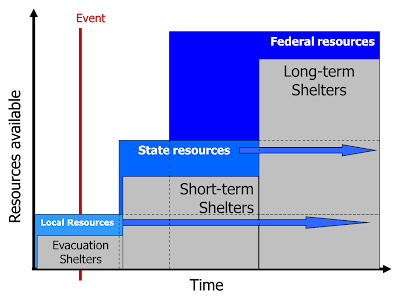
Resources available in Shelters over time

The Shelter Subgroup produced a beautiful document full of valuable information on shelters and shelter staffing. The document was called the Shelter Guidance Aid and Shelter Staffing Matrix. In 2010 we showed the Shelter Guidance Aid to FEMA, proud of our accomplishment, and FEMA said that they couldn't publish it. What? Why? They said resource typing was for resources that could be deployed and shelters were buildings. OK. In a major concession they agreed to let us post the document on a web site as long as we didn't say it was a federal document (which it wasn't). We put it up initially on the International Association of Venue Managers website, and later the National VOAD website.

With this document as a basis the Shelter Subgroup developed the Shelter Manager and Shelter Management Team documents that were almost identical to the documents adopted by the National Integration Center this year for use nationwide. The Type 1 Shelter Manager and Shelter Management Team were for Long Term Shelters, the Type 2 for Short Term Shelters and the Type 3 for Evacuation Shelters. This is not as clear as it should be in these Typing documents because any reference to the rationale for the Typing, the Shelter Guidance Aid, was stripped from the Typing documents before they were published.

When both of these documents were released for Public Comment in a NIMS Alert in October 2012 I could tell right away that people would be confused. Although I submitted detailed comments (basically a summary of this blog post so far) the confusion (in my opinion) wasn't cleared up when the two documents were posted as final in June 2014.

The problem was that neither of the documents defined what a Type 1 or Type 2 or Type 3 shelter was. The Shelter Management Team document had the following statement in the "Composition & Ordering Specifications" portion of the document:

"Specific types of shelters in need of a management team:
1. Temporary Evacuation Point
2. Emergency Evacuation Shelter
3. Standard/Short Term Shelter
4. Long Term/Mega Shelter"

Notice that the shelter types are numbered in inverse order of what the Shelter Subgroup intended. The only clue, an indirect one, comes from the fact that a Type 1 Shelter Management Team has a Type 1 Shelter Manager, and so on with a Type 2 and Type 3. If one has the patience and diligence one can read the fine print of the Shelter Manager document and see that a Type 1 Shelter Manager "is  responsible for providing leadership, supervision, and administrative support for a Long-Term, Mega-Shelter as defined through the American Red Cross Non-Traditional Shelter Concept of Operations Template." The Type 2 Shelter Manager "is responsible for providing supervision and administrative support for short duration shelter operations, a Standard, Short-Term Shelter." The Type 3 Shelter Manager is responsible for a, evacuation shelter.

So what is the American Red Cross Non-Traditional Shelter Concept of Operations Template? The opening pages of the document state that "This Non-Traditional Shelter Concept of Operations was created by the American Red Cross at the request of the City of Los Angeles." This is a fine and valuable document but it does not clearly define (nor, I suppose, was it intended to) the differences between a Long Term, Short Term and Evacuation shelters. I have no idea why this document was referenced rather than the Shelter Guidance Aid. I wasn't consulted when the decision was made.

I don't know. Maybe nobody else in the nation cares about this kind of stuff. The goal of FEMA is to get these new shelter typing documents out before next hurricane season. When the new documents come out next Spring, and you ask yourself, "Why in the hell did they do it this way?" maybe this blog post will give you an idea why.

I'm not saying anybody is screwing up. I spent 4 years complaining that FEMA wasn't publishing any mass care resource typing documents, in spite of the work that we were doing to create such documents. "Just publish the damn things," I said, "and hear what the community has to say about it."

So FEMA publishes documents that I don't like and I'm complaining about it. I guess FEMA is used to being complained about.