On Tuesday night, September 17 I was sitting at home watching the Braves lose another game to the Nats when I got a phone call from a local emergency manager in Colorado. He got my phone number from a friend of a friend and wanted to "pick my brain" about the long term shelter problem he was facing.
For Colorado, the Big One had finally arrived. And for the Red Cross, the Salvation Army, the Baptists, and the state/local emergency managers involved in mass care in the state this is the Big Test. Are they prepared? Did all that time they spent writing plans, teaching classes, and conducting exercises build the required level of capability in Mass Care Services required?
Based on media reports and my discussions with friends responding to the disaster the answer is Yes. Has everything gone perfectly? Good Lord, if that's your standard then you'll never be happy. It's a disaster. If everything was all right then we wouldn't have a job as emergency managers. The problem we always face is that when the disaster strikes the citizens have never read our perfectly drafted plans. They don't obey our carefully crafted public messages. They insist on acting in what they perceive to be their best interests at the time.
Imagine.
The first rule of emergency management is that the citizens will do whatever they want, regardless of what they've been advised. The second rule is that no matter what we do, it won't be enough - especially when it comes to mass care. So if you're in the job accept these rules, move on and do the best you can to help the most.
The Big News in this disaster has come from the Red Cross. For the first time in my knowledge the Red Cross Disaster Relief Operation is organizing according to the Incident Command System (ICS) and issuing daily Incident Action Plans (IAP). For me, this is great news and long overdue.
There has been a lot of discussion (at least, if you hang out with the people I do) about the re-engineering the Red Cross has undergone and is still undergoing. Change is painful and controversial. I was not privy to the reasons for the current re-engineering and no one is in a position now to know how successful it will be.
I have discovered (to my dismay) that there are some people who devote an inordinate amount of time criticizing the Red Cross. The Red Cross is a big organization that plays an important role in disaster responses of all size in every corner of our nation. Public institutions in our society must expect to be criticized and such criticisms are often required to drive needed changes. An institution like the Red Cross, which survives primarily on public donations, is especially sensitive to public criticisms.
Yet most of the criticisms of the Red Cross that I hear are motivated more by destruction than a desire for change. Unfortunately, this is common in much of our social discourse these days. In my view, the critics have an unreasonable expectation of the capabilities of the Red Cross and, in some cases, an unreasoning sense of entitlement. Both of these problems apply to the Staten Island politician who, in the days after Sandy struck, publicly denounced the performance of the Red Cross only to discover that no, no, the Red Cross doesn't perform search and rescue operations in the immediate aftermath of the disaster.
We need the Red Cross. We need the idea of the Red Cross - the idea that we can respond to disasters with volunteers and donations. We can get mad at people in the Red Cross. The people who are human and make mistakes and do stupid things. But we can't confuse the people in the Red Cross with the idea of the Red Cross. We need the idea of the Red Cross. The people will come and go. We need the idea to live on.
Sunday, September 29, 2013


Sunday, August 18, 2013
Shelter Transition Teams
In June 2012 Tropical Storm Debby dumped over 25 inches of rain on the City of Live Oak, the County Seat of Suwannee County in North Florida. When I got to the State EOC the morning of June 26 I read Information Message #155 from Suwannee County on the EM Constellation Message System. The Message, titled "Evacuations/Roads", and posted at 0556 hours, read in its entirety, "Suwannee County is
evacuating many many houses within the County as well as City of Live Oak , US US Hwy 90 and Pine" was in downtown Live Oak.
The day before, seeing as it was "just" a Tropical Storm, I saw no reason to cancel my plane flight to Atlanta for the FEMA Region IV Individual Assistance Conference. Hmmmmm, I thought, after reading the message. I don't think I'm going to Atlanta. I called my good friend Ryan Logan at FEMA Region IV (woke him up) and gave him the bad news.
About 2 weeks later the Shelter Report for the state was down to one shelter open, in Suwannee County, with a population that had dropped to and stayed at around 50 people. Mike Delorenzo, the SERT Chief, declared in the State EOC that the priority for the disaster was to get the Suwannee County Shelter closed. I turned to Beth Boyd, the Red Cross liaison in the State EOC and said, "OK, Beth, get the shelter closed."
As the State Mass Care Coordinator that was about all that I could do. In the state of Florida, shelters are a local issue and getting everyone out of the shelter was the responsibility of the local authorities. Even if I wanted to help I had no resources to bring to bear on the problem. Bryan Koon, the Director of the Florida Division of Emergency Management, commented at the TS Debby "hot wash" that we took too long to get the shelter in Suwannee County closed.
I agreed, and started looking into possible solutions. I discovered a best practice that was utilized with some success during the Alabama tornadoes in 2011 and even (in some places) during Hurricane Sandy in 2012: the Shelter Transition Team. As we drafted Florida's new State Shelter Support Plan we incorporated the Shelter Transition Team concept into the document.
As we are all aware the introduction of a new concept into a plan requires development of a process for execution in a disaster and the acceptance and understanding of this new concept and process by the various stakeholders. The biggest stakeholders and beneficiaries of the Shelter Transition Team are the local emergency managers. I began introducing this concept to them at training sessions in October 2012 at well as at the Governor's Hurricane Conference and State Hurricane Exercise in May of this year.
The message that I communicated to the local emergency managers was that the process began when the County requested a Shelter Transition Team from the State. This would be done in the same manner that the Counties request any other resources from the state. When this request arrives at the State EOC the responsibility for coordinating this mission would be assigned to State ESF #6, Mass Care. That's me.
I do not have a cache of Jedi Knights in Tallahassee that I can send to the counties in response to this request in order to solve their shelter transition problems. The assignment of the mission to ESF #6 signifies two important things: 1) The County has asked the State for assistance in transitioning their shelter populations, and 2) The State Emergency Response Team (SERT) Chief has directed the State Mass Care Coordinator (me) to marshal federal, state and nongovernmental agency resources toward the outcome of moving all shelter residents to appropriate housing (as specified in the State Shelter Support Plan).
This is important to the County emergency managers (or so I have/will explain to them) because in a disaster closing the shelters is one of a list of problems they are wrestling with and the shelters may not even make the Top 10 on the list. Secondly, none of the federal, state and nongovernmental agencies that can bring resources to bear to get the people out of the shelters and into appropriate housing work for the County Emergency Manager. Third, the actions of the federal, state and nongovernmental agencies are seldom well-coordinated at the local (or even state) level.
So how would this Shelter Transition Team work at the local level? The process we are developing in Florida begins, as I said before, with a request by the County to the State. The second step is that the county either a) designates a local Shelter Transition Team Leader, or b) approves a local representative nominated by one of the agencies in the State Shelter Support Plan to be the Team Leader.
The Team Leader would become the local coordination point for all the agencies working to transition the shelter residents to appropriate housing. This coordination could be performed through regular meetings and/or conference calls. The Team Leader would also be in regular contact with State ESF #6 in order to exchange information and get assistance with resolving multi-agency disputes (which, in disasters, is a common occurrence).
I am under no illusions that getting any of this done in a disaster would be easy. FEMA and the American Red Cross are also big stakeholders in this process and we need to work with them to determine how they can help to make this concept work in Florida. I hope that we can get the detailed coordination finalized before we have to actually use this plan in a disaster.
With the peak of hurricane season approaching.... Well, this is one of my top priorities.
Sunday, July 28, 2013
State Mass Care Coordination
The national mass care community needs to agree on a standard state mass care coordination process and then sell the concept to the emergency management community. I am sure that this is not a burning item on your priority list but here me out. Right now, responsibility for mass care coordination for most of the fifty states can be divided into one of three categories: 1) Let the Red Cross do it, 2) Let the Red Cross and FEMA do it, and 3) let a social service service state agency do it.
Emergency managers don't want to mess with mass care. This situation reminds me of the role of civil affairs in the Army. Civil Affairs consists of officers and soldiers who deal with civilians on the battlefield. The Infantry and Armor Officers who are In Charge don't want to mess with the civilians because they wouldn't take orders and were a drain on resources needed for combat operations. All of our tabletop and field exercises were full of combat units but civilians and their problems were nowhere to be seen. The civilians were assumed to be out of the exercise, taken care of by the civil affairs units.
Emergency managers are rightly concerned with life safety actions immediately after the disaster hits. But, as they say, after 72 hours you're not doing search and rescue, you're doing body recovery. Most big exercises end by 72 hours after the event, if they even last that long. Yet, at 72 hours, in disasters involving millions of people (which are the ones that most concern me) the mass care problems are only beginning.
The intent of a standardized state mass care coordination process is not to dictate to states how they should do business. When the Big One hits and the State starts screaming for help and people from other states or voluntary agencies or FEMA start streaming into the State EOC it would be very helpful if everyone used and understood a common process for mass care coordination. These new people are already dealing with an unfamiliar geography, a strange system and co-workers that they have never seen before. By giving them a nationally known and familiar process we can immediately increase their effectiveness. Preferably this process would have been taught in FEMA mass care courses and practiced in exercises like the National Mass Care Exercise. I've written about this in a previous blog post.
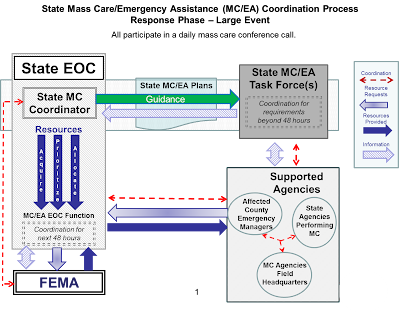
After the recent National Mass Care Exercise, held in Tallahassee in May, we came up with the diagram below to explain the coordination process that we utilized in the exercise. This diagram didn't spring forth from anyone's head fully formed. At least 30 or 40 members of the national mass care community nationwide made comments on various drafts. At first they said to add this and don't forget to include that. Then they said the damn thing was too complicated and hard to understand. So we simplified the diagram and found someone in FEMA Headquarters who could draw pretty Power Point pictures. This is the result.
 At the FEMA Region IV Individual Assistance Conference in Atlanta last week I briefed this diagram to the FEMA, state and voluntary agency attendees. They then broke up into groups and discussed the diagram. Some groups briefed that we needed to add this or include that. Others said that it was too complicated.
But we're making progress. We need to get the diagram out in front of people so that they can talk about it and maybe even think about how they can adopt it in their states.
To me there are a number of important features of the diagram that must be pointed out. First, and most importantly, the diagram establishes the critical role of the State Mass Care Coordinator (SMCC). FEMA has published a Job Title that establishes education and experience requirements for a Type 1 and Type 2 State Mass Care Coordinator. The National Mass Care Strategy recommends that states identify a State Mass Care Coordinator. FEMA needs to encourage this by sending identified State Mass Care Coordinators to training and exercises, like the National Mass Care Exercise.
A second important feature is the concept that the SMCC acquires, prioritizes and allocates resources and information to the supported agencies. In large events the SMCC is assisted in this coordination process through the establishment of Mass Care Task Forces, that operate in accordance with State Mass Care/Emergency Assistance Plans.
Finally, the diagram defines the supported agencies as the affected counties, the Mass Care Voluntary Agencies Field Headquarters (like the American Red Cross Disaster Relief Organization) and those state agencies that perform mass care (like a state Social Services agency that operates shelters). These Supported Agencies request and receive resources from the State EOC.
I am going to do my best to engage the national mass care community with the concepts incorporated into this diagram. The first step in the engagement is to get everyone to understand the existence and importance of the state coordination process. The second step in the engagement is to get everyone to understand the concepts represented in the diagram of the process and how they would apply to a disaster in their state. Finally, I want to get informed analysis and criticism of the diagram so that we can make it better.
Emergency managers don't want to mess with mass care. This situation reminds me of the role of civil affairs in the Army. Civil Affairs consists of officers and soldiers who deal with civilians on the battlefield. The Infantry and Armor Officers who are In Charge don't want to mess with the civilians because they wouldn't take orders and were a drain on resources needed for combat operations. All of our tabletop and field exercises were full of combat units but civilians and their problems were nowhere to be seen. The civilians were assumed to be out of the exercise, taken care of by the civil affairs units.
Emergency managers are rightly concerned with life safety actions immediately after the disaster hits. But, as they say, after 72 hours you're not doing search and rescue, you're doing body recovery. Most big exercises end by 72 hours after the event, if they even last that long. Yet, at 72 hours, in disasters involving millions of people (which are the ones that most concern me) the mass care problems are only beginning.
The intent of a standardized state mass care coordination process is not to dictate to states how they should do business. When the Big One hits and the State starts screaming for help and people from other states or voluntary agencies or FEMA start streaming into the State EOC it would be very helpful if everyone used and understood a common process for mass care coordination. These new people are already dealing with an unfamiliar geography, a strange system and co-workers that they have never seen before. By giving them a nationally known and familiar process we can immediately increase their effectiveness. Preferably this process would have been taught in FEMA mass care courses and practiced in exercises like the National Mass Care Exercise. I've written about this in a previous blog post.
After the recent National Mass Care Exercise, held in Tallahassee in May, we came up with the diagram below to explain the coordination process that we utilized in the exercise. This diagram didn't spring forth from anyone's head fully formed. At least 30 or 40 members of the national mass care community nationwide made comments on various drafts. At first they said to add this and don't forget to include that. Then they said the damn thing was too complicated and hard to understand. So we simplified the diagram and found someone in FEMA Headquarters who could draw pretty Power Point pictures. This is the result.

But we're making progress. We need to get the diagram out in front of people so that they can talk about it and maybe even think about how they can adopt it in their states.
To me there are a number of important features of the diagram that must be pointed out. First, and most importantly, the diagram establishes the critical role of the State Mass Care Coordinator (SMCC). FEMA has published a Job Title that establishes education and experience requirements for a Type 1 and Type 2 State Mass Care Coordinator. The National Mass Care Strategy recommends that states identify a State Mass Care Coordinator. FEMA needs to encourage this by sending identified State Mass Care Coordinators to training and exercises, like the National Mass Care Exercise.
A second important feature is the concept that the SMCC acquires, prioritizes and allocates resources and information to the supported agencies. In large events the SMCC is assisted in this coordination process through the establishment of Mass Care Task Forces, that operate in accordance with State Mass Care/Emergency Assistance Plans.
Finally, the diagram defines the supported agencies as the affected counties, the Mass Care Voluntary Agencies Field Headquarters (like the American Red Cross Disaster Relief Organization) and those state agencies that perform mass care (like a state Social Services agency that operates shelters). These Supported Agencies request and receive resources from the State EOC.
I am going to do my best to engage the national mass care community with the concepts incorporated into this diagram. The first step in the engagement is to get everyone to understand the existence and importance of the state coordination process. The second step in the engagement is to get everyone to understand the concepts represented in the diagram of the process and how they would apply to a disaster in their state. Finally, I want to get informed analysis and criticism of the diagram so that we can make it better.
Friday, June 21, 2013
What I learned in the 2013 National Mass Care Exercise
The 2013 National Mass Care Exercise, held in Tallahassee, FL from May 20-24, 2013, brought together 60 federal, state, local, nongovernmental (NGO) and private sector mass care practitioners. We struggled to respond to two hurricanes and three impacts on the state. We tried out several well thought through plans and operational procedures. Like last year's exercise, some things worked and some things didn't.
But because of last year's exercise, we executed our plans and procedures better this year. And next year we will do even better.
A draft of the Exercise After Action Report has been prepared and circulated to the participants for their comments. Our goal is to have the Report finalized and posted to the National Mass Care Strategy web site by July 1.
In the meantime, however, I can let you know what I learned. First, I learned that to write state mass care doctrine, train people to that doctrine, and then exercise that doctrine simultaneously is difficult for the exercise organizers and confusing for the participants.
In a previous post I talked about creating a state Mass Care Services Doctrine. We've come a long way on the last 10 years toward standardizing the way we coordinate mass care at the state level. FEMA has put some of this process into a course, which I talked about in a previous post, but we need to get this course adopted by EMI and get federal, state, NGO and private sector mass care practitioners trained in the process. The exercise would be more effective if all the participants had the benefit of this course as a common baseline of understanding of the state mass care coordination process. I am going to push to make that happen.
The second big thing I learned in this exercise was how to forecast long term feeding and sheltering requirements for a hurricane. The exciting part about this was that we developed simple and effective formulas to make these estimates, and this process can easily taught and widely adopted in the mass care community.
Forecasting future mass care requirements is an important part of the state mass care coordination process. The state does not have an on hand inventory of mass care resources that can be doled out to counties and the voluntary agencies when the requests roll in after the disaster. These resources must be either purchased by the state or requested from FEMA, a process that can take days or longer. This delay in fulfilling the request means that survivors on the ground in the impact area are doing without. This means that I can be requesting resources before the storm has even hit.
What? Requesting resources before the storm has even hit? You could order too much or too little. That's wasteful and in efficient. As Craig Fugate taught us many years ago, there are 3 ways to respond to a disaster: Cheap, Efficient or Fast. You have to choose one. Our political leaders and the public want Fast, which is inefficient and expensive. You want Fast? Then you project the type, kind and quantity of mass care resources that will be in short supply after the disaster and order them before the disaster so that they will be on hand when the public needs them.
Doing that has got to be hard. You're right, it is hard. But as a result of the 2013 National Mass Care Exercise we made a lot of progress toward figuring out how to make those forecasts for feeding and sheltering.
Sunday, May 05, 2013
Coordination Complexity & the National Mass Care Exercise
On Friday, August 13, 2004 I was in the State Emergency Operations Center (EOC) in Tallahassee when Hurricane Charley struck Charlotte County on the southwest coast of Florida as a Category 4 Hurricane. The storm plowed through central Florida and exited into the Atlantic Ocean as a Category 1 near Daytona Beach. Twenty five of the state's 67 counties had been struck by hurricane force winds and they all began screaming for help at the same time.
At that time I had been the State Mass Care Coordinator for almost 5 years. This was my first big disaster and I had plenty of time to study the requirements of the job. I thought my intelligence and diligence would leave me prepared for the tasks at hand. I was wrong. I spent the first week of the disaster overwhelmed and confused. With the hindsight of my current experience I realize that I focused on the trivial and overlooked the important areas, not out of disregard, but out of ignorance of their existence.
I did a few things right. I realized that I was overwhelmed and called for help. The Emergency Management Assistance Compact (EMAC) is a process for states to ask for and receive emergency personnel from other states. I remember filling out an EMAC form asking for "state mass care workers" and then returning to the EMAC desk each day with a hopeful expression. I was so ignorant that I didn't realize the number of state mass care workers in the nation was infinitesimal and I might have had better success asking for kangaroo trainers.
In my defense there wasn't a single document in the nation in 2004 that even identified the position of State Mass Care Coordinator much less explained how to do the job. Now FEMA's National Integration Center has approved Interim Guidance for the State Mass Care Coordinator Job Title. And the nation will be testing a wealth of documents on how to manage mass care at the state level during the 2013 National Mass Care Exercise to be held in Tallahassee, FL from May 20-23, 2013.
The screen shot below of the old Tracker message system we used in the State EOC in 2004 for the Charley response shows a sample of the resource requests and information messages we received on August 16th. At that time, on Day 3 after the storm, we had already received over 3,300 messages. The works out to about 800 a day, or 35 an hour if you assume that they arrived evenly over the 24 hours in the day. But they didn't arrive evenly. The messages came in gushers and waves during the daylight hours and this inundation overwhelmed our ability to process and understand what was happening in the affected area.
 I remember many times during those early days sitting at my desk in the big room of the EOC with a land line in one ear, a cell phone in the other ear, and 3 people standing behind me waiting to ask a question. How much planning and analysis of this wealth of information was being performed by me or anyone else?
We weren't planning for anything. We were just reacting.
During large disasters the very real situation that I just described is not uncommon. Those of you who have experienced these situations are nodding in agreement. The symptom of overwhelmed EOC workers is caused by under-staffing. Duh. So why aren't we doing something about it?
The reason emergency managers across the country are in the situation I described in August 2004? We don't know what we don't know. I didn't know that the systems that I put in place would be inadequate for the required level of the disaster response. I could not have been expected to divine this, and there was nothing written down that could aid me in arriving at this conclusion.
A Homeland Security Institute document published in February 2009 finally gave me a name to the problem that we were facing: Coordination Complexity. An Appendix to this document, entitled Coordination Complexity, talked about the concept but lamented that FEMA had yet to define the term. With the National Integration Center now in the throes of updating the National Incident Management System manual I want to throw the concept of Coordination Complexity on the table as something that needs to be presented and defined in the new manual. Since for my own purposes I needed a definition now, I throw this out for everyone to criticize:
Coordination complexity is the degree to which the size and nature of an event increases the volume of required agency interactions and degrades the ability of an Emergency Operations Center to function without additional procedures and staff.
The Homeland Security Institute article did list some parameters for coordination complexity which I assembled into the table below.
 "Media Attention" is the parameter at the top since it tends to influence actions of the elected leaders who are our bosses. This introduces in some jurisdictions the phenomenon that I call "briefing up," wherein the poor emergency manager is pulled from his/her critical tasks in the EOC to give detailed and lengthy explanations to the elected officials, discussions that would have been more fruitful and less disruptive to the response if they had been conducted before the disaster started.
An EOC is a facility where response agencies assemble to coordinate their actions. The "Stakeholder Composition" of those agencies is a major determinant of the level of coordination complexity involved in the response. The large number of agencies within the EOC are coordinating with local, state and federal agencies external to the EOC. And the agencies involved in this coordination have varying levels of expertise, experience and skill.
Finally, type and quantity of the tasks performed within the EOC and the number and competency of the staff assigned to execute those tasks affects the level of coordination complexity of the event. My favorite parameter is the "# of follow-up actions required" to complete a task.
Using these different parameters one can construct a table to determine the Coordination Complexity Level of an event. The table below is just such an example and can be used to assign the Coordination Complexity Level for a mass care response in Florida.
 In this table a Level 1 is more complex than a Level 3. Thus a State Mass Care Coordinator can use this table (or a similar one adapted to the jurisdiction) to estimate the Complexity Level before the storm hits and then request the additional personnel required to meet that level of complexity.
What level of capability is required for a given Complexity Level? We are working to answer that question during the National Mass Care Exercise this month. Stay tuned.
At that time I had been the State Mass Care Coordinator for almost 5 years. This was my first big disaster and I had plenty of time to study the requirements of the job. I thought my intelligence and diligence would leave me prepared for the tasks at hand. I was wrong. I spent the first week of the disaster overwhelmed and confused. With the hindsight of my current experience I realize that I focused on the trivial and overlooked the important areas, not out of disregard, but out of ignorance of their existence.
I did a few things right. I realized that I was overwhelmed and called for help. The Emergency Management Assistance Compact (EMAC) is a process for states to ask for and receive emergency personnel from other states. I remember filling out an EMAC form asking for "state mass care workers" and then returning to the EMAC desk each day with a hopeful expression. I was so ignorant that I didn't realize the number of state mass care workers in the nation was infinitesimal and I might have had better success asking for kangaroo trainers.
In my defense there wasn't a single document in the nation in 2004 that even identified the position of State Mass Care Coordinator much less explained how to do the job. Now FEMA's National Integration Center has approved Interim Guidance for the State Mass Care Coordinator Job Title. And the nation will be testing a wealth of documents on how to manage mass care at the state level during the 2013 National Mass Care Exercise to be held in Tallahassee, FL from May 20-23, 2013.
The screen shot below of the old Tracker message system we used in the State EOC in 2004 for the Charley response shows a sample of the resource requests and information messages we received on August 16th. At that time, on Day 3 after the storm, we had already received over 3,300 messages. The works out to about 800 a day, or 35 an hour if you assume that they arrived evenly over the 24 hours in the day. But they didn't arrive evenly. The messages came in gushers and waves during the daylight hours and this inundation overwhelmed our ability to process and understand what was happening in the affected area.

We weren't planning for anything. We were just reacting.
During large disasters the very real situation that I just described is not uncommon. Those of you who have experienced these situations are nodding in agreement. The symptom of overwhelmed EOC workers is caused by under-staffing. Duh. So why aren't we doing something about it?
The reason emergency managers across the country are in the situation I described in August 2004? We don't know what we don't know. I didn't know that the systems that I put in place would be inadequate for the required level of the disaster response. I could not have been expected to divine this, and there was nothing written down that could aid me in arriving at this conclusion.
A Homeland Security Institute document published in February 2009 finally gave me a name to the problem that we were facing: Coordination Complexity. An Appendix to this document, entitled Coordination Complexity, talked about the concept but lamented that FEMA had yet to define the term. With the National Integration Center now in the throes of updating the National Incident Management System manual I want to throw the concept of Coordination Complexity on the table as something that needs to be presented and defined in the new manual. Since for my own purposes I needed a definition now, I throw this out for everyone to criticize:
Coordination complexity is the degree to which the size and nature of an event increases the volume of required agency interactions and degrades the ability of an Emergency Operations Center to function without additional procedures and staff.
The Homeland Security Institute article did list some parameters for coordination complexity which I assembled into the table below.

An EOC is a facility where response agencies assemble to coordinate their actions. The "Stakeholder Composition" of those agencies is a major determinant of the level of coordination complexity involved in the response. The large number of agencies within the EOC are coordinating with local, state and federal agencies external to the EOC. And the agencies involved in this coordination have varying levels of expertise, experience and skill.
Finally, type and quantity of the tasks performed within the EOC and the number and competency of the staff assigned to execute those tasks affects the level of coordination complexity of the event. My favorite parameter is the "# of follow-up actions required" to complete a task.
Using these different parameters one can construct a table to determine the Coordination Complexity Level of an event. The table below is just such an example and can be used to assign the Coordination Complexity Level for a mass care response in Florida.

What level of capability is required for a given Complexity Level? We are working to answer that question during the National Mass Care Exercise this month. Stay tuned.
Wednesday, April 03, 2013
Disaster Feeding in New York City during Sandy
Hurricane (or, if you prefer, Post Tropical Cyclone) Sandy had a major, but not catastrophic, affect on New York City . Of the
four hazards from a hurricane (surge, wind, inland flooding & tornadoes),
surge was the principle source of the damage to the city. There was not the
extensive inland roof damage from winds that happened in, for example, Wilma. Six
months afterward, when I flew into Ft. Lauderdale, I was greeted by a sea of
patched, blue roofs. I tried to explain to some New Yorkers that the wind
damage was minimal but they protested and showed me their cell phone photos of
destroyed, ocean side homes. I had seen such images before, in pictures and in
person. What I was unable to convey to them , or they couldn’t understand, was
that when a storm delivers surge, wind, inland flooding & tornadoes to a
spot, there are no pictures of wrecked houses. There is only, like I saw in Bay
St Louis after Katrina, the empty, concrete slabs where the houses had once
been.
The City of New
York , under the strict supervision of the Mayor’s
Office, applied the considerable resources at their disposal to the task of
feeding the survivors of the disaster. After tasking the National Guard to
deliver shelf stable meals and bottled water to Points of Distribution, the
City contracted for catered hot meals to be delivered to fixed feeding sites in
the affected area. They also hired a number of the abundant food trucks to
perform mobile feeding. These actions were paid for from the Mayor’s Fund, a
stash of donated dollars available for use at the Mayor’s discretion.
The American Red Cross and the Southern Baptist Convention
contributed considerable resources to the establishment of a mass care feeding
infrastructure in the five Boroughs of the City and on Long
Island . Three Baptist Field Kitchens were positioned in the City
(Staten Island, Brooklyn & Queens) and one on Long
Island . In mid-November there were approximately 120 Emergency
Response Vehicles (ERVs) assigned to distribute the production of the 4 Field
Kitchens and any additional catered meals.
The Food Banks in NYC, with their associated food pantries
and soup kitchens, shoulder the burden of feeding the needy every day during
blue skies. With the advent of the disaster their burdens were increased. The truckloads of donations increased
significantly after the disaster, which is a good thing. Receiving, sorting and
distributing the additional donations was an additional burden on already
exhausted staff, which is a bad thing.
Finally, ad hoc groups of people sprang into existence to
take care of unmet feeding needs. The Food Banks and the Red Cross tried to
assist these groups with varying success.
When I arrived in NYC in the middle of November 2012, almost 2 weeks after the
impact of the storm, very little of this feeding activity was coordinated.
There were, in the words of a friend of mine, “multiple, parallel,
non-converging" feeding efforts under way in the City (although parallel is, by
definition, 2 straight lines that do not intersect, I add the term
“non-converging” for those of you who never read Euclid). After speaking at the
recently completed National Hurricane Conference to a number of individuals in
the mass care community who served in NYC during Sandy , I arrived at several conclusions that
I would like to share with you.
The reasons for the lack of coordination are primarily
cultural and institutional. I will deal with the institutional first.
NYC is a hard place to live in on a good day and I imagine
is a very difficult place to manage. The successful elected officials and
managers in the City succeeded because of the particular way that they solved
problems. I am not going to attach adjectives or moral judgments to their
problem solving processes. Long ago the 5 Boroughs of the City decided that the
best way to manage the City was with a powerful Mayor. Broward County , Florida Broward
County Big City
The Whole of Community concept that FEMA Administrator Craig
Fugate developed in Florida
and brought to the nation emphasizes communication, collaboration and
cooperation in the disaster response so that all of the resources in the
community are brought together in a Unified Effort. The Unity of Command
brought about by a powerful Chief Executive comes at the expense of a Unity of
Effort. The fact that the disaster was not catastrophic meant that Unity of
Command was sufficient for a successful response. A Unity of Command, that is, augmented by
the remarkable and enormous resources at the disposal of the City Government
and the admirable hardiness of the New
York City survivors.
Another reason for the lack of coordination in the City
during the Sandy
response was the clash between the Culture of the New Yorkers and the (Southern, Midwestern, take your pick) cultures of the Femites and
mass care volunteers who poured into the City during the response. The things
that we did and said angered and worried the New Yorkers. How could they have
confidence that we would perform when we had that kind of attitude? The things
the New Yorkers did and said shocked and offended us. I remember thinking: I
volunteered my time and energy to come here and help. Why are they treating me
this way?
This was not a good environment for communication,
collaboration and coordination.
I don’t believe that NYC is going to change the way that
they handle disasters. They have been hit by 2 storms in successive years and
they believe that their responses were successful. Why should they change?
Subscribe to:
Posts (Atom)