The 2014 National Hurricane Conference is over and now I will have to wait until next year in Austin, TX to see all my mass care friends again. Actually, that's not true, since the Florida Governors Hurricane Conference is in 3 weeks and the National Mass Care Exercise is the week after that. April and May has abundant opportunities for the renewal of mass care friendships.
There was something missing from the 2014 NHC. As Gregg O'Ryon, Vice President for the American Red Cross, pointed out to me, the NHC wasn't helped by the movement of the GHC from Ft. Lauderdale to Orlando this year. The result was 2 hurricane conferences with 4 weeks of each other and both in hotels within spitting distance of each other on International Drive.
There was a drop in the number of Red Cross people at the NHC. The Florida Red Cross people will all be going to the GHC. There also seemed to be a shortage of Femites at the Conference (although Craig Fugate made it and gave a good speech). I could understand the shortage last year because of the sequester but we needed more FEMA mass care people at the conference. I think the reason for the continued absence of FEMA people is the lingering effects of last year's IRS Conference scandal. Getting approval to attend a conference if you're a federal employee is a giant pain in the you-know-what.
A big piece of what was missing at the NHC this year compared to the last 2 years was the absence of a hurricane impact the previous season. The 2012 NHC was filled with enthusiastic North-easterners detailing their newfound knowledge and wisdom gained from battling Tropical Storm Irene. At the 2013 NHC some of the same North-easterners returned, somewhat chastened and wiser, to recount their struggles with Hurricane Sandy (I refuse to call it a superstorm).
The big event last year was the floods in Colorado. We would have all benefited if we could have gotten some people from Colorado to talk about their sheltering issues and maybe some Red Cross people to give us a report on how their new Disaster Relief Operation structure worked out.
But we couldn't invite them because the disaster wasn't a hurricane. There's something wrong with this picture. We had Salvation Army people from Oklahoma at the NHC, and they haven't had any hurricanes there in a while, or maybe ever.
What we need at the NHC, or at least the mass care portion of the NHC, are training and workshops on the latest techniques and best practices in mass care, regardless of whether the techniques and best practices were learned in a Rocky Mountain Flood or the National Mass Care Exercise.
I think the mass care community might be able to do something about that.
Sunday, April 20, 2014


Tuesday, March 25, 2014
How to manage 4 Mass Care Task Forces at once
A FEMA friend who works in mass care emailed me recently with her comments about the Mass Care Task Force White Paper. "This is all very interesting," she said, "but none of the states in my Region have the personnel to set up even one of these Task Forces."
I saw from her comment that she had failed to grasp a key tenet of the White Paper. No state has the organic capacity to set up one or even multiple mass care task forces in a large disaster: not even Florida. As the White Paper clearly states on page 3, "Additional staff must be requisitioned prior to a Noticed Event or immediately after a No-Notice Event." And people with the necessary skill sets are only available out-of-state.
Which is why one of the objectives of the National Mass Care Exercise that we are holding in Tallahassee May 19-22, 2014 is to practice bringing in mass care staff from other states and integrating them into our State mass care operation. This year we are bringing to the Exercise mass care practitioners from multiple states, Femites from multiple Regions, and mass care voluntary agency staff from across the nation. Our Goal is to practice and refine the State Mass Care/Emergency Assistance process that I have outlined in a prior blog.
In fact, we have so many people coming we are going to establish 4 mass care task forces for the exercise: Sheltering, Feeding, Distribution of Emergency Supplies and Reunification. A big question for this exercise will be how the State Mass Care Coordinator (that would be me) will be able to coordinate the activities of the 4 Task Forces. As an experiment, we came up with the organization chart below.

This chart is NOT a hierarchy of command but a diagram showing the recommended flow of information (up & down). In modern parlance, the State Mass Care Coordinator only has so much bandwidth. The information flowing to/from the State Mass Care Coordinator must be controlled so that he/she doesn't become overwhelmed.
When we expanded to 4 task forces we created a Mass Care Task Force Coordinator position. Yes, we have that power. This new position will manage the flow of information between the SMCC and the 4 Task Force Leaders. We will have to see how it works.
As I said when I first showed this chart to the planning team: At the end of the exercise we will be able to say: "Well, at least we now know THAT way doesn't work."
I saw from her comment that she had failed to grasp a key tenet of the White Paper. No state has the organic capacity to set up one or even multiple mass care task forces in a large disaster: not even Florida. As the White Paper clearly states on page 3, "Additional staff must be requisitioned prior to a Noticed Event or immediately after a No-Notice Event." And people with the necessary skill sets are only available out-of-state.
Which is why one of the objectives of the National Mass Care Exercise that we are holding in Tallahassee May 19-22, 2014 is to practice bringing in mass care staff from other states and integrating them into our State mass care operation. This year we are bringing to the Exercise mass care practitioners from multiple states, Femites from multiple Regions, and mass care voluntary agency staff from across the nation. Our Goal is to practice and refine the State Mass Care/Emergency Assistance process that I have outlined in a prior blog.
In fact, we have so many people coming we are going to establish 4 mass care task forces for the exercise: Sheltering, Feeding, Distribution of Emergency Supplies and Reunification. A big question for this exercise will be how the State Mass Care Coordinator (that would be me) will be able to coordinate the activities of the 4 Task Forces. As an experiment, we came up with the organization chart below.
This chart is NOT a hierarchy of command but a diagram showing the recommended flow of information (up & down). In modern parlance, the State Mass Care Coordinator only has so much bandwidth. The information flowing to/from the State Mass Care Coordinator must be controlled so that he/she doesn't become overwhelmed.
When we expanded to 4 task forces we created a Mass Care Task Force Coordinator position. Yes, we have that power. This new position will manage the flow of information between the SMCC and the 4 Task Force Leaders. We will have to see how it works.
As I said when I first showed this chart to the planning team: At the end of the exercise we will be able to say: "Well, at least we now know THAT way doesn't work."
Saturday, February 22, 2014
On Draining the Swamp
"When you're up to your ass in alligators, it's hard to remember that your original objective was to drain the swamp."
I plan to make this quote the unofficial motto of the 2014 National Mass Care Exercise that will be held in Tallahassee May 18-22, 2014. I also may have to re-phrase it a bit in deference to whatever tender ears may be in attendance.
The central focus of the exercise will be testing the concepts laid out in the White Paper on Mass Care Task Forces that was published in December 2013. And the White Paper is all about developing a doctrine for the state mass care coordination process. I know, for some people the word "doctrine" is a dirty word, but they have to get over it. Doctrine is simply a commonly understood way of doing something that is taught to other people. And the mass care community (the states, the voluntary agencies, the feds, even the private sector) need to have a common understanding of the state mass care coordination process so that when we are all assembled in an affected state during a big disaster we can work together more effectively.
Regular readers of this blog will have noticed that I obsess on the big, even large and at times catastrophic disasters. I focus on these disasters because those are the ones with the complex problems, the biggest consequences and that are the least understood because they happen so infrequently. In Florida, disasters have to be big to elevate to the state level because our counties and voluntary agencies are capable. The state doesn't get involved in any serious manner unless they are overwhelmed.
When the disaster grows big the mass care staff at the state Emergency Operations Center (EOC) get overwhelmed trying to fight all the alligators. The State Mass Care Coordinator needs to expand the staff to meet the increased number and complexity of the coordination tasks that they must complete. Staff with the training and experience to step in and help us aren't hanging out in Tallahassee waiting for an opportunity: they must be identified and brought in at the time of the disaster. We must have a structure and processes constructed, in place and in writing for these new arrivals. This structure is the mass care task force. When they get there the people in the task forces work on draining the swamp.
We've been trying to figure out how mass care task forces are supposed to drain the swamp since 2009, when we set up a Feeding Task Force for the Hurricane Suiter exercise (Craig Fugate's last State Exercise before he became a Femite). In 2012 we set up 3 TF's: Feeding, Sheltering and Distribution. In 2013 we had 2 TF's: Feeding and Sheltering. In what turned out to be a trial and error process we had lots of trials and even more errors.
The crux of the issue was that this was a complex problem and nobody really knew how these task forces were supposed to work. Oh, we THOUGHT we knew. Last year I thought I was so smart and had this problem ALL figured out and then 2 hours into the exercise I told myself, "Well, this isn't going to work, either." And we had plenty of criticisms from the participants. Read the After Action Reports, here and here.
But we're getting better. And the best part is that all these mistakes we're learning from are happening in an exercise and not a disaster. The really best part is the Exercise this year will show that we've got it all figured out.
Maybe.
 |
| State of Florida EOC at the opening of the 2013 National Mass Care Exercise |
The central focus of the exercise will be testing the concepts laid out in the White Paper on Mass Care Task Forces that was published in December 2013. And the White Paper is all about developing a doctrine for the state mass care coordination process. I know, for some people the word "doctrine" is a dirty word, but they have to get over it. Doctrine is simply a commonly understood way of doing something that is taught to other people. And the mass care community (the states, the voluntary agencies, the feds, even the private sector) need to have a common understanding of the state mass care coordination process so that when we are all assembled in an affected state during a big disaster we can work together more effectively.
Regular readers of this blog will have noticed that I obsess on the big, even large and at times catastrophic disasters. I focus on these disasters because those are the ones with the complex problems, the biggest consequences and that are the least understood because they happen so infrequently. In Florida, disasters have to be big to elevate to the state level because our counties and voluntary agencies are capable. The state doesn't get involved in any serious manner unless they are overwhelmed.
When the disaster grows big the mass care staff at the state Emergency Operations Center (EOC) get overwhelmed trying to fight all the alligators. The State Mass Care Coordinator needs to expand the staff to meet the increased number and complexity of the coordination tasks that they must complete. Staff with the training and experience to step in and help us aren't hanging out in Tallahassee waiting for an opportunity: they must be identified and brought in at the time of the disaster. We must have a structure and processes constructed, in place and in writing for these new arrivals. This structure is the mass care task force. When they get there the people in the task forces work on draining the swamp.
We've been trying to figure out how mass care task forces are supposed to drain the swamp since 2009, when we set up a Feeding Task Force for the Hurricane Suiter exercise (Craig Fugate's last State Exercise before he became a Femite). In 2012 we set up 3 TF's: Feeding, Sheltering and Distribution. In 2013 we had 2 TF's: Feeding and Sheltering. In what turned out to be a trial and error process we had lots of trials and even more errors.
 |
| The Shelter Task Force in operation during the May 2013 National Mass Care Exercise in Tallahassee. |
But we're getting better. And the best part is that all these mistakes we're learning from are happening in an exercise and not a disaster. The really best part is the Exercise this year will show that we've got it all figured out.
Maybe.
Sunday, January 19, 2014
On the value of being afraid
In the Cycle of Life of an emergency manager in Florida there are 3 seasons: Hurricane season, the Christmas holiday season, and Getting Ready for Hurricane season. There is comfort in this cycle, in the repetition of tasks, and orientation to a new purpose. If this is January then it's time to get ready for June 1st.
As I have in the last half-dozen years, I entered this particular season with a sense of foreboding and even fear. What if this is the year the Big One hits Florida? Am I ready? Is the SERT ready? Is the national mass care community ready? And if the answer to any one of these questions is NO, then what must I do to get them ready?
As I have in the last half-dozen years, I entered this particular season with a sense of foreboding and even fear. What if this is the year the Big One hits Florida? Am I ready? Is the SERT ready? Is the national mass care community ready? And if the answer to any one of these questions is NO, then what must I do to get them ready?
To give you a sense of what I'm talking about, to relieve your concern that I am being overly dramatic, let me say that my idea of the Big One is a storm equivalent in size and intensity to the one that pulverized the Philippines last year. And my nightmare is that this storm strikes the 6.5 million people in southeast Florida. I will leave details of such a disaster to your imagination. I have been in enough disasters to have developed a vivid picture of everything such a disaster would entail.
Of all the worrying questions that spring to my mind as the Cycle turns to January I can only control one: Am I ready? And the answer I give myself every time is that I am more ready this year than I was the year before. Whatever that means. As for the other questions, those that involve people and organizations that I cannot control but only influence, I can only wonder if they are as scared as I am.
In Kuwait, on my way home, the Army asked me if I had ever been scared during the ten months that I had spent in Iraq. I said no. I was wrong. There were a number of times that I was scared in Iraq. Fear is a rational response to real or perceived risk. Being afraid focuses the mind and can improve performance.
So why did I give the wrong answer? I have thought about this a lot. Was it the myth that Real Men don't get scared? Was it the fact that I had not engaged in direct combat with the enemy, been subjected to the many horrors of warfare, and thus had no right to say that I had ever been scared? No. Rather, I believe that I misinterpreted the question. I perceived the question to be, not whether I was scared (although that was the word used in the sentence I read), but whether I was terrified. Terror is an irrational response to a real or perceived risk and degrades performance, sometimes to the point that one is ineffective at almost any task. I had been scared, but never terrified. I cannot say, if circumstances had been different, whether I would have ever been seized with terror. I like to believe that the answer to that is no, but I have never subjected my vivid imagination to such a test.
I am afraid of the Big Hurricane hitting my state, and me being in a position of responsibility to do something about it, and to be prepared for the eventuality. There's value in being afraid of some things.
But I'm not terrified: at least, not now.
I am afraid of the Big Hurricane hitting my state, and me being in a position of responsibility to do something about it, and to be prepared for the eventuality. There's value in being afraid of some things.
But I'm not terrified: at least, not now.
Wednesday, December 25, 2013
A camel ride to the Niger River
Why would anyone pay thousands of dollars to travel thousands of miles to a remote, river settlement on the edge of the Sahara desert? An excellent question that I failed to ask myself until I arrived in Niamey, Niger on a sleek Air France flight from Paris. The scene was reminiscent, if one were imaginative, of the arrival of a riverboat in Vicksburg during the 19th Century.
Actually, I exaggerate. Niamey has a population of 1.3 million people and Niger a population of 17 million, close to the population of Florida. Niger, like Senegal, lies in the Sahel of West Africa. The Sahel is a three thousand plus mile band, stretching from the Atlantic Ocean to the Red Sea, of semi-arid land that divides the Sahara desert from the wooded savannah to the south.
What that means is the landscape is dotted with gnarled trees, twisted by the wind, in a sea of brown grass. The River Niger, swollen from the seasonal rains, courses through the center of Niamey, and is both the origin and the sustenance of the city. Two bridges are prominent when viewed from the air: the Kennedy Bridge, donated by the U.S. government, and another, newer bridge to the east, donated by the Chinese government.
So why did I come? First, I could cite the educational advantages of international travel. In Niger, I learned how the untrained eye (like mine) can differentiate between the types of scrawny, white animals seeking slim sustenance in the countryside. A goat's tail is pointed up, for example, while a sheep's tail is pointed down. It's hard to tell the difference otherwise because the sheep have neither the need nor the desire to generate a lot of wool.
The day after we arrived we headed west out of Niamey with two other Americans to have an adventure. The entertainment options in the Capital City are limited so we chose a camel ride and a boat trip on the River. After stopping to pay a toll we turned off the hard surface road at the golf course sign. The golf course, on the right side of the dirt path we were following, had a driving range and piece of bare, packed earth with a hole and a flag in the middle.
 |
| The Driving Range and "Putting Green." |
Shortly after, we reached the river's edge. The camels, huddled in the shade of some trees with their attendant herders, were underwhelmed at our arrival. Omar, our guide for the brief journey, hailed from a local village on the River. He negotiated the price with the chief camel-herder, a Father Time look-alike. For 7 thousand CFA (about $14) per camel we would be transported 5 kilometers to another village where we would meet a boat for the return journey.
 |
| Omar and Father Time negotiate a price. |
I had never ridden a camel before. I have seen camels in Turkey, Kuwait, Iraq and Senegal. I have ridden horses in Florida and an ornery mule up the side of Yosemite Valley, but nary a camel. And let me add that the phrase "riding a camel" is not on my bucket list.
 |
| The trick to getting on a camel. |
My backside still carries memories of that camel ride, but I hope the damage is not permanent. I don't mean to complain, but the thin strips of cloth separating the hard, wooden slats of the saddle from my rear end were thinner than those offered to my companions. Forty five minutes into our hour journey every position I tried had passed uncomfortable and had arrived at painful. Omar noticed my distress and advised me to move forward in the saddle as far as possible and cross my legs over the camel's neck. This was a dramatic relief and a great improvement in my morale. Another example of the educational benefits of travel: tips on camel riding.
The highlight of the boat trip (of the day) was a cautious survey of three hippos in the River. Evidently, hippos are not the happy, jovial, clumsy, vegetarian animals of Disney lore. They have the disposition of an NFL linebacker in a Playoff game.
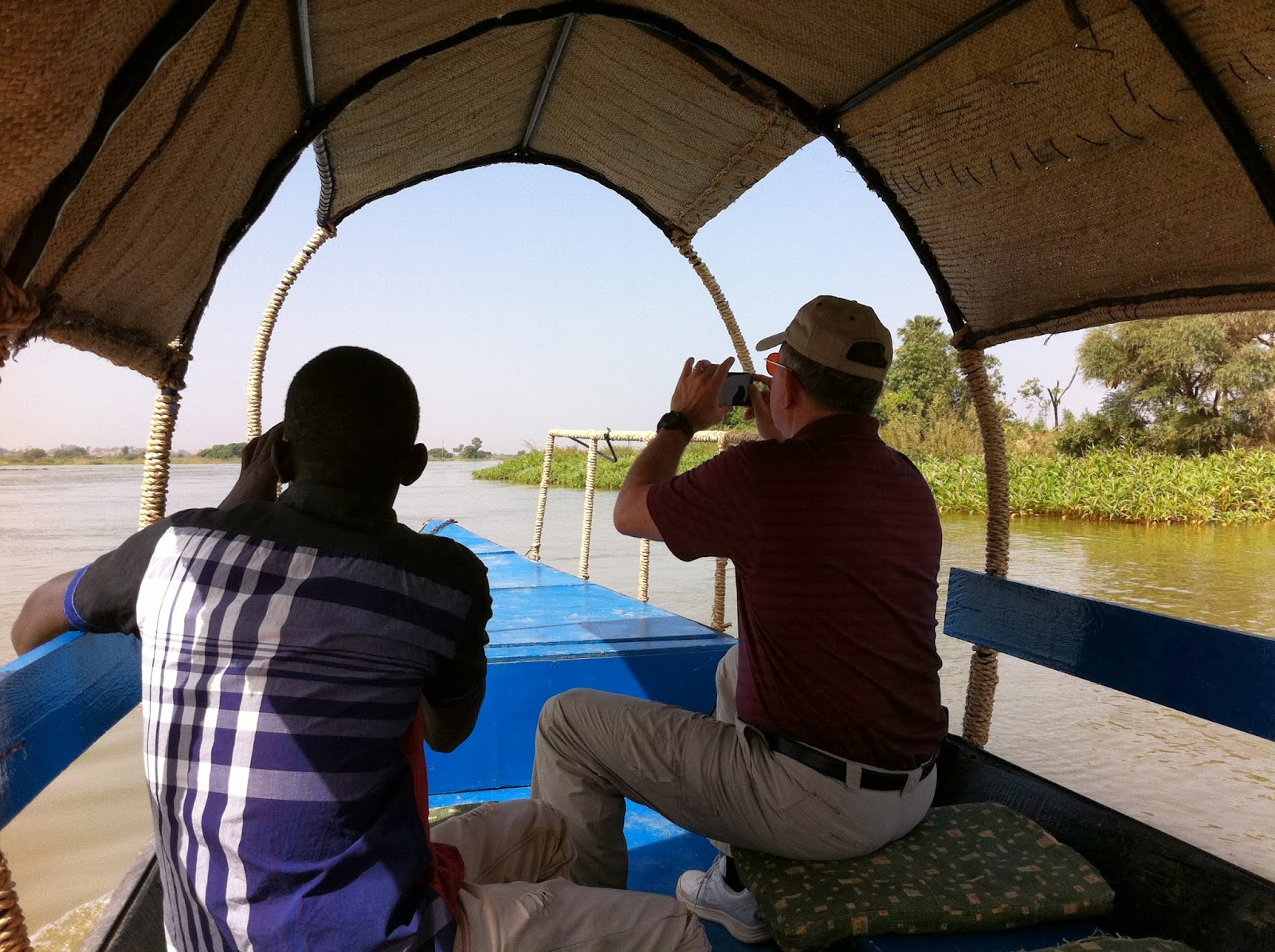 |
| Omar and I taking pictures of the hippos. We were too far away for a good shot. |
He searched his memory, hand to chin, staring into the distance, and came up with a name for a band that fit my demographic.
"Phil Collins?" He asked me.
I nodded. Close enough.
That night Lindsey, Gale and I went to an notable French restaurant in Niamey. The restaurant is notable because some foreigners in Niamey will eat at only two restaurants, and this was one of them. I have vivid memories of every incident of food poisoning in my life, and would hesitate to criticize anyone who wanted to avoid a repeat of the experience.
The food was delicious and the Bordeaux wine was excellent. In the midst of our delightful conversation I remembered why we decided to come to Niamey. She was sitting right next to me.
We came to see our daughter's home, the city she lived in, the place where she worked, and the people that were a part of her life. I had just arrived and the price was already worth it.
Monday, November 11, 2013
First thoughts on Typhoon Haiyan and the Philippines
I have never been to the Philippines or read much about it but I could have written, pre-landfall, 75% of the content of ALL the news articles that have come out in the three days since the storm hit.
The journalists are SHOCKED, SHOCKED that the disaster is much worse than expected. No one expected that the water would rise so high. The Category 5 winds caused a "remarkable" amount of roof damage. The survivors started looting businesses after the storm "in search of necessities." A survivor will be quoted, within 24 hours of impact, as being SHOCKED at the poor response of the government: "Don't they understand how desperate things are here?" International aid organizations will promise relief, and send teams to "assess" the situation. The U.S. military will dispatch supplies, planes and ships "at the request of the Philippines government."
And, of course, global warming may be involved.
Do me a favor. Go look up on Google maps the city of Tacloban, on Leyte Island in the Philippines (it's not that hard). Tacloban looks like its at the bottom of an inverted cup placed at the junction of a 90 degree angle of the East side of the island (or, the side of the approaching storm). I looked at the map before landfall and knew, without benefit of a hurricane evacuation study, that all of the storm surge generated by this enormous storm would be funneled into the bottom of the cup. I knew right away that Tacloban would be in severe trouble from storm surge alone.
Next, go to the National Hurricane Center site and click on the link to the left entitled "Wind Scale." There you can read about the types of damage to be expected from a Category 5 storm: "Catastrophic damage will occur: A high percentage of framed homes will be destroyed, with total roof failure and wall collapse. Fallen trees and power poles will isolate residential areas. Power outages will last for weeks to possibly months. Most of the area will be uninhabitable for weeks or months."
Most of the area will be uninhabitable for weeks or months. Hummnnn.
Let's go back to the fact that Tacloban is on an Island. Granted, it's a big island, but this big island doesn't have Interstate 10 crossing the island, nor does it have I-75 connecting the north to the south. That means relief supplies have to be brought in by plane. Or by boat, when the port is opened.
They don't have enough planes or money or time to take care of 200,000 people in those conditions. And I equate their conditions to be like trying to survive in the middle of the Libyan desert. Every plane that flies into Tacloban airport should be leaving full of people. When the boats and ships start arriving (and they should be on the way) they should drop off supplies and haul back people.
If the government of the Philippines hasn't figures this out yet then people are going to start dying. The World English Dictionary defines uninhabitable as "not capable of being lived in." The only way to bring the supply of food, water and shelter into equilibrium with supply in this situation is to reduce the demand. The increased rate of mortality will achieve this end but the more civilized approach is to bring the people to a place that they can be sustained at the First Level of Maslow's Hierarchy of Needs.
When (not if) the Category 5 storm hits Miami the same type of calculus will come into play. Miami-Dade County is not an island but it's close. It's at the very end of a long peninsula, with 2.5 million people (not 200k) crammed into a narrow strip of land between the Atlantic Ocean and the Everglades.
When the Cat 5 comes we are going to start having to bus and fly them out as fast as we can.
"You can't make them leave!" I have already heard the naysayers shout.
Oh, I agree. A good portion of them will be screaming to get out. Live. On national television.
Let's see what happens in the Philippines the next few weeks and months. We may see a preview of coming attractions. I hope the right people are watching, and that they learn the right lessons.
Subscribe to:
Posts (Atom)