Wednesday, April 29, 2026

Loading the train to Hohenfels

In January 1978 we loaded our mechanized infantry battalion vehicles on a train to make the journey to the Hohenfels training area. Our kaserne was in Goeppingen, FRG,  a small town southeast of Stuttgart in southwest Germany. To avoid traffic, we rumbled in the early morning through the silent streets of the city to the railhead. When we arrived we saw a long row of flatbed rail cars for the vehicles and passenger cars for the infantry.

In the motor pool of the 1/26th Infantry, Goeppingen, Federal Republic of Germany, in 1978. Lt Whitehead, Platoon Leader, is on the right.

That is what we were, infantry. I was the Weapons Platoon Leader for Bravo Company, 1st Battalion, 26th Infantry Regiment of the fabled 1st Infantry Division, known as the Big Red One. The joke that we heard too often was “If you to be one, be a big, red one.” 

This being January in Germany it was cold, so we were ready to get on with the business of loading the train so that we could go sit in the warm passenger cars. The Federal Republic of Germany (FRG) was commonly called West Germany in the days when there was an East Germany and a wall through the middle of Berlin. The 7th Army and US Army in Europe, with over 200,00 troops, was comprised of the V and VII Corps, with two Armored Divisions (the 1st and 3rd), two Infantry Divisions (the 3rd and 8th) plus the 1st Infantry Division (Forward). We were the trip wire on the Russian Front if the Warsaw Pact horde was to pour across the border.

At the end of the train was a loading ramp. The first M113 Armored Personnel Carrier (APC) in the 1st Platoon  of Alpha Company edged up the loading ramp and on to the last flatbed car in the train. The drivers head poked from a hatch at the top left front of the vehicle. The vehicle commander, in a hatch at the top center of the vehicle, was exposed from the waist up. Both wore helmets, which they used to communicate with each other by intercom over the roar of the diesel engine positioned to the right of the driver. A ground guide stood in front, ready to lead the vehicle forward.

With over 100 armored vehicles in the battalion, and dozens of wheeled vehicles, there were close to a hundred flatbed rail cars stretched into the distance.  The Alpha Company APC had to drive the length of the train. I noticed that the tracks of the vehicle hung 6 inches over the side of the flatbed on each side.

Loading the train was a job for the enlisted men and non-commissioned officers. The officers were spectators. When the APCs reached their designated spot on the railcar, the crew pulled out the tie down equipment. The men worked with speed and confidence, demonstrating that they had done this before. A large wooden block was positioned at the front and the rear of each track. With hammers and large nails, the blocks were secured to the rail car. Crossed tie down cables in the front and the rear completed the task. 

When the troops had completed their work, I wondered if we could leave the cold night for the warm embrace of the passenger cars. But we were not finished. The train load had to be inspected by a sturdy, middle-aged representative of the German Bundesban. His blue coat and hat signaled his position and responsibility. From one end of the train I watched as he walked beside the rail cars, accompanied by our S-4 Supply Officer. His pace was neither fast, nor slow, but methodical. I wondered if he was going to inspect the tie downs of every vehicle. Indeed, he was, and he did.

When he finished, the signal was given, and we boarded the train. When we got to Hohenfels, there was snow on the ground.

Tuesday, December 09, 2025

Working a disaster in Alaska

On the evening of October 14th I was sitting in my living room thinking about going to bed soon. It was 9:30. I glanced at my Red Cross phone and saw a text from my boss:

“We have to write an advance operational plan before we go to bed tonight.”

My job at Red Cross National Headquarters is to write Red Cross deployment plans for large operations. I don’t normally have to do this on such short notice. And 10:30 is my normal bed time. Adrenalin would keep me awake for the next 3 hours.

I spent two days helping to open one of the two congregate shelters in Anchorage
to house the incoming evacuees.

The week prior a typhoon struck western Alaska and severely impacted three native Alaskan villages. These villagers lived in traditional societies in which they hunted and fished over the summer and then ate what they had stored through the winter. The storm surge and wind damaged or destroyed many of their homes, as well as the supplies they needed to survive over the winter.

No government can make any citizen evacuate when they do not want to. In Florida, where I worked many hurricane disasters, people who needed to evacuate wouldn’t leave and people who didn’t need to evacuate would. The native Alaskans decided that they needed to evacuate and requested assistance.

The state of Alaska decided to fly the people who wanted to leave to Anchorage where they could be cared for. The state of Alaska asked the Red Cross to assist in caring for these evacuees in Anchorage. The request from the state took several hours to be translated into a text message that ended on my Red Cross phone.

I went to my office in my house to call my boss to ask him what was going on.  His phone was busy, of course. I’ve done many of these plans, so I pulled up the template and began preparing to write the plan when I got the necessary information.

When my boss called, I was ready. He told me that we needed to resource a disaster relief operation in Anchorage that could shelter 2000 people at two locations. I started writing the plan and when I finished, I asked if I could go to Anchorage to support the operation

He told me yes.

At noon the next day I was at Dulles airport for a 2 1/2 hour flight to Minneapolis and then a six hour flight to Anchorage. Flying from the East Coast to Anchorage is like trying to fly to Frankfurt. Germany. Takes a long time.

I arrived in Anchorage at 6:30 PM. This was 10:30 PM Eastern time and I was already having to adjust my bedtime two days in a row. I got the opportunity to go to the first shelter that had been established at the University of Alaska in Anchorage.

The next morning, I reported to work to do my job of writing plans for the next day for the disaster relief operation. My plans were changed when we were told that a second plane load of native Alaskans was due to arrive in several hours in Anchorage and we needed to go to the Egan Convention & Civic Center downtown and help establish a second shelter.

As they say in the Red Cross, everyone is a shelter worker. Everything in Anchorage, I discovered, is 15 minutes away by vehicle. I parked on the street next to a meter and returned eight hours later to find that I had a parking ticket. A week later I called the city of Anchorage, begged forgiveness, and they gave it to me.

I was one of the first people to arrive at the Egan center. We were expecting 200 evacuees in several hours. Fortunately for the evacuees and the American Red Cross, a highly experienced shelter manager was coming to supervise me and the other Red Cross people who were arriving at the shelter. I have worked in many shelters before but never had to establish such a large shelter under such a tight deadline.

A lot of resources - cots, shelter workers, snacks, medical staff - were heading for the Egan Center and I wondered whether the evacuees would get there first. Our shelter manager knew what to do. We toured the building with the facility manager and came up with a plan. All of the bathrooms were on the bottom floor so we decided to make those conference rooms the dormitory, or sleeping area. 

We would guide the evacuees off the buses when they arrived to a large conference room on the first floor where we had tables, chairs, drinks and snacks. When the cots were set up in the dormitory we would direct them downstairs.

Dozens of local volunteers arrived to help set up the cots. Only, the cots were on a truck and heading our way. When will the the cots arrive? I asked over my cell phone. “Soon,” I was told.

The buses arrived in front of the Center and the evacuees poured into the first floor. We were there to direct them to the nice dining area we had set up, where they could sit down, relax, have a drink and some snacks. What we had not foreseen was that more than half of them were in urgent need of a bathroom.

Best laid plans. They had been on a C-17 flight from Bethel to Anchorage. At the airport they were immediately loaded on buses for the short trip to the Egan Center. Neither one of these conveyances had bathrooms.

Fortunately, in the middle of the first floor was an escalator to the ground floor and the bathrooms. For many of the evacuees this was a day of firsts. Their first trip on a C-17 transport plane then their first trip on an escalator. The escalator was so fascinating to the children that, in the subsequent days, we became concerned for their safety and had to post Red Cross volunteers to steer them away.

The next 4 hours I interviewed evacuee families and entered their information into the Red Cross shelter registration system. I sat at a desk near the dining area with the head of the household seated in front of me. As I entered the information into my Red Cross computer a line of native Alaskans formed, waiting their turn.

I finished the registration job as the night shift of Red Cross shelter workers arrived at the Egan Center. Several members arrived straight from the airport, their luggage in hand. As more volunteers flew in the next morning their were also sent to the Egan Center and University of Alaska shelters to staff the day shifts.

With the shelter established and staffed I returned to my regular job of preparing incident action plans for the headquarters. In the coming weeks I was able to assist in the planning to move the evacuees from their congregate shelters to hotels as well as our plan to assist with the distribution of emergency supplies to those individuals still remaining in the impacted communities in Western Alaska.

My work station at the relief operation headquarters where I helped prepare operational plans.

This was another great Red Cross deployment for me in that I was able to work directly with the affected clients and I learned a lot that will help me with my job at national headquarters.

In my third week in Alaska I volunteered to help move the evacuees and their luggage from the congregate shelters to the hotel rooms that the State of Alaska contracted for them.


Sunday, December 15, 2024

The Fall of Damascus vs The Fall of Baghdad

This week I watched the televised accounts of the fall of Damascus and the overthrow of the Assad regime with interest and a considerable level of emotion. The scenes all reminded me of the fall of Baghdad in April 2003.

Iraqis gathered around the ruined status of Saddam in Firdos Square, Baghdad, on April 13, 2004

On April 9, 2003, in a spectacle that was televised throughout the world, the Iraqi populace, with some help from the U.S. Marines, toppled a statue of Saddam Hussein in Firdos Square in central Baghdad. On April 14, 2003, 5 days later, I arrived at the Palestine Hotel overlooking Firdos Square to find the remains of the statue. The details of my trip and visit to Baghdad are described in my memoir of the Iraq war, Messages from Babylon.
The front of the Palestine Hotel overlooking Firdos Square, where I spent the night.

Several televised news accounts from Damascus got my attention. The first was an interview with some police officers in Damascus who were directing traffic. The regime police, along with their army, had melted away after the lightning overthrow of the government. The interviewed police officers, wearing police uniforms, said that they had recently been brought in from rebel held areas. This wasn’t a spontaneous action. The introduction of outside police and the use of the rebel forces to secure government buildings was planned.

I think when the rebels started the offensive they knew that the regime would fall and they made preparations to assume control of the city and provincial governments.

Contrast that to how the U.S. military assumed control of Baghdad in April 2003. I was one of about 1,500 U.S. Army Civil Affairs Reservists who were mobilized and sent to Ft. Bragg, NC in February 2003. I assumed - we all assumed - that our mission was to be part of a military government of the populace when the Saddam regime was overthrown.

Members of my unit in Ft. Bragg, NC in March 2004 preparing to deploy to Iraq.

We also knew that this wasn’t going to be like the 1991 Gulf War, when the U.S. military occupied the southern half of the country but left Baghdad unoccupied and Saddam still in charge. Saddam, part of the Sunni minority that ran the country, used his military to slaughter the Shia uprising that was a consequence of our invasion. I read the U.S. invasion plan and our mission was to enter the country and remove the Saddam regime.
Members of my unit in Ft. Bragg, NC in March 2004 preparing our vehicles for deployment to Iraq.

The invasion plan had scant information about what we were supposed to do once Baghdad fell. When I arrived in Ft. Bragg we searched for information about what we were supposed to do once we got to Iraq. From somewhere I obtained a U.S. Army plan, dated December 1944, for the occupation of Germany. This was a good plan, with a lot of specifics actions to be taken by the occupying forces.

“This is great,” I thought. “Why don’t we use this?”

In contrast to what happened in Damascus, when Baghdad fell the Iraqi populace invaded and destroyed the principal government ministry buildings. The institutional memory of how to administer the country was eliminated. This was an inauspicious beginning to our stay in Iraq.

The BBC carried an interview with the new provincial governor in Damascus. He was a civil engineer who had been a part of the resistance for ten years. He had a plan of action. A civil servant who had worked in that office for 28 said that she had never been in the provincial governor’s office until this new governor had arrived.

Within a week of the overthrow of the Assad regime, the schools were reopened. This was another example of the forethought of the resistance. Why had the Syrian resistance done so well when they had so little? Why had we done so poorly when we had so much?

After the war I read a lot of memoirs of the senior administration officials in an effort to discover why we weren't prepared for what happened when Baghdad fell. The answer was disheartening, and the topic for another post. 

I don't know what's going to happen in Syria now that Assad is gone. At least the resistance planned for what needed to happen after Damascus fell. They may have a chance to make it.

Sunday, March 10, 2024

My Memory of the War in Iraq 20 years later: March 2024

 “From: Whitehead, Michael (USA)

    Sent: Saturday, March 6, 2004 7:55 am

    Subject: Iraqi hoops

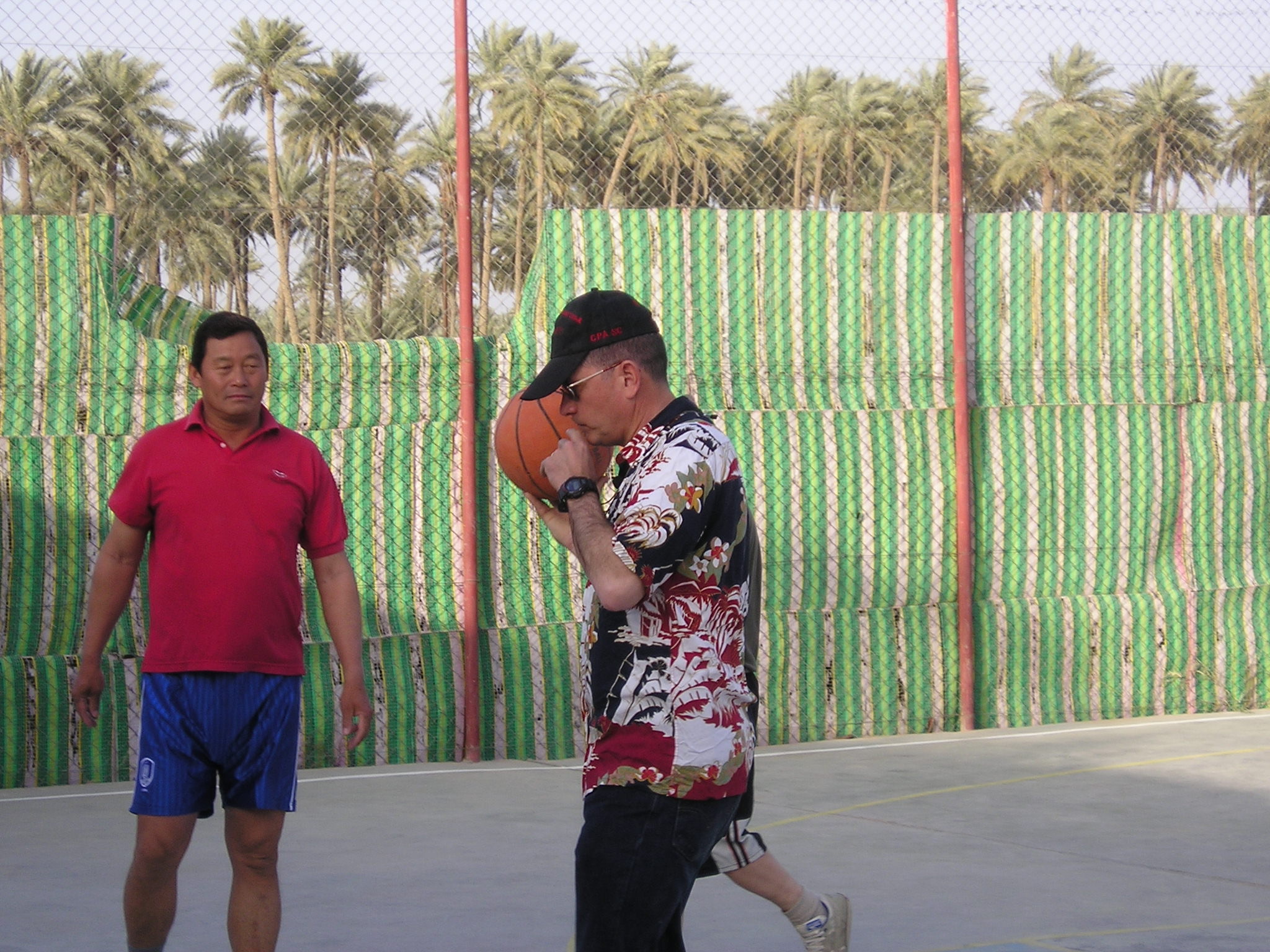
    During my last three days at CPA [Coalition Provisional Authority] in Hillah KBR [Kellog, Brown, & Root, our life support contractor] set up a basketball tournament. 3-on-3, half-court, 12 points or 15 minutes, whichever came first. A regular basket was one point, a three pointer counted two. The tournament had 16 teams, double elimination, which meant we had to play ten games a day for three days. Each day lasted almost three and a half hours. I refereed every game. For the first and hopefully only time in my life I wore a pistol while I was a basketball referee. I didn't need to draw my pistol during the three days, but a few times I felt like it.

    We had five Gurkha teams, two Iraqi teams and the rest were Americans with a few Aussies thrown in. At my suggestion, they let the Iraqi workers on the compound watch the tournament. Each team was limited to four total players. Mr. Gfeller's PSD had two teams, the MP's entered a team, Operations had a team and KBR had two teams.

    “KBR set up lights, a mobile microphone for me, and played music during the intermissions. A large number of fans turned up every day. The Iraqis cheered loudly for their fellow Iraqi teams, but shifted to the KBR favorite team when their comrade teams fell out. Only a few of the Gurkhas understood English well, and almost none of the Iraqis did. I had a hard time explaining the rules at times.

    Of course, those that best understood the rules also knew how to break them. The Gurkha and Iraqi games were exciting, sedate and polite affairs. The Americans played street basketball. Not all of my calls were popular. I heard irate protests from fans and players alike. Although I did not use the technical foul (foul shots did not play a part in the tournament), I did take advantage of the three foul limit per player. In one wild game, I fouled out five of the eight players on the two teams. Some people were MAD at me.”

“The favored KBR team won, to the delight of the Iraqi KBR workers. The fans went wild, and the KBR foreman, who played on the winning team, leaped on to the bed of a pickup loaded with Iraqis, held up his trophy, and jumped up wildly with them in celebration. It was a wild moment, where sports brought everyone together. We had a good time.

    I was exhausted. The next morning I left for Kuwait.”

Excerpt From

Messages from Babylon

Michael Whitehead

https://books.apple.com/us/book/messages-from-babylon/id407775151

This material may be protected by copyright.

Saturday, February 10, 2024

My Memory of the War in Iraq 20 years later: February 2024

“From: Whitehead, Michael (USA)

Sent: Friday, February 13, 2004 10:22 AM

Subject: Looking at Iran


    On Feb 11 we made our long planned and once canceled visit to the Iran/Iraq border. One of the three major crossing points from Iran into Iraq is in our sector in Wasit province, just north of Al Kut. We had heard many times concerns from many people, including Iraqis, about the lack of controls at the border. We decided to travel to the border to investigate ourselves.

At the Iraq/Iran border. In the background are the mountains of Iran.

    The visit called for traveling to Al Kut, spending the night there and then leaving for the Border the next day. While we were there, we linked up with Timm Timmons, the Deputy Governate Coordinator. Timm traveled with us to the border and was our guide. Timm is the lone American State Department officer in an office of British Foreign Office people. In fact, COL Strong and I call the Governate Coordinator, Mark Etherington, the Viceroy and Wasit the New Outpost of The British Empire.”


“The next morning we headed north for the border… The day we went to the border was windy and cold, with occasional drops of rain. In front of us and flowing toward us was a never ending stream of large 44 passenger buses and smaller minivans with luggage piled on racks on the roofs. They were all full of people flowing to and from the border.”


“Finally, through the haze of this blustery day, I saw them – the mountains of Iran. When we arrived at the border I saw a scene out of the television news, or a movie. The scene resembled the fevered chaos and organization of an ant colony. No vehicles could cross the border, so there was a laborious process of unloading the baggage from the vehicles on to carts for the walk across the border. Numerous men hired out themselves and their carts for this service. In some of the carts were even old women and children. The road in front of us filled with carts, pedestrians, vehicles and border guards frantically trying to clear a path for our vehicle. For some reason in this culture otherwise indolent police or security officials will spring into action at the sight of a Coalition vehicle, especially if it involves ordering other Iraqis out of our way.


    The Iraqi Customs building was built in the shape of a little fort, with turrets. The Customs Director spoke English, and briefed myself, COL Strong and Timm Timmons on his situation. He had a list of complaints and items he needed which he immediately supplied to Timm. The Director said that he was stamping passports. I wanted to see the process and Timm did too, so we walked out of the building and toward the border. The crossing was a cut in the land about the size of a two lane road, with a strip of barbed wire down the middle. On the right a stream of people walked toward Iran. On the left, a stream of people came into Iraq. We followed the stream toward Iran.


    After 75 meters we came to a mud hut about the size of our bathroom. Inside were a wooden table and one Iraqi Customs official with a date stamp. If you wanted your passport stamped he would do so, but only a few applied for this service. No one was checking the baggage. Some of the people coming into Iraq were refugees who had fled Saddam. They had no passports, and were very happy to see Col Strong's and my uniform. To a number of people I pointed to the flag on my right shoulder and they nodded happily. COL Strong took a picture of a family walking by, and then showed the digital image to them, to their great delight. Timm did not dress for the weather, and was freezing, so we headed back. As I looked back, I could see about 200 meters away the Iranian border crossing point.

Lt Alicia Galvany and I at the “passport office” on the Iraq/Iran border.

    While I was away, my troops had made friends with the Iraqi border guards, who had not been paid for five months. They posed for pictures. Before we left, we gave them a case of our MRE's to eat. On the way out the road turned into Iraqi gridlock, as it has in so many other places in Iraq. As I had done before in such situations, I got out of the vehicle and walked forward, pistol in hand, to clear a path through the ant bed. I led both vehicles out of the confusion and then got back into my seat for the trip back to Hillah.

A memorable day.”


Colonel Bede Strong, of Her Majesty’s Army, and I on the banks of the Tigris River in Al Kut, Iraq. This was our last visit to that city


Excerpt From

Messages from Babylon

Michael Whitehead

https://books.apple.com/us/book/messages-from-babylon/id407775151

This material may be protected by copyright.


Wednesday, January 10, 2024

My Memory of the War in Iraq 20 years later: January 2024

 “From: Whitehead, Michael (USA)

Sent: Saturday, January 24, 2004 5:36 PM

Subject: Alan Prizzey, CBS News, reporting


I saw a familiar face in a crowd of news people at the Woman's Rights Center in Diwaniyah today. He identified himself as Alan Prizzey, CBS news. We ended up escorting them to Hillah and dropping them off with our press person at the Hillah Woman's Rights Center. I guess if I get to hang out with important news personalities that must make me important, too. Or does it?

Convoy briefing prior to departure from the Coalition Provisional Authority -
South Central compound in Al Hillah.

Earlier this week I stopped by the Abu Ghraib prison, which is on the western outskirts of Baghdad. A miserable US MP Company was condemned to supervise the Iraqi guards and prisoners in this former model of Saddam's fascist society. Inside the prison are prisoners who have violated Iraqi law. Outside is a barbed wire encircled Stalag 17 only with tents. At the corners are guard shacks with machine guns. I didn't see any German shepherds. The guards on the camp were MP's, and inside were "security detainees", or persons who have committed crimes against the Coalition forces. If you rob a fellow Iraqi and get caught, you go inside the prison. If you take a shot at a “GI and survive to get caught, you go in the barbed wire camp.

At a meeting ceremony in Al Hillah. I am surrounded by students of the local university.

I haven't been in too many prisons, and I imagine that old prisons, like this one, look even grimmer than usual. An MP assigned there told me that when they first arrived the inmate areas of the prison were covered in several feet of human excrement, and the prison under Saddam had been packed to overcapacity. I'm sure it was a charming place to live and work.


 Two Ukrainian sailors are imprisoned there for smuggling, and they were the purpose of my visit. A Ukrainian Army Officer works here at CPA with me, and he asked to be taken by the prison during our visit to Baghdad so he could check on his countrymen.


 Jan 21 marked the 10 month anniversary of my arrival in the Middle East. I am ready to come home.”


Excerpt From

Messages from Babylon

Michael Whitehead

https://books.apple.com/us/book/messages-from-babylon/id407775151

This material may be protected by copyright.

Monday, December 18, 2023

My Memory of the War in Iraq 20 years later: December 2023

 “From: Whitehead, Michael (USA)

Sent: Friday, December 05, 2003 7:39 AM

Subject: Hail and farewell

    The staff here continues the normal Army custom of a Hail and Farewell evening. The room normally fills up on Saturday and Sunday night for football games. They get a cake for a birthday, some wings and pizza chips for a farewell. We even had a promotion there the other day. This week Air Force Sergeant Vanessa Kidby got fare welled. She had been here four months, and was rotating home. The Air Force takes care of their people, she confided to me. Vanessa has a husband and two small children waiting for her. She deserves to leave. Nevertheless, her farewell depressed me. She was leaving after four months: I had four months to go – but I had already been here for eight months.

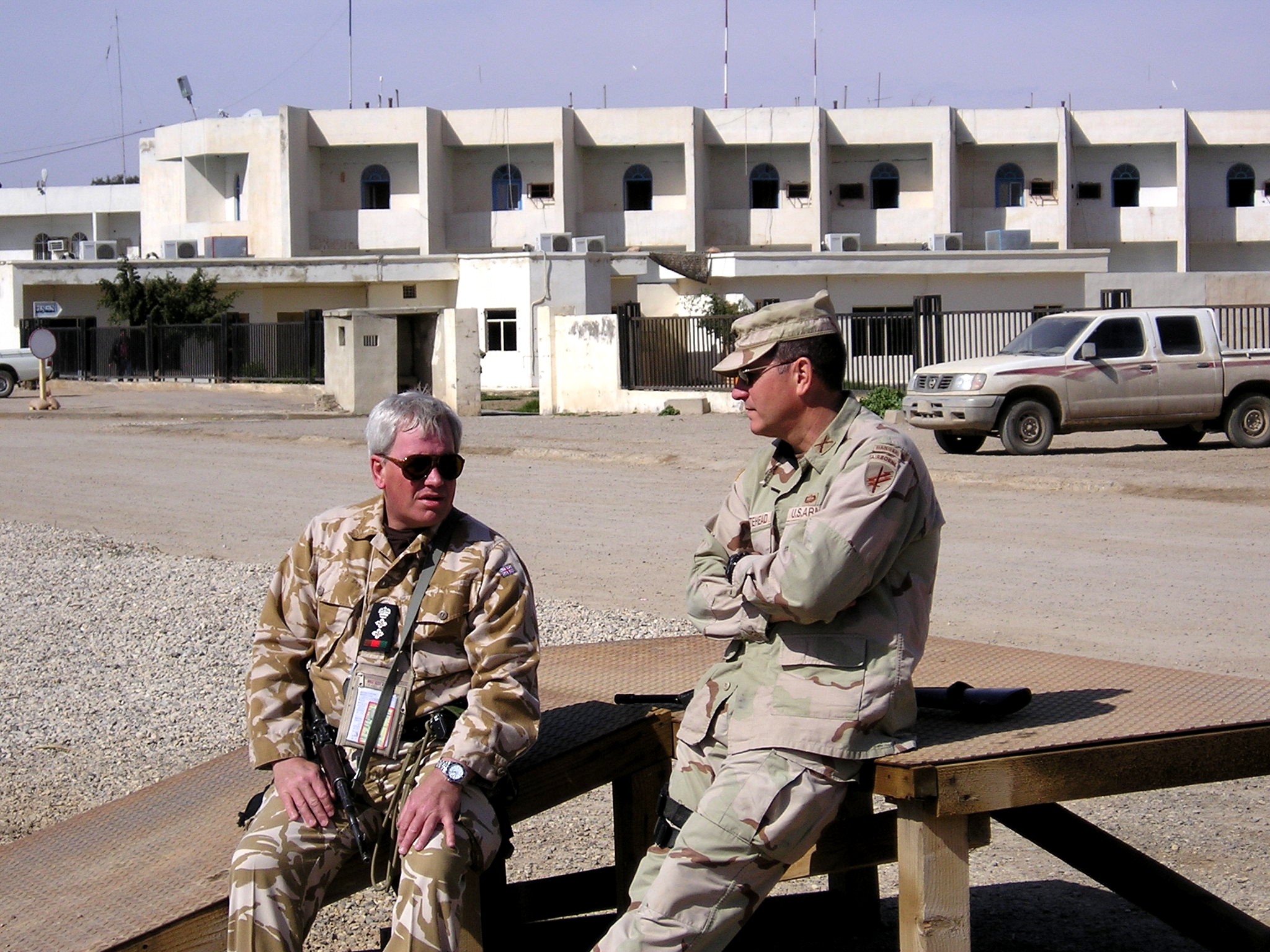
Myself and my friend Colonel Bede Strong, from Her Majesty’s Armed Forces, at a Hail and Farewell.

    The view from my foxhole is that we are doing what needs to be done right now. Everyone is on board with what the President and Amb. Bremer have decided to do. There isn't much second guessing here about our future course. As for past actions: several critical mistakes were made and one fundamental one. The fundamental mistake, and I blame the Bush Administration at the highest level for this one, was failing to recognize up front that we would be an occupying power. This was obvious to me when I first saw the plan in November 2002 but no where did I see the kind of detailed planning required to execute such an awesome and unprecedented task as occupying a large Arab country. 

Myself and a crowd listening to President Bush announce the capture of Saddam Hussein.

    During all the frantic planning before the war we (the Civil Affairs people) were screaming for answers to fundamental questions. Plenty of plans and annexes and appendices were written, but the critical questions were not answered. And the reason for this failure is that the political decision directing the military to prepare (in earnest) to occupy the country never came. And what is infuriating is that we have made this same mistake so many times before. We do a great job of planning for and executing the war and a miserable job of dealing with the aftermath.”

Excerpt From

Messages from Babylon

Michael Whitehead

https://books.apple.com/us/book/messages-from-babylon/id407775151

This material may be protected by copyright.

Saturday, November 11, 2023

My Memory of the War in Iraq 20 years later: November 2023

From: Whitehead, Michael (USA)

Sent: Thursday, November 27, 2003 9:28 AM

Subject: The end of Ramadan and Thanksgiving.

    Ramadan ended Tuesday night according to one Najaf cleric and Monday night according to another. Evidently, Ramadan starts on the full moon and ends on the new moon. The leading cleric is supposed to make this determination. Confusion reigns because they cannot decide which cleric is the lead.

November 2003, city of Ramadi, Anbar Province, Iraq.

    It has been overcast and rainy for two days. This has turned desert dust into desert mud. Since it seems like EVERY vehicle in Iraq either leaks or spews oil, the introduction of water on the roads has sent some of us spinning. One SUV slid into a ditch and we had to call a Humvee to winch it out.

    By order of the Combined & Joint Task Force today is Thanksgiving and everyone will be served turkey, even if they are a Pole, Brit or Ukrainian and didn't ask for it. Today we will have a Continental breakfast from 0630 to 0900 and then a Holiday meal from two to 6 in the afternoon. The Packers against the Lions on TV in the evening. The Pakistani cooks have been busy smoking the turkeys.

Group Captain Wilkinson, our resident Aussie Air Force rep, said at a meeting the other night, when told CPA would have reduced activities and a holiday turkey meal, said "Oh, so we're going to follow their quaint custom." There is a lot of friendly international needling. The Group Captain is suffering from the jibes of Col Strong, of Her Majesty's 1st Royal Tank Regiment, after the Aussies lost to the Brits in the Rugby World Cup final.

“There was tremendous interest in this game on this compound, and people who actually saw it on television. The Aussies and Brits look with amusement at our fanatical interest in football, and only ask that they not be required to sit and watch an entire game. They will watch for a few minutes, grow bored and move on. "Too much standing around," they will say.

Convoy briefing prior to departure from our compound in Al-Hillah, Iraq.

    The Iraqis have definitely not been standing around, but have been celebrating the end of a month of fasting. There are similarities and differences between how we Americans celebrate a holiday and how the Iraqis celebrate. From my observations of Hillah, Karbala and Al Kut the last few days, the Iraqis appear to have combined our Easter and July 4th. Like Easter, there are lots of families out in their best attire, little boys in suits and ties and little girls in adorable dresses and hats. While on the 4th we use firecrackers, bottle rockets and fireworks, the Iraqis use AK's, RPG's and hand grenades. I walked to breakfast to what sounded like a gun battle, but what I knew to be the famous or infamous Iraqi "celebratory" fire.


“Other Iraqis walked through the streets beating a large drum or playing a horn in a decidedly off tune non-medley rendition of something. Yet, as I stood on the roof of a building in our compound in Al Kut, inspecting the line of Texas barriers and barbed wire we had erected in the last two weeks, I could see Iraqi families promenading in the park, enjoying their holiday in peace and without fear. As we left the children ran up to us shouting, "Thank you" in English. I had never heard them say that before. We waved back.”


Excerpt From

Messages from Babylon

Michael Whitehead

https://books.apple.com/us/book/messages-from-babylon/id407775151

This material may be protected by copyright.

Wednesday, October 04, 2023

My Memory of the War in Iraq 20 years later: October 2023

From: Michael Whitehead  
Sent: Friday, October 3, 2003 4:40 AM 
Subject: Moving across the street 

We went to Baghdad yesterday (1 OCT) to discuss our mission with the Powers That Be and FINALLY got some resolution. We are moving to the Coalition Provisional Authority (CPA) Regional Headquarters in Hillah, which is five minutes away from Camp Babylon. Our move is only five minutes away, but it will be a world of difference. 

Our new workplace, the Coalition Provisional Authority South Central Headquarters, a 5 minute drive from our former quarters at Camp.Babylon.

Our trip to Baghdad was interesting. I had not been there since July, and there had been a lot of changes. Most of the changes were security related: lots of new concrete barriers and streets closed. We had to take different routes to go where we were heading. There wasn’t as much of a military presence in the city as I had remembered. This was intentional on the military’s part. 

I had a near religious experience during my visit. I got to use a commode in a real bathroom for the first time in almost three months. This wasn’t any old bathroom – it was a Saddam palatial bathroom in one of the buildings in the main palace complex in Baghdad. There was a real commode (not some hole in the floor), with a real sink with running water, and a mirror and a towel rack. The floors were marble, with some special kind of rock trimming the sink, and a bidet next to the toilet. Lots of toilet paper. I mean fancy. I paused during this moment to savor the experience. I luxuriated, even I dare say reveled in this rare and unique moment. 

You may be laughing at me, but you have to look at the chain of events that brought me here. I went from an airman during the war giving me a shovel and pointing to a spot of desert near an airfield, to using a Seabee constructed wooden outhouse with a sawed off 55 gallon drum, to the ever fragrant and widely varied quality conditions of the INNUMERABLE portajohns that are scattered everywhere in Iraq, to the mountaintop of the Saddam palatial toilet. Wait a minute… I think I missed a category there, like a McDonald’s bathroom and then a Holiday Inn. Don’t have those here. I am really sick of portajohns. I am ready to trade the experience of them all for my newly renovated bathroom back home. 

We traveled to Baghdad with some Polish MP’s and some Filipino police as force protection. The Filipinos are dressed all in blue, with black helmets and a sign on their back that says “Philippines Police.” As we passed through a checkpoint, I saw a G.I point at one of the Filipinos and say, “Hey, who is that?” I was afraid he was going to stop and question us. 

 The interesting part, though, was on the highway back to Babylon, when two Apache helicopters took a VERY great interest in us as we rode down the highway. They moved very slowly down the median, only 100 foot above the ground. I immediately sat up in my seat because I thought they may be trying to warn us about something. One of them turned sideways and hovered as we approached. I have no idea what they were doing, but I think they were looking at our Filipino and Polish comrades, and trying figure out who they were. The Apache moved off as we got close, sending a backwash of wind rolling over us as we passed through. The Apaches are scary enough when you just look at them flying by – to have one LOOKING at us was disconcerting.”

 Excerpt From Messages from Babylon Michael Whitehead https://books.apple.com/us/book/messages-from-babylon/id407775151 This material may be protected by copyright.

Wednesday, September 06, 2023

My Memory of the War in Iraq 20 years later: September 2023

    From: Michael Whitehead

    Sent: Friday, September 12, 2003 11:14 AM

    Subject: The dates are getting ripe


    Most of the palm trees around us are full of dates, and they are beginning to get ripe. When I say most, I understand from Phil McMillan, our agricultural officer, that there are male and female date palm trees. The females carry the fruit. The males, I guess, sit around absorbing sun and water. I have eaten some of the dates (in fact, I just ate one) and they are very good and sweet. Hillah will be having their date festival soon. We talked to Phil about having a Date Palm Queen and a Date Palm Parade, and all the dates you can eat contests, but we won't be here to organize all that. We are off to other parts.


My cot, sleeping bag, chair and accumulated stuff in my air conditioned tent. Note the Florida pennant.

    Things are picking up here, like from 5 MPH to 10 MPH. Not much, but something. We got news from the unit up north we will be supporting, and they want us and have work for us to do, which is good. The logistics guys are busy doing a lot of coordinating and are anxious to get up there right away to get all the care, feeding, housing, communications, etc. issues worked before we all arrive. We also have a lot of equipment in containers down in Commando that will have to be moved north, and we have to prepare everything and arrange the big trucks to haul the stuff. My B bag and my C bag are still in Commando, and I haven't seen them for months. I was assured recently that they are still there, but I am anxious to get my hands on them. These bags have my cold weather clothing and boots the Army gave me back in Bragg, and the warm liner to my sleeping bag. They told us to expect temps down in the 30's this winter.

In September 2003, Secretary of Defense Donald Rumsfeld visited Camp Babylon. 

    I finally decided to wash the poncho liner that I have been sleeping on for six months. I figure with this wash, I should be good for the deployment. I borrowed West's wash buckets (more on that later), took one over to the water buffalo, put a little laundry detergent in it, and filled it with water. I put my poncho liner in, moved it around in the bucket, emptied the dirty water, refilled it with clean water, and then emptied that out. After rinsing, I wrung it out the best I could and hung it up on some white engineer tape that was strung between two poles to mark the barbed wire that is no longer in front of our tent. The sun, as always, was shining brightly and a stiff breeze was blowing, so I literally stood there for 20 minutes and watched it dry. I had to guard it because a poncho liner is the kind of thing that would disappear off a clothes line in a New York minute around here. I already had two pair of socks stolen off my clothes line when I wasn't looking back in May.


Excerpt From

Messages from Babylon

Michael Whitehead

https://books.apple.com/us/book/messages-from-babylon/id407775151

This material may be protected by copyright.

Monday, August 14, 2023

My Memory of the War in Iraq 20 years later: August 2023

 “From: Whitehead Col Michael

    Sent: Sunday, August 10, 2003 8:50 AM

    Subject: It is HOT here”


“Did I mention that it is hot here? I mean really, really, REALLY hot. I'm from Florida and I know hot, and this is HOT. My buddy Phil McMillan from Blountstown, Florida says that it is so hot he saw two fire hydrants fighting over a dog. What a miserable place this country is! This place is so screwed up because anyone with any sense left several millennia ago.

My new residence in an air conditioned tent. My cot, chair, black trunk and sleeping bag that I have slept in for 3 months without benefit of cleaning.

The official forecast is 116 degrees, but someone saw a thermometer (in the shade) by a tent in the parking lot at midday and the temp was 142 degrees.

We sent a convoy down south to Talill Airbase Thursday to link up with a convoy from Kuwait, and the temp in Talill was 128 degrees. When they opened up an air-conditioned tent for the troops in the Palace two weeks ago, not everyone moved down. "We like it up here," they said. They are now deserting the Palace like rats from a sinking ship. One holdout said that the LOW temp in the Palace last night was 99 degrees. All that stone in the Palace absorbs the heat during the day and cooks everyone at night. Plus, the breezes that were a godsend in June and July have disappeared. Larry West finally gave up and moved in our tent with us last night.

I went to run last night a 7 PM and I felt a little sluggish. Actually, I felt a lot sluggish. I had a bottle of ice water waiting for me when I got back, but I still took a long time to cool down. The water in the shower is even warm, and doesn't provide any relief. The shower tent, with all the people and water, is like a sauna. I don't even dry off. I just put on my shorts and shower shoes, and walk outside to put on my sneakers. By the time I walk back to my tent, the water has evaporated off me and I stay a lot cooler in the mean time. Tricks of the trade.

Did I mention that it's hot here?

Of course, this could all be a lot worse. I could be patrolling downtown Baghdad every day, for instance.”


Excerpt From

Messages from Babylon

Michael Whitehead

https://books.apple.com/us/book/messages-from-babylon/id407775151

This material may be protected by copyright.


Saturday, July 08, 2023

My Memory of the War in Iraq 20 years later: July 2023

 “From: Whitehead Col Michael

  Sent: Sunday, July 13, 2003 8:08 AM

  Subject: I saw history being made

  On July 9, 2003 at 9:21 in the evening I saw history being made.

  I was walking from the Palace to visit one of our new portapotties lined up on the road when I saw a large convoy, a string of headlights, positioned to enter the front gate: the Polish Army had arrived at Camp Babylon. This in fact was the Division Headquarters, the advanced party of a 2,000 man plus contingent from Poland. I called my friend, [COL] Bill Faulkner (from Tampa) over, and pointed the sight out to him. "This is history being made," I told him, and he agreed. We watched as the vehicles pulled in, twisting through the terrorist barricades, and I thought of how exhausted they must feel, having completed the 12 hours drive (in this heat) from Commando in one day.

The ruins of the city of Babylon in the foreground, with one of the palaces of Saddam Hussein, where I slept for 3 months, in the distance.

  Bill, a devout Christian, pointed to a piece of the black land to our front, and said, "According to the Bible, this is where the Tower of Babel was built." We are in Babil province, another spelling for Babel. He continued, "Isn't it strange that the Headquarters for this Multinational Division of twenty nations is right here?" I agreed. This was a strange and special moment. I saw history being made.

  Two nights before, Lee Ermey, the actor who was a Marine Drill Instructor and then played one in Stanley Kubrick's Movie "Full Metal Jacket," came to Babylon to give us a talk. He has been here all week traveling throughout the sector to talk to Marines in the field. He spoke to us in the Mess Hall before a packed house. He began the speech as he began the Movie, with his Opening Speech to the recruits, which I am sure he gave hundreds of times when he was a Marine DI. The worst profanity I have EVER heard in my life, on or off the screen, came out of his mouth in the movie.

  "THE FIRST AND LAST WORDS OUT OF YOUR SEWERS WILL BE SIR! DO YOU UNDERSTAND?”

“Sir, yes sir," We shouted in unison.

  "BULLSHIT I CAN'T HEAR YOU!"

  "SIR, YES SIR” We shouted again.

  The Marines, of course, ate all this up. The soldiers and sailors in the audience enjoyed it, too.

  A common saying overheard here from soldiers, sailors or Marines who don't want to do a particular task, "And what will they do if I don't do it: shave my head and send me to Iraq?"

  MJW


Excerpt From

Messages from Babylon

Michael Whitehead

https://books.apple.com/us/book/messages-from-babylon/id407775151

This material may be protected by copyright.

Saturday, June 17, 2023

My Memory of the War in Iraq 20 years later: June 2023

 “From: Whitehead Col Michael

    Sent: Friday, June 20, 2003 10:22 AM

    Subject: Laundry Day

    Today is laundry day so I have to empty my pockets. Laundry day is signaled by the fact that my clean clothes bag is almost empty and my dirty clothes bag is REALLY full. I monitor my dirty clothes bag by using it as a pillow every night (my pillow was stolen in Arifjan back in March). This process takes about six to seven days. Laundry day is good because I put on a clean uniform. If you only have two uniforms, you get a lot of use between washes.

The officer sleeping quarters in one of Saddam Hussein's castles at Camp Babylon, Iraq in June 2003. The skinny guy in the picture is me. I had lost 20 pounds.

    To wash my uniform, however, I have to empty my pockets and there are a lot of pockets to empty. The shirt has four pockets and the pants have four. I keep them filled with things because: 1) I don't have a desk or office where I can leave things, 2) Anything I leave out in our work area is subject to walk away, because we have about 15 people working in a small room, and 3) If I find I need anything during the day, it is a LONG walk back up the hill to get it. I walk around with everything I need to work in my uniform pockets.”

    “In my bottom left shirt pocket I have a baggie filled with vitamins and Malaria pills. I take one of each after breakfast. In my bottom right shirt pocket I keep my sunglasses in a case. In my top right pocket I keep a flashlight (never can tell when you may need one) and my antibacterial hand wash. In my top left pocket I keep two pens and important pieces of paper that I may pick up or have thrust upon me during the day. On laundry day I discard or file the papers. In my right rear pants pocket I “keep my wallet. In my left rear pants pocket I keep my Red Man. In my left cargo pocket I keep a memo book to write down important, Secret, Army War info. I also keep there a brush I use to clean my pistol. I can't use my right cargo pocket because my pistol is hanging there.

    So you see, laundry day is a busy day of unloading and loading pockets. Then I lug my dirty clothes down the hill to the laundry point behind my office building. Things are a little better now because they installed a new laundry (and shower) point at the bottom of the hill. I put my clothes in the washer, go eat breakfast, and then go back to put them in the dryer. When I am done, I put my laundry bag of clean clothes near my desk and hope to remember to take it back up the hill with me at the end of the day. Once I put my clothes in the dryer and forgot about them until 4:30 that afternoon. When I went over to the laundry point, there they were, sitting all lonely on top of a dryer.”


Excerpt From

Messages from Babylon

Michael Whitehead

https://books.apple.com/us/book/messages-from-babylon/id407775151

This material may be protected by copyright.


Sunday, May 07, 2023

My Memory of the War in Iraq 20 years later: May 2023

 “From: Whitehead Col Michael

      Sent: Sunday, May 18, 2003 6:12 PM

      Subject: Magical Iraqi tour

      I left Babylon for seven days and civilization arrived. Washing machines. And dryers. No more bucket brigade.

      Ten of us left in three vehicles, me in command for a tour of the provincial capitals in our area. We went east from Hillah to Al Kut, on the banks of the Tigris River. We drove south from the banks of the Tigris to An Nasiriyah on the banks of the Euphrates. Then we went northwest to Ad Diwaniyah. NW again to An Najaf. Then north to Karbala. Finally SE today back to Hillah. Got a lot of pictures and a lifetime worth of experiences.

      Stark memories of my trip:

      Children, seeing us approach on the highway, streaming to the road to wave. This happened DOZENS of times.

      A line of Iraqi women, covered from head to foot in black or colored dress, pots full of laundry balanced on their heads as they walk from the river.

    A civil affairs soldier reported in a meeting, "We come out of a meeting tonight and some Iraqis approached us and said there were some teenagers nearby, drinking whiskey, and they had hand grenades. I sent the Marines over to deal with that." "Good idea," I told her.

    A scene out of Lawrence of Arabia: sitting cross-legged on carpets in a large tent, filled with Muslim clerics, and eating lamb and rice and pita bread with our hands (right hand only!) from a large bowl.

      Listening to a city council meeting in Karbala while a crowd of protestors chanted outside.

      Seeing every military or civilian vehicle on the side of the road picked CLEAN down to the chassis. Once I saw a group of children trying to pry something off the top of a bus.

    Sleeping on a cot on the hood of my vehicle. With a mosquito net.

      Taking a bath with Baby Wipes.

    Riding in a Hummer in full battle gear in 109-degree heat.

      Three men walking abreast in the right lane of a street in An Nasiriyah. They were blocking the lane. Directly behind each man was a woman clothed head to foot completely in black. We drove around them.

      Seeing men throwing wheat up in the air with a pitchfork, separating the wheat from the chaff as they have done here for thousands of years.

      Drinking water that is so hot it tastes like the water from the hot water faucet. And then drinking some more because you are so hot and thirsty you have no choice.

    Hearing a Marine Battalion Commander describe how his troops captured the University of Baghdad.

      Vendors outside the barbed wire of every Marine compound selling Iraqi Army bayonets, medals, ice, sodas and coolers. We bought ice, coolers and sodas. And pita bread.


      MJW”


Excerpt From

Messages from Babylon

Michael Whitehead

https://books.apple.com/us/book/messages-from-babylon/id407775151

This material may be protected by copyright.


Friday, April 07, 2023

My Memory of the War in Iraq 20 years later: April 2023

 “From: Michael Whitehead

    Sent: Monday, April 7, 2003 4:57 pm

    Subject: Haircut day

    The sky has clouded up and the wind has increased so things have cooled down considerably. Earlier, we felt like we were in a sauna. SGT Manning gave me a crew cut and I have a picture of me to record the event. How your hair looks doesn't seem very important out here. I have tried several times to attach a photo to my e-mails w/o success. I will keep trying.

    I am in a tent full of people and we are all working on computers. We have to tape Saran Wrap over the keyboard and monitor to keep out the Major League caliber dust that is EVERYWHERE.I just heard someone ask, "What is going on in the war?" We hear things in bits and pieces as they happen.

    I am getting a lot more information. Now I can read the classified Situation Reports that are coming from the major Marine and British units “information about "kill boxes", boundary changes and a lot of other very technical jargon that comes with controlling the violence and making sure the bad guys are getting shot by all this technological violence and not the good guys. The complexity and level of sophistication in the management of combat is incredible.

    Iraq is still a very dangerous place, so they are keeping us here at Camp Commando until "Indian country" is a little subdued.We are coordinating relief convoys of humanitarian aid into Iraq. Some of our people are going "north of the berm" as they call it to do assessments of the civilian populace. We are getting reports of these assessments from tactical civil affairs teams attached to the combat units. The information is flowing to us and we are analyzing this information, submitting reports and preparing briefing slides for the Marine General down the hill.

    We live in North Camp and the flagpole is down this sloping hill at South Camp. The mess hall is at the top of the hill so that in the evening after supper when we come out of the mess hall we can see the Persian Gulf and Kuwait City in the distance.

    I get up every morning and look forward to my job. When we go forward across the berm we will be a part of an historic enterprise. I am expecting a lot of confusion, chaos and long hours. We all look forward to getting the job done and going home.


 Mike”


Excerpt From

Messages from Babylon

Michael Whitehead

https://books.apple.com/us/book/messages-from-babylon/id407775151

This material may be protected by copyright.

Sunday, March 19, 2023

My Memory of the Iraq War 20 years later: March 2003

March 21, 2003, Pope Air Force Base, North Carolina

I took this picture on March 21, 2003 at Green Ramp on Pope Air Force Base. The line of faceless, helmeted soldiers carrying rucksacks and rifles was dramatic. Since the Army liked to do things in alphabetical order I was, as usual, at the end of the line. I vaguely remembered and discarded a prohibition against taking photographs on Green Ramp. I stopped, pulled out my camera and took this this photo. . 

I'm glad I did. The picture is framed and hanging on the wall of my office.

The United Airlines 747 was chartered to take us first to Germany and then on to Kuwait City. I have two big memories from that flight. The first was the announcement by the flight attendant after we boarded to "Please move your machine guns out of the aisles." Have not heard that announcement on a airplane before or since. The second memory was of our approach to Kuwait City Airport in the darkness before the dawn. The pilot asked us to close our windows since the plane was extinguishing all lights to ensure that we were a more difficult target. More reassuringly, he advised us that two US Air Force fighters would escort us the rest of the way.

As this anniversary approached I was confused about the date that the war started. I vividly remember sitting in the ancient World War II barracks on Ft. Bragg, NC that had been our home for the last 4 weeks (the same barracks where I mobilized for the Bosnia operation in 1996), listening on Public Radio as the President announced that the long anticipated war had started. This was the dreary, cold evening of Wednesday, March 19, 2003. I was disappointed. I thought that we were going to be in Kuwait before the war started. 

The Washington Post announced this morning that the war started on March 20. A quick Google search verified the date. Did I have the date wrong all these years? No. March 19 in North Carolina was March 20 in Iraq. We were both right.

Wednesday, October 06, 2021

On awaiting my 50-year HS Reunion

The Orlando International Airport inherited the airport code MCO in 1975 when McCoy Air Force Base shut down and the Orlando Airport Authority took over. Most of the horde of visitors to the airport today head West to Mouse Land and the rest to the theme parks, hotels and restaurants hacked out of the scrub pine and palmetto 50 years ago. 

When I land at the airport I head North on State Road 436 toward Orlando. The 30 minute ride from the airport to my parent’s house in Winter Park carries a lot of memories for me. When we stop at the traffic light on Lake Underhill Road (there are a LOT of traffic lights on SR 436) I stare at the enormous overpass for the East-West Expressway and think about the house on Hermosa St only a few blocks away. I lived in that house through the 5th grade. Just past the Expressway, on the left, is the shopping center with the barber where my mother sent me with her last $20 bill. Somehow, I lost the money on the way there. 

When I was a boy, riding my bicycle to the barber, $20 was worth a lot more than it is now. 

I’m heading to WP in November for my 50th high school reunion. Why would someone want to go to their 50th high school reunion? I have attended previous reunions. They can be 50 recitations of the Summary of Your Life in 25 words or less. A better approach is to offer the three biggest things that I want everyone to remember about me. 

Plus, some people don’t have fond memories of high school. And yet, the people you knew then aren’t the same people they are now. Believe it or not, some of them changed. They grew up. And some of those people aren’t even alive. 

I played on the basketball team at Glenridge Junior High School and the football team at Winter Park with David Alcorn. David was a great guy. He and I sat the bench on the basketball team until one game the Coach sent all of us bench warmers in to finish a game in the 4th quarter. David, bless his soul, fouled out before the game ended. Lee Ann Inman, a cheerleader who knew that I normally sat the bench, congratulated me at the end of the game. I expect to see Lee Ann at the reunion. 

David died of a heart attack in 1985. 

Yours truly after a morning session of 2-a-day football practice in the August heat of Florida


In high school, Margo Roman took me on my first trip to a synagogue. I listened to the Rabbi speak, and that was the first time that I ever heard the word Holocaust. I immediately knew what he was referring to. Margo is now an internationally renowned veterinarian. I hope to see her at the reunion. 

I can remember the first time that I ever heard about Hobbits and Frodo and Sam. And the Ring. I was told about “The Lord of the Rings.” “But you have to read The Hobbit first,” the boy told me. The boy was Randy Brown, and I expect to see him and talk about Gandalf at the reunion. 

What happens when one of your children read the epistle in your yearbook from your High School girlfriend? I hope to see the former girlfriend at the Reunion and tell her all about it.

I try not to focus on regrets, but I have a considerable, consistent cadre that increases with age. The faces and names that stare back from the Senior Year Yearbook pages represent, one would hope, individuals who have morphed into different people. 

You only get one chance to attend your 50-year HS reunion. I don’t want to miss the opportunity and add one more regret to the time that I have left. 

What are the 3 biggest things that I want everyone to remember about me? To find out, you have to come to the reunion.


Sunday, December 15, 2019

Puerto Rico 2017 & Maria: Review of "Out of the Whirlwind" by Phillip Palin

A mass care buddy of mine and I ran into each other at FEMA Headquarters in Washington, D.C. this summer. The topic of Puerto Rico and Maria came up.

"That response still bothers me," I told him.

"You need to read Out of the Whirlwind," he replied.

So I did. A lot has been written about the September 2017 rendezvous of Maria, a Category 5 hurricane, and Puerto Rico, a beautiful Caribbean island with some fabulous inhabitants who don’t deserve the  bankrupt government bequeathed to them. Out of the Whirlwind, a novel by Philip Palin, doesn’t try to understand and explain everything that happened during the days, weeks and months after the storm’s impact. Instead, the novel takes a microscope to a part of the response that normally doesn’t get a lot of attention.

Graphical representation of National Hurricane Center forecast for Hurricane Maria,
8 AM, September 20, 2017.

I wrote about my deployment to Puerto Rico with the Red Cross in an earlier post, What I learned in Puerto Rico. I also wrote a Review of Jose Andres Book on Puerto Rico after Maria. For a lot of reasons, I’m still disturbed by what happened during the response to this catastrophe.


I arrived at the San Juan Airport at 1 AM on Saturday, September 23, 2017 on a FEMA chartered flight from Atlanta filled with a Disaster Medical Assistance Team from Arizona and 14 Red Cross volunteers and employees. I spent the next 3 weeks working in the Mass Care Task Force, a part of the State and Federal Headquarters on the 3rd floor of the San Juan Convention Center.


Interestingly enough, the Mass Care Task Force (but fortunately, not my name) were mentioned in both Chef Jose’s and Phillip Palin’s books.


Mr. Palin participated in a fascinating study entitled Supply Chain Resilience and the 2017 Hurricane Season, published by the Center for Naval Analysis’s Institute for Public Research (IPR). Two of the chapters in this study were about Puerto Rico, with one of the two exploring the impact of the storm on the availability of food on the island and the work of the Mass Care Task Force.

The food supply chain on the island was a constant and recurring topic of conversations not only within the Joint Field Office and the Mass Care Task Force at the San Juan Convention Center during my time on the island, but with conversations that we had with individuals back on the mainland. The elephant in the room during the entire time was the 6 million meal per day request by the Governor of Puerto Rico to the federal government. 


The Resource Request Form (RRF) from Puerto Rico to FEMA for  6 million meals/day. Source: Supply Chain Resilience and the 2017 Hurricane Season, CNA
How did they come up with a 6 million meals per day requirement, one wonders? When I first heard about the Resource Request Form (RRF) I thought the same thing. The answer is that the population of the island is 3.4 million and they estimated 2 million people would need to be fed, times 3 meals a day. Voila, 6 million.

The storm hit on Wednesday, September 20 and the RRF was submitted the following Monday, September 25. There were some people in the Convention Center, including me, who thought that the number, for a variety of reasons, was too high. My opinion on the subject was not solicited by the State of Puerto Rico nor FEMA.

Maria was the 25th hurricane that I have worked as a responder and this situation was the direst that I had ever experienced. Essentially the entire island was without power and cell coverage. I could make cell phone calls to the United States but couldn’t call anyone across the room, much less in the building or the other side of town.

In the first week that I was there we were a communications center that couldn't communicate, a coordination center that couldn't coordinate and a response center that couldn't respond. We tried hard but no one thought to bring carrier pigeons or signal flags.

OK, Smart Guys, if you think 6 million meals per day is too high, then what do you think is the right number? It's my job at Red Cross Headquarters to estimate feeding requirements for disasters. The issue was, with the exception of the guy that filled out the RRF, few people had ever tried to make such an estimate. I was willing to try, but this was a catastrophic event, on an island that I had only ever visited once before in my life, in which 40% of the population were on the Puerto Rican version of food stamps.

In areas impacted by high intensity events (like a Category 4 or 5 hurricane) in the continental United States the voluntary agencies, on average, feed 2 meals/day to about 12% of the population for a brief period (3-7 days). That's on average, with considerable variability. My guesstimate (at the time) for Puerto Rico after Maria was 800,000 meals/day for 2 weeks, with a decline to zero for another 8 weeks. And I thought that was a very conservative estimate. But, like I said, no one asked me.

According to Phillip Palin, who I imagine is quoting from documents obtained during his participation in the CNA study, from September 24 to October 12 FEMA shipped 8.4 million shelf stable meals to Puerto Rico and handed them over to the state, provinces and municipalities for distribution. That's about 400,000 meals/day. Considering everything else (bottled water, generators) FEMA had to load in the port of Jacksonville, ship on barges to Puerto Rico, unload at the port of San Juan and then truck to the distribution stages, FEMA logistics did a helluva job. By the end of March 2018, FEMA  shipped over 60 million shelf stable meals, and turned about half over to the state of Puerto Rico.

After my experience with the RRF and the questions about the food supply on the island, reading the CNA study and Out of the Whirlwind made my head explode. Not literally, but figuratively. 

Out of the Whirlwind is Mr. Palin’s effort to translate the academic consultant-speak of the CNA report into a fable about the Puerto Rican people and their remarkable efforts to respond and recover from a catastrophic event. He also wants to teach us about supply chains, how they work, how they respond and how they recover.

Needless to say, the state and federal governments are not the heroes of this fable. The men and women living on the island who did their best to deal with the staggering problems they encountered due to the impact are the heroes.

Mr. Palin has an obvious affection and understanding of the island, its history and inhabitants. He also wants to explain a complex topic (supply chains), using the example of Hurricane Maria and Puerto Rico, to an audience unfamiliar with the academic literature. The target audience for this novel is the emergency management community throughout the nation, although I’m not sure they are even aware of that fact.

The narrative of the novel tells the story of the storm’s impact on the food and fuel supply chains on the island, told from the point of view of fictionalized characters. These characters represent key parts of the wholesale, retail and transport parts of the chain. 

The narrative of the novel demonstrates that the six million meals/day requirement was excessive and more importantly, impossible for the Logisticians to meet within the specified timeframe (i.e. for the 3 week period after impact).  Furthermore, there was neither the distribution system nor the demand to meet even a fraction of the proposed supply.

As Palin (and the CNA Study) demonstrates, there was food on the island and a pre-existing commercial system to distribute that food. We knew that this commercial system existed but we thought that it was broken. We were wrong.

Produce available for sale in a San Juan grocery store,
October 7, 2017(Picture taken by the author).

I went into a grocery store near my hotel in San Juan on October 7, two and a half weeks after the storm impacted. The shelves where perishable food normally resided were covered because there was insufficient electricity for refrigeration. There were plenty of empty shelves, but canned food and produce not requiring refrigeration were available.

Non-perishable food items for sale in a San Juan grocery store,
October 7, 2017 (Picture taken by the author).

I spoke to an older woman in the store who had a cart and was shopping. I asked her how she was cooking the food and she said that the electricity on the island was so unreliable that most households had propane stoves as a backup. 

After a sample of one store, I couldn’t draw any broad conclusions about the status of food on the island. There were numerous small villages in the mountains that were inaccessible to ground transportation by commercial or emergency vehicles and were being resupplied by air. Yet, the numbers of people in these isolated villages weren’t in the millions or hundreds of thousands.

According to Palin, the supplies in the store that I visited in San Juan and hundreds of other accessible stores throughout the island were being supplied through the heroic efforts of commercial wholesalers and retailers.  These men and women were struggling to overcome two giant problems. The first was the lack of fuel, an huge issue that I don’t want to get into in this post. The other problem was that the consumer had no access to funds to purchase the food.

When I was staging in Atlanta prior to flying to Puerto Rico, I was instructed to draw $1,000 in cash against the travel debit card that I had been given to cover my expenses for the trip. I was very unaccustomed to and uncomfortable about carrying that much cash on my person, but I did. I needed every bit of the money because Puerto Rico, when I arrived and for several weeks after, was a cash-only place of business. 

You couldn’t use your credit or debit card for purchases. You could only with difficulty extract a limited amount of cash from your account, regardless of the balance. And the 40% of the population using PAN, the island’s food stamp program, had no access to these funds.

In places where the electricity was restored the retail establishments had no access to the cellular network to confirm the electronic transactions. Establishments that were able to restore their antenna searched in vain for a network signal because the network tower was down. An unstated implication in the book is that the federal government’s feeding strategy should have focused on restoring the cellular network instead of bringing in shelf stable meals that the island did not have the full capacity to distribute.

The peak in the influx of shelf-stable meals from FEMA didn’t happen until mid-October. By then, according to Palin, the cell network was sufficiently repaired to allow retail food transactions on most of the island. The bureaucratic momentum of the state/federal disaster feeding strategy was to continue until March of the following year.

They may be some who may want to attribute the situation described here to malfeasance or incompetence. Such accusations could only be justified with 20/20 hindsight. I was there on the ground, trying to utilize some of my considerable disaster feeding experience to identify the problem and suggest solutions. The shortage of cell towers was known. What wasn’t known was the importance of this gap in feeding the population. We were all searching through a dense fog, trying to do what was needed for the population. 

That’s why this answer, when I first read it, blew my mind. That’s why my memories of those 3 weeks in the San Juan Convention Center still bother me. I believe with all my heart that we did the very best we could in a terrible situation. I will forever be sorry that what we were able to do wasn’t enough.