Sunday, March 19, 2023

My Memory of the Iraq War 20 years later: March 2003

March 21, 2003, Pope Air Force Base, North Carolina

I took this picture on March 21, 2003 at Green Ramp on Pope Air Force Base. The line of faceless, helmeted soldiers carrying rucksacks and rifles was dramatic. Since the Army liked to do things in alphabetical order I was, as usual, at the end of the line. I vaguely remembered and discarded a prohibition against taking photographs on Green Ramp. I stopped, pulled out my camera and took this this photo. . 

I'm glad I did. The picture is framed and hanging on the wall of my office.

The United Airlines 747 was chartered to take us first to Germany and then on to Kuwait City. I have two big memories from that flight. The first was the announcement by the flight attendant after we boarded to "Please move your machine guns out of the aisles." Have not heard that announcement on a airplane before or since. The second memory was of our approach to Kuwait City Airport in the darkness before the dawn. The pilot asked us to close our windows since the plane was extinguishing all lights to ensure that we were a more difficult target. More reassuringly, he advised us that two US Air Force fighters would escort us the rest of the way.

As this anniversary approached I was confused about the date that the war started. I vividly remember sitting in the ancient World War II barracks on Ft. Bragg, NC that had been our home for the last 4 weeks (the same barracks where I mobilized for the Bosnia operation in 1996), listening on Public Radio as the President announced that the long anticipated war had started. This was the dreary, cold evening of Wednesday, March 19, 2003. I was disappointed. I thought that we were going to be in Kuwait before the war started. 

The Washington Post announced this morning that the war started on March 20. A quick Google search verified the date. Did I have the date wrong all these years? No. March 19 in North Carolina was March 20 in Iraq. We were both right.

Wednesday, October 06, 2021

On awaiting my 50-year HS Reunion

The Orlando International Airport inherited the airport code MCO in 1975 when McCoy Air Force Base shut down and the Orlando Airport Authority took over. Most of the horde of visitors to the airport today head West to Mouse Land and the rest to the theme parks, hotels and restaurants hacked out of the scrub pine and palmetto 50 years ago. 

When I land at the airport I head North on State Road 436 toward Orlando. The 30 minute ride from the airport to my parent’s house in Winter Park carries a lot of memories for me. When we stop at the traffic light on Lake Underhill Road (there are a LOT of traffic lights on SR 436) I stare at the enormous overpass for the East-West Expressway and think about the house on Hermosa St only a few blocks away. I lived in that house through the 5th grade. Just past the Expressway, on the left, is the shopping center with the barber where my mother sent me with her last $20 bill. Somehow, I lost the money on the way there. 

When I was a boy, riding my bicycle to the barber, $20 was worth a lot more than it is now. 

I’m heading to WP in November for my 50th high school reunion. Why would someone want to go to their 50th high school reunion? I have attended previous reunions. They can be 50 recitations of the Summary of Your Life in 25 words or less. A better approach is to offer the three biggest things that I want everyone to remember about me. 

Plus, some people don’t have fond memories of high school. And yet, the people you knew then aren’t the same people they are now. Believe it or not, some of them changed. They grew up. And some of those people aren’t even alive. 

I played on the basketball team at Glenridge Junior High School and the football team at Winter Park with David Alcorn. David was a great guy. He and I sat the bench on the basketball team until one game the Coach sent all of us bench warmers in to finish a game in the 4th quarter. David, bless his soul, fouled out before the game ended. Lee Ann Inman, a cheerleader who knew that I normally sat the bench, congratulated me at the end of the game. I expect to see Lee Ann at the reunion. 

David died of a heart attack in 1985. 

Yours truly after a morning session of 2-a-day football practice in the August heat of Florida


In high school, Margo Roman took me on my first trip to a synagogue. I listened to the Rabbi speak, and that was the first time that I ever heard the word Holocaust. I immediately knew what he was referring to. Margo is now an internationally renowned veterinarian. I hope to see her at the reunion. 

I can remember the first time that I ever heard about Hobbits and Frodo and Sam. And the Ring. I was told about “The Lord of the Rings.” “But you have to read The Hobbit first,” the boy told me. The boy was Randy Brown, and I expect to see him and talk about Gandalf at the reunion. 

What happens when one of your children read the epistle in your yearbook from your High School girlfriend? I hope to see the former girlfriend at the Reunion and tell her all about it.

I try not to focus on regrets, but I have a considerable, consistent cadre that increases with age. The faces and names that stare back from the Senior Year Yearbook pages represent, one would hope, individuals who have morphed into different people. 

You only get one chance to attend your 50-year HS reunion. I don’t want to miss the opportunity and add one more regret to the time that I have left. 

What are the 3 biggest things that I want everyone to remember about me? To find out, you have to come to the reunion.


Sunday, December 15, 2019

Puerto Rico 2017 & Maria: Review of "Out of the Whirlwind" by Phillip Palin

A mass care buddy of mine and I ran into each other at FEMA Headquarters in Washington, D.C. this summer. The topic of Puerto Rico and Maria came up.

"That response still bothers me," I told him.

"You need to read Out of the Whirlwind," he replied.

So I did. A lot has been written about the September 2017 rendezvous of Maria, a Category 5 hurricane, and Puerto Rico, a beautiful Caribbean island with some fabulous inhabitants who don’t deserve the  bankrupt government bequeathed to them. Out of the Whirlwind, a novel by Philip Palin, doesn’t try to understand and explain everything that happened during the days, weeks and months after the storm’s impact. Instead, the novel takes a microscope to a part of the response that normally doesn’t get a lot of attention.

Graphical representation of National Hurricane Center forecast for Hurricane Maria,
8 AM, September 20, 2017.

I wrote about my deployment to Puerto Rico with the Red Cross in an earlier post, What I learned in Puerto Rico. I also wrote a Review of Jose Andres Book on Puerto Rico after Maria. For a lot of reasons, I’m still disturbed by what happened during the response to this catastrophe.


I arrived at the San Juan Airport at 1 AM on Saturday, September 23, 2017 on a FEMA chartered flight from Atlanta filled with a Disaster Medical Assistance Team from Arizona and 14 Red Cross volunteers and employees. I spent the next 3 weeks working in the Mass Care Task Force, a part of the State and Federal Headquarters on the 3rd floor of the San Juan Convention Center.


Interestingly enough, the Mass Care Task Force (but fortunately, not my name) were mentioned in both Chef Jose’s and Phillip Palin’s books.


Mr. Palin participated in a fascinating study entitled Supply Chain Resilience and the 2017 Hurricane Season, published by the Center for Naval Analysis’s Institute for Public Research (IPR). Two of the chapters in this study were about Puerto Rico, with one of the two exploring the impact of the storm on the availability of food on the island and the work of the Mass Care Task Force.

The food supply chain on the island was a constant and recurring topic of conversations not only within the Joint Field Office and the Mass Care Task Force at the San Juan Convention Center during my time on the island, but with conversations that we had with individuals back on the mainland. The elephant in the room during the entire time was the 6 million meal per day request by the Governor of Puerto Rico to the federal government. 


The Resource Request Form (RRF) from Puerto Rico to FEMA for  6 million meals/day. Source: Supply Chain Resilience and the 2017 Hurricane Season, CNA
How did they come up with a 6 million meals per day requirement, one wonders? When I first heard about the Resource Request Form (RRF) I thought the same thing. The answer is that the population of the island is 3.4 million and they estimated 2 million people would need to be fed, times 3 meals a day. Voila, 6 million.

The storm hit on Wednesday, September 20 and the RRF was submitted the following Monday, September 25. There were some people in the Convention Center, including me, who thought that the number, for a variety of reasons, was too high. My opinion on the subject was not solicited by the State of Puerto Rico nor FEMA.

Maria was the 25th hurricane that I have worked as a responder and this situation was the direst that I had ever experienced. Essentially the entire island was without power and cell coverage. I could make cell phone calls to the United States but couldn’t call anyone across the room, much less in the building or the other side of town.

In the first week that I was there we were a communications center that couldn't communicate, a coordination center that couldn't coordinate and a response center that couldn't respond. We tried hard but no one thought to bring carrier pigeons or signal flags.

OK, Smart Guys, if you think 6 million meals per day is too high, then what do you think is the right number? It's my job at Red Cross Headquarters to estimate feeding requirements for disasters. The issue was, with the exception of the guy that filled out the RRF, few people had ever tried to make such an estimate. I was willing to try, but this was a catastrophic event, on an island that I had only ever visited once before in my life, in which 40% of the population were on the Puerto Rican version of food stamps.

In areas impacted by high intensity events (like a Category 4 or 5 hurricane) in the continental United States the voluntary agencies, on average, feed 2 meals/day to about 12% of the population for a brief period (3-7 days). That's on average, with considerable variability. My guesstimate (at the time) for Puerto Rico after Maria was 800,000 meals/day for 2 weeks, with a decline to zero for another 8 weeks. And I thought that was a very conservative estimate. But, like I said, no one asked me.

According to Phillip Palin, who I imagine is quoting from documents obtained during his participation in the CNA study, from September 24 to October 12 FEMA shipped 8.4 million shelf stable meals to Puerto Rico and handed them over to the state, provinces and municipalities for distribution. That's about 400,000 meals/day. Considering everything else (bottled water, generators) FEMA had to load in the port of Jacksonville, ship on barges to Puerto Rico, unload at the port of San Juan and then truck to the distribution stages, FEMA logistics did a helluva job. By the end of March 2018, FEMA  shipped over 60 million shelf stable meals, and turned about half over to the state of Puerto Rico.

After my experience with the RRF and the questions about the food supply on the island, reading the CNA study and Out of the Whirlwind made my head explode. Not literally, but figuratively. 

Out of the Whirlwind is Mr. Palin’s effort to translate the academic consultant-speak of the CNA report into a fable about the Puerto Rican people and their remarkable efforts to respond and recover from a catastrophic event. He also wants to teach us about supply chains, how they work, how they respond and how they recover.

Needless to say, the state and federal governments are not the heroes of this fable. The men and women living on the island who did their best to deal with the staggering problems they encountered due to the impact are the heroes.

Mr. Palin has an obvious affection and understanding of the island, its history and inhabitants. He also wants to explain a complex topic (supply chains), using the example of Hurricane Maria and Puerto Rico, to an audience unfamiliar with the academic literature. The target audience for this novel is the emergency management community throughout the nation, although I’m not sure they are even aware of that fact.

The narrative of the novel tells the story of the storm’s impact on the food and fuel supply chains on the island, told from the point of view of fictionalized characters. These characters represent key parts of the wholesale, retail and transport parts of the chain. 

The narrative of the novel demonstrates that the six million meals/day requirement was excessive and more importantly, impossible for the Logisticians to meet within the specified timeframe (i.e. for the 3 week period after impact).  Furthermore, there was neither the distribution system nor the demand to meet even a fraction of the proposed supply.

As Palin (and the CNA Study) demonstrates, there was food on the island and a pre-existing commercial system to distribute that food. We knew that this commercial system existed but we thought that it was broken. We were wrong.

Produce available for sale in a San Juan grocery store,
October 7, 2017(Picture taken by the author).

I went into a grocery store near my hotel in San Juan on October 7, two and a half weeks after the storm impacted. The shelves where perishable food normally resided were covered because there was insufficient electricity for refrigeration. There were plenty of empty shelves, but canned food and produce not requiring refrigeration were available.

Non-perishable food items for sale in a San Juan grocery store,
October 7, 2017 (Picture taken by the author).

I spoke to an older woman in the store who had a cart and was shopping. I asked her how she was cooking the food and she said that the electricity on the island was so unreliable that most households had propane stoves as a backup. 

After a sample of one store, I couldn’t draw any broad conclusions about the status of food on the island. There were numerous small villages in the mountains that were inaccessible to ground transportation by commercial or emergency vehicles and were being resupplied by air. Yet, the numbers of people in these isolated villages weren’t in the millions or hundreds of thousands.

According to Palin, the supplies in the store that I visited in San Juan and hundreds of other accessible stores throughout the island were being supplied through the heroic efforts of commercial wholesalers and retailers.  These men and women were struggling to overcome two giant problems. The first was the lack of fuel, an huge issue that I don’t want to get into in this post. The other problem was that the consumer had no access to funds to purchase the food.

When I was staging in Atlanta prior to flying to Puerto Rico, I was instructed to draw $1,000 in cash against the travel debit card that I had been given to cover my expenses for the trip. I was very unaccustomed to and uncomfortable about carrying that much cash on my person, but I did. I needed every bit of the money because Puerto Rico, when I arrived and for several weeks after, was a cash-only place of business. 

You couldn’t use your credit or debit card for purchases. You could only with difficulty extract a limited amount of cash from your account, regardless of the balance. And the 40% of the population using PAN, the island’s food stamp program, had no access to these funds.

In places where the electricity was restored the retail establishments had no access to the cellular network to confirm the electronic transactions. Establishments that were able to restore their antenna searched in vain for a network signal because the network tower was down. An unstated implication in the book is that the federal government’s feeding strategy should have focused on restoring the cellular network instead of bringing in shelf stable meals that the island did not have the full capacity to distribute.

The peak in the influx of shelf-stable meals from FEMA didn’t happen until mid-October. By then, according to Palin, the cell network was sufficiently repaired to allow retail food transactions on most of the island. The bureaucratic momentum of the state/federal disaster feeding strategy was to continue until March of the following year.

They may be some who may want to attribute the situation described here to malfeasance or incompetence. Such accusations could only be justified with 20/20 hindsight. I was there on the ground, trying to utilize some of my considerable disaster feeding experience to identify the problem and suggest solutions. The shortage of cell towers was known. What wasn’t known was the importance of this gap in feeding the population. We were all searching through a dense fog, trying to do what was needed for the population. 

That’s why this answer, when I first read it, blew my mind. That’s why my memories of those 3 weeks in the San Juan Convention Center still bother me. I believe with all my heart that we did the very best we could in a terrible situation. I will forever be sorry that what we were able to do wasn’t enough.


Thursday, November 28, 2019

Thanksgiving 2003, Al Hillah, Iraq

“From: Whitehead, Michael (USA)
Sent: Thursday, November 27, 2003 9:28 AM
Subject: The end of Ramadan and Thanksgiving.

Ramadan ended Tuesday night according to one Najaf cleric and Monday night according to another. Evidently, Ramadan starts on the full moon and ends on the new moon. The leading cleric is supposed to make this determination. Confusion reigns because they cannot decide which cleric is the lead.

Pre-convoy briefing, All Hillah, Iraq in 2003.


It has been overcast and rainy for two days. This has turned desert dust into desert mud. Since it seems like EVERY vehicle in Iraq either leaks or spews oil, the introduction of water on the roads has sent some of us spinning. One SUV slid into a ditch and we had to call a Humvee to winch it out.

By order of the Combined & Joint Task Force today is Thanksgiving and everyone will be served turkey, even if they are a Pole, Brit or Ukrainian and didn't ask for it. Today we will have a Continental breakfast from 0630 to 0900 and then a Holiday meal from two to 6 in the afternoon. The Packers against the Lions on TV in the evening. The Pakistani cooks have been busy smoking the turkeys.”

“The Iraqis have definitely not been standing around, but have been celebrating the end of a month of fasting. There are similarities and differences between how we Americans celebrate a holiday and how the Iraqis celebrate. From my observations of Hillah, Karbala and Al Kut the last few days, the Iraqis appear to have combined our Easter and July 4th. Like Easter, there are lots of families out in their best attire, little boys in suits and ties and little girls in adorable dresses and hats. While on the 4th we use firecrackers, bottle rockets and fireworks, the Iraqis use AK's, RPG's and hand grenades. I walked to breakfast to what sounded like a gun battle, but what I knew to be the famous or infamous Iraqi "celebratory" fire.

Other Iraqis walked through the streets beating a large drum or playing a horn in a decidedly off tune non-medley rendition of something. Yet, as I stood on the roof of a building in our compound in Al Kut, inspecting the line of Texas barriers and barbed wire we had erected in the last two weeks, I could see Iraqi families promenading in the park, enjoying their holiday in peace and without fear. As we left the children ran up to us shouting, "Thank you" in English. I had never heard them say that before. We waved back.”

Michael Whitehead
Colonel, Civil Affairs”

Excerpt From
Messages from Babylon
Michael Whitehead
https://books.apple.com/us/book/messages-from-babylon/id407775151
This material may be protected by copyright.

Sunday, March 31, 2019

Review of Jose Andres’ book on Puerto Rico after Maria

Jose Andres is a Big Time Chef in Washington, D.C. and he wrote a book about his participation in the response in Puerto Rico to the impact of Hurricane Maria. The book is called We Fed an Island: the True Story of Rebuilding Puerto Rico, One Meal at a Time, by Jose Andres with (a mediocre performance by) Richard Wolffe.

I saw this book in a bookstore and picked it up because I thought that there was an excellent possibility that my name was in it. I went to Puerto Rico to respond to the storm. I arrived on the Saturday after the storm hit and worked at the State/Federal Operations Center in the San Juan Convention Center for 3 weeks.

San Juan Convention Center, P.R., early in the response to Hurricane Maria
I was involved in a lot of the events and even was present in some of the scenes that Jose depicted in his book. He named a lot of people from many different organizations, but, for whatever reason, he left a few people out. Spoiler: I didn’t make the book.

He spends a lot of time ridiculing Trump’s comments about Puerto Rico, equivalent to shooting fish in a barrel. He also spent a lot of words and pages complaining about how the federal government is large, and bureaucratic.  And slow. Well, duh. Congress made it that way.

The way these disasters work, the media and the politicians spend the first month complaining about how the federal government is failing to get the $$ out to the poor citizenry fast enough. Six months later, they have the FEMA Administrator answering questions before Congress, on national television, about why Joe Schmo got some precious federal taxpayer dollars that he didn’t deserve.

Craig Fugate, former FEMA Administrator, former Director of Emergency Manager for the State of Florida, and former Alachua County Emergency Manager, said it best: there are 3 ways to respond to a disaster - fast, efficient or cheap. You have to pick one. The citizenry demand FAST, which is inefficient and expensive.

Jose made a lot of what he considered to be brilliant and simple suggestions about improving the feeding response in Puerto Rico after Maria. One suggestion that he made, multiple times, is that FEMA should have put him in charge of feeding the island. When his suggestion wasn’t followed, he literally fell on the floor of the San Juan Convention Center and pitched a fit. And I’m not exaggerating.

Jose and his organization made a lot of sandwiches. They made pots of chicken and rice. They gave it all away. A lot they put in cars and trucks and people drove up to 4 hours to places and gave it away.  The disaster food production and distribution system that he created and described in his book did not meet the customary food safety standards. I kept thinking about those ham and cheese and mayonnaise sandwiches in the back of a vehicle for hours in the tropics. 

The problem with putting Jose in charge of feeding on the island (the problem with putting any individual in charge of feeding the island, unless it was the Governor of PR, who was otherwise occupied) would be that such an act would be in violation of federal law. 

The Stafford Act specifies how the federal government will respond to disasters. The local government executes the response. The state manages the response, The federal government supports the response. Despite the criticism of President Bush after Katrina, and now President Trump after Maria, the President actually has .00001% to do with the actual response to a disaster.

Think about it. If we were waiting for the President to make a decision (and really, what the hell is he going to know about the disaster response, sitting in the White House), we would never get anything done.


To be honest, what is INFURIATING to those of us who were working ourselves to exhaustion at the San Juan Convention Center during the response, was the snide remarks made in the book that the response was less than average because the survivors were “only” Puerto Ricans.

I’m going to count to 10 and not give those comments the derision that they deserve.

I’m sure that Jose Andres is a fine cook and businessman. Despite what he presents in this book, and the long list of his claimed accomplishments, he doesn’t, and still doesn’t, know a lot about emergency management, disaster response and mass care.

I’m not sure how many hurricanes that Jose has worked, but Maria was the 24th hurricane that I have worked. Jose expressed a lot of opinions, and he is entitled to those opinions. He’s even entitled to put those opinions in a book and sell them. But he doesn’t really know much about emergency management, disaster response and mass care.

And he still doesn’t.

Wednesday, July 04, 2018

The Year the State of Florida Tried to Burn Down

The series of fires that ravaged Florida in 1998 began in mid-May and continued through the early part of July. During this period approximately 500,000 acres were burned in approximately 2,200 separate fires. (U.S. Fire Administration/Technical Report Series Wildland Fires, Florida – 1998)

I’ve spent at least a year’s worth of days in a State Emergency Operations Center (EOC), working a variety of disasters, but July 3, 1998 ranks as one of the most serious and dramatic episodes in my career.

In 1998, I was to spend six months in the Florida State Emergency Operations Center in Tallahassee responding to a seemingly unending series of disasters. The tornadoes were in February, and the flooding in north Florida persisted through March and April. The wildfires started in May but didn’t draw us into the State Emergency Operations Center until June. And then, of course, in October, there was a hurricane.

The President signed a disaster declaration on June 18th, authorizing federal assistance to help Florida fight the fires. On June 21st the Florida Division of Emergency Management, the Florida Division of Forestry, the U.S. Forest Service and FEMA created a Unified Area Command at the State EOC in Tallahassee.

I was in the State EOC when FEMA and all these state and federal firefighters moved in. As one of many cogs in Emergency Support Function #11, Food, Water and Ice at the State EOC, I was occupied with acquiring food, water and ice for the brave firefighters in the field. Fires were raging throughout the state, but they were threatening homes on the East Coast around Volusia and Flagler counties.
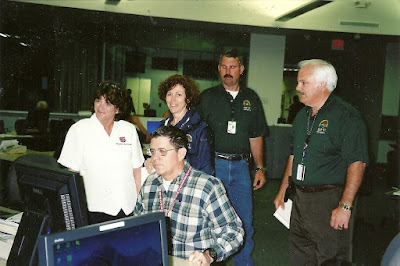
The State ESF #11 crew at the State EOC in 1998; from left Pam Hughes (then with the Salvation Army), myself (seated), Gloria Van Treese (Lead for State ESF 11 and my boss), George Kolias and Jim Guerry.
On July 1st and 2nd the fires jumped across I-95 and other natural firebreaks in several locations as they moved toward the east. The fires threatened to sweep into several urban areas and residential subdivisions. An intense battle raged for three days, as the flames consumed dozens of structures. In Volusia County the fires reached built-up areas of Daytona Beach and Ormond Beach. On the afternoon and evening of July 2nd flames consumed 51 dwellings in Palm Coast in Flagler County. In northern Brevard County 36 homes were destroyed during the same period. (U.S. Fire Administration/Technical Report Series Wildland Fires, Florida – 1998).

Fire damage in Volusia County in 1998.
As the July 4th holiday approached they canceled the big race at the Daytona Speedway and the state of Florida ran out of bagged ice. I know for a fact that there was no ice because I spent the better part of a morning calling every single ice vendor in the state, without success. This is when I rediscovered the awesome power of the federal government during a disaster. I reported this problem to FEMA and, after some magic beans, rather magic pieces of paper were signed, two truckloads of bagged ice were dispatched from Michigan to Florida.

Why Michigan? I have no idea. Lowest bidder, or something.

When I walked into the State EOC the morning of July 3rd, I knew something big was going on. Governor Lawton Chiles was there, but that wasn’t unusual. What was unusual was that the Cabinet was there, a Senator and several Florida Representatives in the U.S. Congress. I don’t recall (I’m trying to be factual where I can) which of our two Senators were there, Republican Connie Mack or Democrat Bob Graham, but Graham was running for reelection (which he won) so I think it was him. Never before, or since, had I seen so many high level elected officials in a State EOC.

Their presence was driven by the events of the previous 2 days:
To the north of Daytona Beach, another group of major fires was burning in Flagler County. Approximately 50 structures were lost in the large unincorporated community of Palm Coast on the afternoon and evening of July 2nd when the wind pushed the flames and burning embers into populated areas. The following morning reconnaissance reports indicated that these fires had the potential to join together and create a giant firestorm. If this had occurred, it could have wiped out Palm Coast, the town of Bunnell and several similar communities. (U.S. Fire Administration/Technical Report Series Wildland Fires, Florida – 1998).

Florida Division of Forestry workers doing the hard, dirty work in the Florida heat and humidity.
The Bigwigs had all arrived for the 0830 morning brief and some of the State worker rabble who work at the front of the EOC were cleared out to make room for the guests. The State Meteorologist started off with the weather brief and immediately made clear the seriousness of the situation.

The high temperatures, relatively low humidity (for Florida) and “sea breezes” expected from the Atlantic had the potential to create a firestorm in Flagler County. For that reason the Governor was ordering an evacuation of the entire civilian population of Flagler County, about 45,000 people. The order was to be announced that morning, within minutes, and we were told we would be responsible for coordinating the evacuation.

I turned to a comrade in the EOC and said, “Now I understand why all the politicians are here.”

I don’t remember the co-worker, a seasoned veteran, but I do remember his comment, “The good citizens of the State understand how a hurricane of a tornado might damage their property. But if their house burns down, they get pissed and wonder why somebody didn’t do something to stop it.”

So how did the State Emergency Response Team plan to handle this evacuation? We didn’t have a binder on the bookshelf with “Evacuate Entire County for a Wildfire” printed on the seam. I was wondering what-the-hell-we-were-going-to-do (one of many times in my emergency management career that I was to have that feeling).

The evacuation plan that had been worked out, probably on a conference call with the Counties, was to treat it just like an evacuation for a hurricane. When they announced that in the EOC I immediately felt better. Hurricane evacuation. Good. We know how to do that.

The major roads through Flagler County, Interstate 95, US1 and Florida A1A, all run north and south, parallel to the coast and within a few miles of the Atlantic Ocean. The evacuation required all of the residents to use these roads to travel either north, into St. Johns County, or south into Volusia and Brevard counties, all of which were also at a high risk. The evacuees were directed through these counties to either Jacksonville to the north or the Orlando area to the southwest to get them out of the endangered area. These residents were unable to return to their homes for four days. (U.S. Fire Administration/Technical Report Series Wildland Fires, Florida – 1998).

A lot happened to me the rest of that day but I don’t remember much - probably because the evacuation went smoothly. There were, of course, a few glitches. I do remember hearing that the population of a retirement home was evacuated to a shelter in Gainesville, where they were given sack lunches consisting of peanut butter sandwiches and an apple.

In the next few days I once again witnessed the awesome power of the federal government in action during a disaster. At the request of the State of Florida FEMA procured from the U.S. Air Force 12 Lockheed C-5A Galaxy sorties that flew 78 pieces of firefighting apparatus from California to Jacksonville Naval Air Station, where they were off loaded and made available to fight the fires.

FEMA workers in the Florida State EOC during the 1998 response.
But by then the crisis was over. The weather changed, and it started to rain. The exhausted firefighters were finally able to rest.

The events that occurred in Florida during June and July resulted in the nation’s largest deployment of wildland and structural firefighting resources. More than 10,000 fire fighters were involved in the operations, which utilized almost all of the deployable wildland fire firefighting resources in the United States. The air operation was the largest ever conducted. It is also believed to be the largest commitment of structural fire fighters to a wildland interface situation. (U.S. Fire Administration/Technical Report Series Wildland Fires, Florida – 1998).

And I and the rest of the State EOC crew were also able to rest. We didn’t return to the State EOC until October, when Hurricane Georges visited the Panhandle.

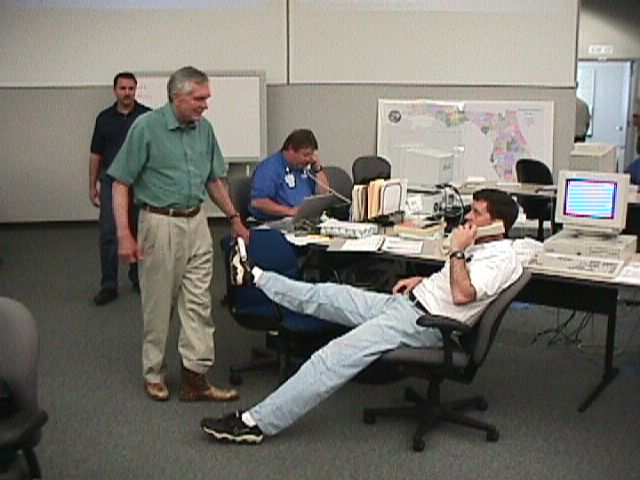
During the 1998 response: I had my foot propped up while I was talking on the phone when I felt someone pinch my toe. I looked up and it was Governor Chiles. A newspaper photographer captured the moment and let me have the image.
The elections in November saw Bob Graham re-elected for Senator. Jeb Bush defeated Buddy McKay to become our new Governor. Governor Chiles, “Walking Lawton,” died of a heart attack at the Governor’s Mansion in December. Buddy McKay, who lost the Governor’s race, was to serve as Governor the final 23 days of Chiles’ term.