Saturday, June 17, 2023

My Memory of the War in Iraq 20 years later: June 2023

 “From: Whitehead Col Michael

    Sent: Friday, June 20, 2003 10:22 AM

    Subject: Laundry Day

    Today is laundry day so I have to empty my pockets. Laundry day is signaled by the fact that my clean clothes bag is almost empty and my dirty clothes bag is REALLY full. I monitor my dirty clothes bag by using it as a pillow every night (my pillow was stolen in Arifjan back in March). This process takes about six to seven days. Laundry day is good because I put on a clean uniform. If you only have two uniforms, you get a lot of use between washes.

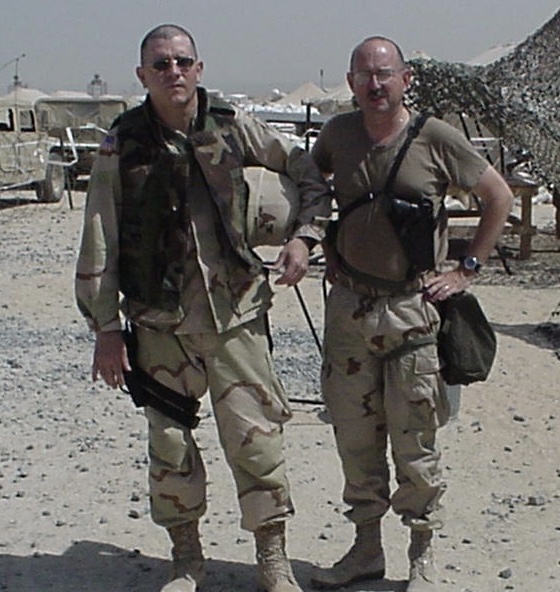
The officer sleeping quarters in one of Saddam Hussein's castles at Camp Babylon, Iraq in June 2003. The skinny guy in the picture is me. I had lost 20 pounds.

    To wash my uniform, however, I have to empty my pockets and there are a lot of pockets to empty. The shirt has four pockets and the pants have four. I keep them filled with things because: 1) I don't have a desk or office where I can leave things, 2) Anything I leave out in our work area is subject to walk away, because we have about 15 people working in a small room, and 3) If I find I need anything during the day, it is a LONG walk back up the hill to get it. I walk around with everything I need to work in my uniform pockets.”

    “In my bottom left shirt pocket I have a baggie filled with vitamins and Malaria pills. I take one of each after breakfast. In my bottom right shirt pocket I keep my sunglasses in a case. In my top right pocket I keep a flashlight (never can tell when you may need one) and my antibacterial hand wash. In my top left pocket I keep two pens and important pieces of paper that I may pick up or have thrust upon me during the day. On laundry day I discard or file the papers. In my right rear pants pocket I “keep my wallet. In my left rear pants pocket I keep my Red Man. In my left cargo pocket I keep a memo book to write down important, Secret, Army War info. I also keep there a brush I use to clean my pistol. I can't use my right cargo pocket because my pistol is hanging there.

    So you see, laundry day is a busy day of unloading and loading pockets. Then I lug my dirty clothes down the hill to the laundry point behind my office building. Things are a little better now because they installed a new laundry (and shower) point at the bottom of the hill. I put my clothes in the washer, go eat breakfast, and then go back to put them in the dryer. When I am done, I put my laundry bag of clean clothes near my desk and hope to remember to take it back up the hill with me at the end of the day. Once I put my clothes in the dryer and forgot about them until 4:30 that afternoon. When I went over to the laundry point, there they were, sitting all lonely on top of a dryer.”


Excerpt From

Messages from Babylon

Michael Whitehead

https://books.apple.com/us/book/messages-from-babylon/id407775151

This material may be protected by copyright.


Sunday, May 07, 2023

My Memory of the War in Iraq 20 years later: May 2023

 “From: Whitehead Col Michael

      Sent: Sunday, May 18, 2003 6:12 PM

      Subject: Magical Iraqi tour

      I left Babylon for seven days and civilization arrived. Washing machines. And dryers. No more bucket brigade.

      Ten of us left in three vehicles, me in command for a tour of the provincial capitals in our area. We went east from Hillah to Al Kut, on the banks of the Tigris River. We drove south from the banks of the Tigris to An Nasiriyah on the banks of the Euphrates. Then we went northwest to Ad Diwaniyah. NW again to An Najaf. Then north to Karbala. Finally SE today back to Hillah. Got a lot of pictures and a lifetime worth of experiences.

      Stark memories of my trip:

      Children, seeing us approach on the highway, streaming to the road to wave. This happened DOZENS of times.

      A line of Iraqi women, covered from head to foot in black or colored dress, pots full of laundry balanced on their heads as they walk from the river.

    A civil affairs soldier reported in a meeting, "We come out of a meeting tonight and some Iraqis approached us and said there were some teenagers nearby, drinking whiskey, and they had hand grenades. I sent the Marines over to deal with that." "Good idea," I told her.

    A scene out of Lawrence of Arabia: sitting cross-legged on carpets in a large tent, filled with Muslim clerics, and eating lamb and rice and pita bread with our hands (right hand only!) from a large bowl.

      Listening to a city council meeting in Karbala while a crowd of protestors chanted outside.

      Seeing every military or civilian vehicle on the side of the road picked CLEAN down to the chassis. Once I saw a group of children trying to pry something off the top of a bus.

    Sleeping on a cot on the hood of my vehicle. With a mosquito net.

      Taking a bath with Baby Wipes.

    Riding in a Hummer in full battle gear in 109-degree heat.

      Three men walking abreast in the right lane of a street in An Nasiriyah. They were blocking the lane. Directly behind each man was a woman clothed head to foot completely in black. We drove around them.

      Seeing men throwing wheat up in the air with a pitchfork, separating the wheat from the chaff as they have done here for thousands of years.

      Drinking water that is so hot it tastes like the water from the hot water faucet. And then drinking some more because you are so hot and thirsty you have no choice.

    Hearing a Marine Battalion Commander describe how his troops captured the University of Baghdad.

      Vendors outside the barbed wire of every Marine compound selling Iraqi Army bayonets, medals, ice, sodas and coolers. We bought ice, coolers and sodas. And pita bread.


      MJW”


Excerpt From

Messages from Babylon

Michael Whitehead

https://books.apple.com/us/book/messages-from-babylon/id407775151

This material may be protected by copyright.


Friday, April 07, 2023

My Memory of the War in Iraq 20 years later: April 2023

 “From: Michael Whitehead

    Sent: Monday, April 7, 2003 4:57 pm

    Subject: Haircut day

    The sky has clouded up and the wind has increased so things have cooled down considerably. Earlier, we felt like we were in a sauna. SGT Manning gave me a crew cut and I have a picture of me to record the event. How your hair looks doesn't seem very important out here. I have tried several times to attach a photo to my e-mails w/o success. I will keep trying.

    I am in a tent full of people and we are all working on computers. We have to tape Saran Wrap over the keyboard and monitor to keep out the Major League caliber dust that is EVERYWHERE.I just heard someone ask, "What is going on in the war?" We hear things in bits and pieces as they happen.

    I am getting a lot more information. Now I can read the classified Situation Reports that are coming from the major Marine and British units “information about "kill boxes", boundary changes and a lot of other very technical jargon that comes with controlling the violence and making sure the bad guys are getting shot by all this technological violence and not the good guys. The complexity and level of sophistication in the management of combat is incredible.

    Iraq is still a very dangerous place, so they are keeping us here at Camp Commando until "Indian country" is a little subdued.We are coordinating relief convoys of humanitarian aid into Iraq. Some of our people are going "north of the berm" as they call it to do assessments of the civilian populace. We are getting reports of these assessments from tactical civil affairs teams attached to the combat units. The information is flowing to us and we are analyzing this information, submitting reports and preparing briefing slides for the Marine General down the hill.

    We live in North Camp and the flagpole is down this sloping hill at South Camp. The mess hall is at the top of the hill so that in the evening after supper when we come out of the mess hall we can see the Persian Gulf and Kuwait City in the distance.

    I get up every morning and look forward to my job. When we go forward across the berm we will be a part of an historic enterprise. I am expecting a lot of confusion, chaos and long hours. We all look forward to getting the job done and going home.


 Mike”


Excerpt From

Messages from Babylon

Michael Whitehead

https://books.apple.com/us/book/messages-from-babylon/id407775151

This material may be protected by copyright.

Sunday, March 19, 2023

My Memory of the Iraq War 20 years later: March 2003

March 21, 2003, Pope Air Force Base, North Carolina

I took this picture on March 21, 2003 at Green Ramp on Pope Air Force Base. The line of faceless, helmeted soldiers carrying rucksacks and rifles was dramatic. Since the Army liked to do things in alphabetical order I was, as usual, at the end of the line. I vaguely remembered and discarded a prohibition against taking photographs on Green Ramp. I stopped, pulled out my camera and took this this photo. . 

I'm glad I did. The picture is framed and hanging on the wall of my office.

The United Airlines 747 was chartered to take us first to Germany and then on to Kuwait City. I have two big memories from that flight. The first was the announcement by the flight attendant after we boarded to "Please move your machine guns out of the aisles." Have not heard that announcement on a airplane before or since. The second memory was of our approach to Kuwait City Airport in the darkness before the dawn. The pilot asked us to close our windows since the plane was extinguishing all lights to ensure that we were a more difficult target. More reassuringly, he advised us that two US Air Force fighters would escort us the rest of the way.

As this anniversary approached I was confused about the date that the war started. I vividly remember sitting in the ancient World War II barracks on Ft. Bragg, NC that had been our home for the last 4 weeks (the same barracks where I mobilized for the Bosnia operation in 1996), listening on Public Radio as the President announced that the long anticipated war had started. This was the dreary, cold evening of Wednesday, March 19, 2003. I was disappointed. I thought that we were going to be in Kuwait before the war started. 

The Washington Post announced this morning that the war started on March 20. A quick Google search verified the date. Did I have the date wrong all these years? No. March 19 in North Carolina was March 20 in Iraq. We were both right.

Wednesday, October 06, 2021

On awaiting my 50-year HS Reunion

The Orlando International Airport inherited the airport code MCO in 1975 when McCoy Air Force Base shut down and the Orlando Airport Authority took over. Most of the horde of visitors to the airport today head West to Mouse Land and the rest to the theme parks, hotels and restaurants hacked out of the scrub pine and palmetto 50 years ago. 

When I land at the airport I head North on State Road 436 toward Orlando. The 30 minute ride from the airport to my parent’s house in Winter Park carries a lot of memories for me. When we stop at the traffic light on Lake Underhill Road (there are a LOT of traffic lights on SR 436) I stare at the enormous overpass for the East-West Expressway and think about the house on Hermosa St only a few blocks away. I lived in that house through the 5th grade. Just past the Expressway, on the left, is the shopping center with the barber where my mother sent me with her last $20 bill. Somehow, I lost the money on the way there. 

When I was a boy, riding my bicycle to the barber, $20 was worth a lot more than it is now. 

I’m heading to WP in November for my 50th high school reunion. Why would someone want to go to their 50th high school reunion? I have attended previous reunions. They can be 50 recitations of the Summary of Your Life in 25 words or less. A better approach is to offer the three biggest things that I want everyone to remember about me. 

Plus, some people don’t have fond memories of high school. And yet, the people you knew then aren’t the same people they are now. Believe it or not, some of them changed. They grew up. And some of those people aren’t even alive. 

I played on the basketball team at Glenridge Junior High School and the football team at Winter Park with David Alcorn. David was a great guy. He and I sat the bench on the basketball team until one game the Coach sent all of us bench warmers in to finish a game in the 4th quarter. David, bless his soul, fouled out before the game ended. Lee Ann Inman, a cheerleader who knew that I normally sat the bench, congratulated me at the end of the game. I expect to see Lee Ann at the reunion. 

David died of a heart attack in 1985. 

Yours truly after a morning session of 2-a-day football practice in the August heat of Florida


In high school, Margo Roman took me on my first trip to a synagogue. I listened to the Rabbi speak, and that was the first time that I ever heard the word Holocaust. I immediately knew what he was referring to. Margo is now an internationally renowned veterinarian. I hope to see her at the reunion. 

I can remember the first time that I ever heard about Hobbits and Frodo and Sam. And the Ring. I was told about “The Lord of the Rings.” “But you have to read The Hobbit first,” the boy told me. The boy was Randy Brown, and I expect to see him and talk about Gandalf at the reunion. 

What happens when one of your children read the epistle in your yearbook from your High School girlfriend? I hope to see the former girlfriend at the Reunion and tell her all about it.

I try not to focus on regrets, but I have a considerable, consistent cadre that increases with age. The faces and names that stare back from the Senior Year Yearbook pages represent, one would hope, individuals who have morphed into different people. 

You only get one chance to attend your 50-year HS reunion. I don’t want to miss the opportunity and add one more regret to the time that I have left. 

What are the 3 biggest things that I want everyone to remember about me? To find out, you have to come to the reunion.


Sunday, December 15, 2019

Puerto Rico 2017 & Maria: Review of "Out of the Whirlwind" by Phillip Palin

A mass care buddy of mine and I ran into each other at FEMA Headquarters in Washington, D.C. this summer. The topic of Puerto Rico and Maria came up.

"That response still bothers me," I told him.

"You need to read Out of the Whirlwind," he replied.

So I did. A lot has been written about the September 2017 rendezvous of Maria, a Category 5 hurricane, and Puerto Rico, a beautiful Caribbean island with some fabulous inhabitants who don’t deserve the  bankrupt government bequeathed to them. Out of the Whirlwind, a novel by Philip Palin, doesn’t try to understand and explain everything that happened during the days, weeks and months after the storm’s impact. Instead, the novel takes a microscope to a part of the response that normally doesn’t get a lot of attention.

Graphical representation of National Hurricane Center forecast for Hurricane Maria,
8 AM, September 20, 2017.

I wrote about my deployment to Puerto Rico with the Red Cross in an earlier post, What I learned in Puerto Rico. I also wrote a Review of Jose Andres Book on Puerto Rico after Maria. For a lot of reasons, I’m still disturbed by what happened during the response to this catastrophe.


I arrived at the San Juan Airport at 1 AM on Saturday, September 23, 2017 on a FEMA chartered flight from Atlanta filled with a Disaster Medical Assistance Team from Arizona and 14 Red Cross volunteers and employees. I spent the next 3 weeks working in the Mass Care Task Force, a part of the State and Federal Headquarters on the 3rd floor of the San Juan Convention Center.


Interestingly enough, the Mass Care Task Force (but fortunately, not my name) were mentioned in both Chef Jose’s and Phillip Palin’s books.


Mr. Palin participated in a fascinating study entitled Supply Chain Resilience and the 2017 Hurricane Season, published by the Center for Naval Analysis’s Institute for Public Research (IPR). Two of the chapters in this study were about Puerto Rico, with one of the two exploring the impact of the storm on the availability of food on the island and the work of the Mass Care Task Force.

The food supply chain on the island was a constant and recurring topic of conversations not only within the Joint Field Office and the Mass Care Task Force at the San Juan Convention Center during my time on the island, but with conversations that we had with individuals back on the mainland. The elephant in the room during the entire time was the 6 million meal per day request by the Governor of Puerto Rico to the federal government. 


The Resource Request Form (RRF) from Puerto Rico to FEMA for  6 million meals/day. Source: Supply Chain Resilience and the 2017 Hurricane Season, CNA
How did they come up with a 6 million meals per day requirement, one wonders? When I first heard about the Resource Request Form (RRF) I thought the same thing. The answer is that the population of the island is 3.4 million and they estimated 2 million people would need to be fed, times 3 meals a day. Voila, 6 million.

The storm hit on Wednesday, September 20 and the RRF was submitted the following Monday, September 25. There were some people in the Convention Center, including me, who thought that the number, for a variety of reasons, was too high. My opinion on the subject was not solicited by the State of Puerto Rico nor FEMA.

Maria was the 25th hurricane that I have worked as a responder and this situation was the direst that I had ever experienced. Essentially the entire island was without power and cell coverage. I could make cell phone calls to the United States but couldn’t call anyone across the room, much less in the building or the other side of town.

In the first week that I was there we were a communications center that couldn't communicate, a coordination center that couldn't coordinate and a response center that couldn't respond. We tried hard but no one thought to bring carrier pigeons or signal flags.

OK, Smart Guys, if you think 6 million meals per day is too high, then what do you think is the right number? It's my job at Red Cross Headquarters to estimate feeding requirements for disasters. The issue was, with the exception of the guy that filled out the RRF, few people had ever tried to make such an estimate. I was willing to try, but this was a catastrophic event, on an island that I had only ever visited once before in my life, in which 40% of the population were on the Puerto Rican version of food stamps.

In areas impacted by high intensity events (like a Category 4 or 5 hurricane) in the continental United States the voluntary agencies, on average, feed 2 meals/day to about 12% of the population for a brief period (3-7 days). That's on average, with considerable variability. My guesstimate (at the time) for Puerto Rico after Maria was 800,000 meals/day for 2 weeks, with a decline to zero for another 8 weeks. And I thought that was a very conservative estimate. But, like I said, no one asked me.

According to Phillip Palin, who I imagine is quoting from documents obtained during his participation in the CNA study, from September 24 to October 12 FEMA shipped 8.4 million shelf stable meals to Puerto Rico and handed them over to the state, provinces and municipalities for distribution. That's about 400,000 meals/day. Considering everything else (bottled water, generators) FEMA had to load in the port of Jacksonville, ship on barges to Puerto Rico, unload at the port of San Juan and then truck to the distribution stages, FEMA logistics did a helluva job. By the end of March 2018, FEMA  shipped over 60 million shelf stable meals, and turned about half over to the state of Puerto Rico.

After my experience with the RRF and the questions about the food supply on the island, reading the CNA study and Out of the Whirlwind made my head explode. Not literally, but figuratively. 

Out of the Whirlwind is Mr. Palin’s effort to translate the academic consultant-speak of the CNA report into a fable about the Puerto Rican people and their remarkable efforts to respond and recover from a catastrophic event. He also wants to teach us about supply chains, how they work, how they respond and how they recover.

Needless to say, the state and federal governments are not the heroes of this fable. The men and women living on the island who did their best to deal with the staggering problems they encountered due to the impact are the heroes.

Mr. Palin has an obvious affection and understanding of the island, its history and inhabitants. He also wants to explain a complex topic (supply chains), using the example of Hurricane Maria and Puerto Rico, to an audience unfamiliar with the academic literature. The target audience for this novel is the emergency management community throughout the nation, although I’m not sure they are even aware of that fact.

The narrative of the novel tells the story of the storm’s impact on the food and fuel supply chains on the island, told from the point of view of fictionalized characters. These characters represent key parts of the wholesale, retail and transport parts of the chain. 

The narrative of the novel demonstrates that the six million meals/day requirement was excessive and more importantly, impossible for the Logisticians to meet within the specified timeframe (i.e. for the 3 week period after impact).  Furthermore, there was neither the distribution system nor the demand to meet even a fraction of the proposed supply.

As Palin (and the CNA Study) demonstrates, there was food on the island and a pre-existing commercial system to distribute that food. We knew that this commercial system existed but we thought that it was broken. We were wrong.

Produce available for sale in a San Juan grocery store,
October 7, 2017(Picture taken by the author).

I went into a grocery store near my hotel in San Juan on October 7, two and a half weeks after the storm impacted. The shelves where perishable food normally resided were covered because there was insufficient electricity for refrigeration. There were plenty of empty shelves, but canned food and produce not requiring refrigeration were available.

Non-perishable food items for sale in a San Juan grocery store,
October 7, 2017 (Picture taken by the author).

I spoke to an older woman in the store who had a cart and was shopping. I asked her how she was cooking the food and she said that the electricity on the island was so unreliable that most households had propane stoves as a backup. 

After a sample of one store, I couldn’t draw any broad conclusions about the status of food on the island. There were numerous small villages in the mountains that were inaccessible to ground transportation by commercial or emergency vehicles and were being resupplied by air. Yet, the numbers of people in these isolated villages weren’t in the millions or hundreds of thousands.

According to Palin, the supplies in the store that I visited in San Juan and hundreds of other accessible stores throughout the island were being supplied through the heroic efforts of commercial wholesalers and retailers.  These men and women were struggling to overcome two giant problems. The first was the lack of fuel, an huge issue that I don’t want to get into in this post. The other problem was that the consumer had no access to funds to purchase the food.

When I was staging in Atlanta prior to flying to Puerto Rico, I was instructed to draw $1,000 in cash against the travel debit card that I had been given to cover my expenses for the trip. I was very unaccustomed to and uncomfortable about carrying that much cash on my person, but I did. I needed every bit of the money because Puerto Rico, when I arrived and for several weeks after, was a cash-only place of business. 

You couldn’t use your credit or debit card for purchases. You could only with difficulty extract a limited amount of cash from your account, regardless of the balance. And the 40% of the population using PAN, the island’s food stamp program, had no access to these funds.

In places where the electricity was restored the retail establishments had no access to the cellular network to confirm the electronic transactions. Establishments that were able to restore their antenna searched in vain for a network signal because the network tower was down. An unstated implication in the book is that the federal government’s feeding strategy should have focused on restoring the cellular network instead of bringing in shelf stable meals that the island did not have the full capacity to distribute.

The peak in the influx of shelf-stable meals from FEMA didn’t happen until mid-October. By then, according to Palin, the cell network was sufficiently repaired to allow retail food transactions on most of the island. The bureaucratic momentum of the state/federal disaster feeding strategy was to continue until March of the following year.

They may be some who may want to attribute the situation described here to malfeasance or incompetence. Such accusations could only be justified with 20/20 hindsight. I was there on the ground, trying to utilize some of my considerable disaster feeding experience to identify the problem and suggest solutions. The shortage of cell towers was known. What wasn’t known was the importance of this gap in feeding the population. We were all searching through a dense fog, trying to do what was needed for the population. 

That’s why this answer, when I first read it, blew my mind. That’s why my memories of those 3 weeks in the San Juan Convention Center still bother me. I believe with all my heart that we did the very best we could in a terrible situation. I will forever be sorry that what we were able to do wasn’t enough.