Nearly three years into the Obama administration, Department of Homeland Security (DHS) Secretary Janet Napolitano and FEMA Administrator Craig Fugate are putting their stamp on the nations preparations for natural disasters and threats from terrorism. The focus on preparing the nation in the Bush administration began after 9/11 and then intensified after Katrina. The Obama Administration is not changing the direction set by the Bush Administration so much as refining it and making it more accountable in this era of diminished resources.
Earlier this Spring President Obama released the Presidential Preparedness Directive 8 (PPD 8) which laid out how the nation would prepare for disasters in the future and directed DHS and FEMA to prepare and release a set of documents within an ambitious series of deadlines over the next year. In October FEMA released the National Preparedness Goal and I commented on the document in my October blog. Earlier this month another document directed by PPD 8 was released, the National Preparedness System description.
Preparedness is all about building and maintaining capability. The new National Preparedness Goal identified the Nation’s core capabilities across five mission areas: Prevention, Protection, Mitigation, Response, and Recovery. Mass Care Services is one of fourteen core capabilities in the Response Mission Area. But what is capability? In 2007 the Bush Administration, in the National Preparedness Guidelines, defined capability as "the combination of elements required to deliver the desired outcome." The new National Preparedness System description defines capabilities as "the means to accomplish a mission, function, or objective based on the performance of related tasks, under specified conditions, to target levels of performance."
The key part of that definition is the phrase "to target levels of performance." The phrase looks like accountability, walks like accountability and smells like accountability. The people looking for this accountability are in Congress, and they have, in typical federal government fashion, thrown billions of dollars in the last decade at states and communities and fire departments and police departments and fancy emergency operations centers in an effort to build the nation's capability. And to what end? Are we more prepared? We don't know, but we sure spent a lot of money on it.
In June of this year I wrote about creating national standards for mass care resources and how that can help to develop mass care capability. The State of Florida Mass Care & Emergency Assistance Capability Level Guide, adopted this year, makes an effort to define mass care by "related tasks, under specified conditions, to target levels of performance." To evaluate the mass care performance of a jurisdiction during an event or exercise the evaluator must compare performance against a targeted level. If the performance does not meet the target then corrective action is needed. The corrective action could be to apply for a grant for federal funds using the evaluation as justification. Or the corrective action could be to fire the mass care coordinator.
What all this really means is that target levels will drive accountability and federal dollars to jurisdictions. So who gets to decide at what levels the targets should be for a given jurisdiction? The federal government in Washington? How will that go over? Not too well. They tried that already with the Target Capabilities List in 2007, to much wailing and gnashing of teeth by the locals.
So let each jurisdiction set their own target levels for each core capabilities. But who's got the time for that? And that leaves the funding process open to gaming by each jurisdiction by setting high targets that need lots of federal dollars to achieve.
I am curious to see how FEMA sets this thing up. Stay tuned.
Monday, December 12, 2011


Wednesday, November 16, 2011
IAEM Conference - next year in Orlando, FL
This was an excellent Conference, not only because of the international composition of the attendance but due to the wider scope of hazards other than hurricanes. There are people in this country who actually worry about earthquakes. Amazing.
I am thrilled that the Conference will be held in Orlando, FL next year. This will dramatically increase my odds of attendance and decrease the costs to the government of my participation .
The U.S. Air Force was well represented at the Conference and we had a respectable contingent of Army officers also on hand. There were some FEMA people on hand but not as many as at the other emergency management conferences that I attend. What also caught my eye was the number of Left Coast participants, particularly from California and Washington State. There were also a lot of local emergency managers from all over the country and its good to hear the different perspectives that they bring.
The Red Cross and Salvation Army were well represented, with some of the usual suspects here as well as the opportunity for me to meet and interact with mass care professionals from other parts of this nation.Jeff Jellets from the Salvation Army and I gave a presentation on Tuesday on "What's New (and Important) in Mass Care." I credit Jeff for making up the sexy title.
Jeff talked about the new National Mass Care Strategic Council and their charge to develop a National Mass Care Strategy. He also promoted the Mass Care Feeding Template, available at the National VOAD site. This template was developed by a national working group (on which I participated) to help the emergency management and mass care communities resolve some of the feeding "challenges" that were encountered in 2008 during the responses to hurricanes Gustav and Ike.
I spoke about the National Incident Management System Mass Care Working Group (MCWG), of which I am the Chairman. For the last three years we have been working on resource typing, an effort to standardize naming conventions and capability descriptions mass care resources nationwide. This effort encompasses everything from Field Kitchens and Food Distribution Vehicles to Shelter Management Teams to State Mass Care Coordinators (like me). Our first set of documents were passed to FEMA in August for approval and should be made available for public comment soon (that is, in FEMA's definition of "soon").
I brought a lot of business cards and used them and was able to expand my network of emergency management professionals, which is a lot of what these conferences are about. I attended a lot of informative workshops and speeches and broadened my base of professional knowledge, which is the second important part of these conferences. There is still a lot that I need to learn in the ever changing world of emergency management.
Tonight is the banquet where I get to walk across the stage and receive my Certified Emergency Management Certification from IAEM. I am looking forward to it. I am also looking forward to returning to Tallahassee tomorrow.
I am thrilled that the Conference will be held in Orlando, FL next year. This will dramatically increase my odds of attendance and decrease the costs to the government of my participation .
The U.S. Air Force was well represented at the Conference and we had a respectable contingent of Army officers also on hand. There were some FEMA people on hand but not as many as at the other emergency management conferences that I attend. What also caught my eye was the number of Left Coast participants, particularly from California and Washington State. There were also a lot of local emergency managers from all over the country and its good to hear the different perspectives that they bring.
The Red Cross and Salvation Army were well represented, with some of the usual suspects here as well as the opportunity for me to meet and interact with mass care professionals from other parts of this nation.Jeff Jellets from the Salvation Army and I gave a presentation on Tuesday on "What's New (and Important) in Mass Care." I credit Jeff for making up the sexy title.
Jeff talked about the new National Mass Care Strategic Council and their charge to develop a National Mass Care Strategy. He also promoted the Mass Care Feeding Template, available at the National VOAD site. This template was developed by a national working group (on which I participated) to help the emergency management and mass care communities resolve some of the feeding "challenges" that were encountered in 2008 during the responses to hurricanes Gustav and Ike.
I spoke about the National Incident Management System Mass Care Working Group (MCWG), of which I am the Chairman. For the last three years we have been working on resource typing, an effort to standardize naming conventions and capability descriptions mass care resources nationwide. This effort encompasses everything from Field Kitchens and Food Distribution Vehicles to Shelter Management Teams to State Mass Care Coordinators (like me). Our first set of documents were passed to FEMA in August for approval and should be made available for public comment soon (that is, in FEMA's definition of "soon").
I brought a lot of business cards and used them and was able to expand my network of emergency management professionals, which is a lot of what these conferences are about. I attended a lot of informative workshops and speeches and broadened my base of professional knowledge, which is the second important part of these conferences. There is still a lot that I need to learn in the ever changing world of emergency management.
Tonight is the banquet where I get to walk across the stage and receive my Certified Emergency Management Certification from IAEM. I am looking forward to it. I am also looking forward to returning to Tallahassee tomorrow.
Tuesday, November 15, 2011
International Association of Emergency Managers (IAEM)
I arrived in Las Vegas, NV yesterday for the IAEM annual conference. This is my first visit to Nevada and Las Vegas. For those of us involved in emergency management, this is the place to be this week.
The highlight of the week will be the banquet Wednesday night when I will be invited to the podium with some forty odd others to receive my Certified Emergency Managers Certificate. The CEM is a professional certification awarded by IAEM. In the spring I submitted a 3 ring binder two inches thick full of documentation. I had to complete an essay and take a test showing my general knowledge of mitigation, preparedness, response and recovery. I didn't need the certification for my job but I looked at the requirements, and they were substantial, and decided that I could meet them. I'm glad I did.
This morning at the conference we listen to speeches and this afternoon we attend breakout sessions. I will be presenting at one of this afternoons sessions with my good friend Jeff Jellets from the Salvation Army.The title of our session is "What's New (and What's Important) Mass Care?" Sound interesting? There are a lot of people at this conference and I'm sure some will be. I have talked to some Red Cross and Salvation Army friends that I have not met in some time. I have made some interesting people that I had not met before and I have already learned a lot.
A good start to the conference.
The highlight of the week will be the banquet Wednesday night when I will be invited to the podium with some forty odd others to receive my Certified Emergency Managers Certificate. The CEM is a professional certification awarded by IAEM. In the spring I submitted a 3 ring binder two inches thick full of documentation. I had to complete an essay and take a test showing my general knowledge of mitigation, preparedness, response and recovery. I didn't need the certification for my job but I looked at the requirements, and they were substantial, and decided that I could meet them. I'm glad I did.
This morning at the conference we listen to speeches and this afternoon we attend breakout sessions. I will be presenting at one of this afternoons sessions with my good friend Jeff Jellets from the Salvation Army.The title of our session is "What's New (and What's Important) Mass Care?" Sound interesting? There are a lot of people at this conference and I'm sure some will be. I have talked to some Red Cross and Salvation Army friends that I have not met in some time. I have made some interesting people that I had not met before and I have already learned a lot.
A good start to the conference.
Wednesday, October 12, 2011
The National Preparedness Goal for Mass Care
FEMA Administrator Craig Fugate announced the publication of the National Preparedness Goal this month and "Mass Care Services" is one of the national core capabilities identified in the document. The NPG is the first of several outcomes directed by Presidential Policy Directive / PPD-8: National Preparedness, released in March of this year. Buried in PPD-8, the NPG and The National Preparedness System document (due to be released next month) is verbiage designed to better target the dwindling future stream of homeland security dollars.
With headlines like "How Far Did $635 Billion Spent on Homeland Security Go?," and Congress seeking more accountability of where the money is going, FEMA and DHS must be able to answer the following questions:
- How Prepared are we?
- Where are the shortfalls in capability?
- Who gets the priority for resources?
The previous administration tried to tackle this monster with the Targeted Capability List (TCL), among other things, to less than rave reviews from state and local emergency managers. From 2007-2009 I participated on a mass care working group assembled by the FEMA Preparedness Directorate to prepare the next version of the TCL. Called Capability Level Guidance (CLG), we developed a pretty good document for mass care. FEMA decided to hold off on publishing the document until the new PPD-8 and the NPG were released. I didn't want to wait that long.
The problem was that there was no doctrine anywhere on coordinating mass care at the state level. There was no way that that I could objectively measure the mass care capability for the state, or to establish a standard that I could train to. The Mass Care CLG that we developed was the first and only document that fit the bill. And FEMA wanted to wait on it.
So I took the document, de-federalized it, and added some Florida specific items that wouldn't fit in a national document. The document was still 95% like the original. I worked with my mass care partners in the state to get their buy-in, and then asked the Florida Division of Emergency Management to agree to adopt it as the mass care capability standard for the State Emergency Response Team. The State of Florida Mass Care Capability Level Guidance was released in July 2011.
With the release of the NPG FEMA will get in the business of defining core capabilities. A core capability is made up of distinct critical elements necessary to achieve the National Preparedness Goal. A capability provides the means to achieve an outcome. Mission Areas - Prevention, Protection, Mitigation, Response and Recovery - are groups of core capabilities. Mass Care Services is one of the core capabilities in the Response Mission Area.
The term "mass care" is commonly understood in the emergency management community as feeding, sheltering and distribution of relief supplies to disaster survivors. Mass Care Services is defined in the National Preparedness Goal (NPG) as: "Provide life-sustaining services to the affected population with a focus on hydration, feeding, and sheltering to those who have the most need, as well as support for reunifying families."
If we want to define the amount of mass care resources that we want to pay for, then we need to define what level of outcome we want this capability to achieve. In the NPG FEMA started this process by assigning each core capability one or more performance thresholds. The preliminary (which means FEMA is amenable to modification) targets for Mass Care Services are:
"1. Move and deliver resources and capabilities to meet the needs of disaster survivors, including
individuals with access and functional needs and others who may be considered to be at-risk.
2. Establish, staff, and equip emergency shelters and other temporary housing options (including
accessible housing) for the affected population.
3. Move from congregate care to non-congregate care alternatives and provide relocation assistance or
interim housing solutions for families unable to return to their pre-disaster homes."
As the NPG makes clear: "The capability targets - the performance threshold(s) for each core capability - will guide our allocation of resources in support of our national preparedness."
The mass care community needs to be involved in this discussion about capability. We can start by understanding the National Preparedness Goal. Next up, next month, is the release of the National Preparedness System. This document will provide more detail about defining and measuring capability.
Sunday, September 11, 2011
Responding to Irene in New Jersey
In May of this year I made my first visit to Atlantic City, New Jersey to assist as instructor for the pilot of FEMA's new State Mass Care Coordinator's Course. That was when I first met Bill Schaffer, my counterpart and the State Mass Care Coordinator for NJ. I told him if he ever needed any help to call me, because if I had a big storm bearing down on me I was definitely going to call him to send me a couple of people to help me out.
Little did I know ...
I spent the weekend of Aug 20-21 watching all the computer models steer Irene into Florida as a major hurricane and I was loading Bill Schaffer and a lot of other friends into my speed dial. By Tuesday Bill was looking at a possible historic Category 2 impact on New Jersey and we started chatting on the phone about what he and the Garden State were facing.
"What are the chances you can come up here?" he asked me.
Under the Emergency Management Assistance Compact (EMAC) the state of New Jersey could request me and pay my expenses. Florida requested and received over 800 state and municipal workers from other states during the historic 2004 hurricane season. I had EMACed before, to Mississippi in 2005 after Katrina and to Baton Rouge in 2008 for Ike. With the hurricane season already going hot and heavy, I didn't think I could be gone for 14 days, the normal EMAC deployment, but I could handle 7 days out of the state.
Since I'm a state employee who doesn't own his own work time I had to check this out with my bosses in the agency and they were agreeable. I told Bill I was ready to go and by Friday morning I received my deployment orders and I was on the plane to Philadelphia that afternoon. The storm was 48 hours from landfall.
On Saturday August 27 I arrived at the New Jersey Intelligence and Operations Center (aka The Rock) at a little after six in the morning. The dark clouds in the sky and the whispers of the wind reminded me of other early mornings when I walked into a building to prepare for the arrival of a hurricane. The National Hurricane Center said that tropical storm force winds would arrive that afternoon, so whatever other resources needed to be moved, they had to be rolling that morning.
Bill and I quickly arrived at a division of labor. Bill's situation reminded me of the old saying, "When you're up to your ass in alligators, its hard to remember your original objective was to drain the swamp." We decided that Bill would focus on the alligators while I figured out the resources required to drain this particular swamp.
Bill was worried about what was happening that moment, that day. My job was to determine what mass care resources New Jersey would require in two days and the rest of the week. To do that I had to define the scale of the disaster. To determine the mass care resources required for a disaster response (whether hurricane, earthquake or flood) one has to define the scale of the disaster in terms of population, geography and intensity. The process to accomplish this task is defined in the State Mass Care Coordinator's Course (see previous post on this Course).
Unfortunately, the NHC predicted track carried the eye of the storm up the coast of the state. Fortunately, the predicted intensity had dropped to a Category 1. In my 16 year emergency management career I had responded to many Category 1 hurricanes in Florida. All of those responses had been handled by our counties, with little assistance from the state. But New Jersey wasn't Florida (duh!). The building codes were different, the emergency management capabilities of the counties, municipalities and voluntary agencies were different. Yet they had endured the vaunted winter nor'easters. Was this equivalent to a Category 1 hurricane? Is a Category 5 hurricane equivalent to an 8.0 earthquake? Don't know.
The State Mass Care Coordinators Course also says that we need to define the scale of the disaster, estimate the mass care requirements and determine what resources the voluntary agencies are providing by 24 hours before impact (or by 12 hours after for a no-notice event). If the Red Cross, Salvation Army and other voluntary agencies didn't have enough resources to meet the mass care requirements then the state and/or federal government had to step in to meet the shortfalls. Most states have little or no mass care capability, so FEMA would have to make up any identified shortfalls. And FEMA needed time to get the stuff and get it there.
When I showed up at the Rock on Saturday morning we were almost 24 hours from the impact of Irene. The state of New Jersey had to make a decision: did they need to ask FEMA for additional mass care resources? Or not? The biggest contribution that I could make all week was to help them make that decision.
Even my admirers will admit that I am overly opinionated on many subjects, but especially on mass care. On this topic I kept my opinions to myself. I waited to be asked and I wasn't. I knew that they weren't asking FEMA for additional resources and I silently concurred in that decision. If I thought that they had a substantial mass care shortfall and needed more resources I would have spoken up. They didn't so I didn't.
Overall I would say that New Jersey did really well in responding to Irene. They haven't had a lot of practice with hurricanes in the last century. A number of people told me that this was the largest disaster that New Jersey had experienced in their memory. Consequently, they were unaccustomed to an event this large and had to devise better coordination and communication procedures. In the seven days that I was there, I could see them taking these actions.
The risks from a hurricane are from wind, surge and inland flooding. The old Red Cross adage is to "Run from the water and hide from the wind." New Jersey did that. The greatest effect that Irene had on them was from inland flooding, and that had a lot of practice with inland flooding.
The most impressive part (to me) was that NJ didn't ask for resources from FEMA during the response. With all 21 counties (for the first time) federally declared for Individual Assistance and Public Assistance under the Stafford Act, New Jersey will get their fair share of federal recovery funds. For a medium sized (by population) state they handled a big disaster (not a catastrophic, as some Jerseyites tried to tell me, or even a major disaster) using their own resources during the response. Good job.
But you're only as good as your last disaster. And they could be doing the same or a bigger hurricane again in two weeks. I told this to anyone who would listen. I also said that this wasn't their worst case scenario. And good wasn't good enough. The citizens of New Jersey want and deserve the best. I think that they can deliver it.
I discovered that I was the first individual to ever EMAC into New Jersey. I went there because I truly wanted to help the people of New Jersey in a big response. I also had an ulterior motive. I am the state Mass Care Coordinator for Florida but I have no staff and no budget. When the Big One hits Florida (and it will) I will be looking for help from other states. New Jersey assured me that they will be there when I need them.
Little did I know ...
I spent the weekend of Aug 20-21 watching all the computer models steer Irene into Florida as a major hurricane and I was loading Bill Schaffer and a lot of other friends into my speed dial. By Tuesday Bill was looking at a possible historic Category 2 impact on New Jersey and we started chatting on the phone about what he and the Garden State were facing.
"What are the chances you can come up here?" he asked me.
Under the Emergency Management Assistance Compact (EMAC) the state of New Jersey could request me and pay my expenses. Florida requested and received over 800 state and municipal workers from other states during the historic 2004 hurricane season. I had EMACed before, to Mississippi in 2005 after Katrina and to Baton Rouge in 2008 for Ike. With the hurricane season already going hot and heavy, I didn't think I could be gone for 14 days, the normal EMAC deployment, but I could handle 7 days out of the state.
Since I'm a state employee who doesn't own his own work time I had to check this out with my bosses in the agency and they were agreeable. I told Bill I was ready to go and by Friday morning I received my deployment orders and I was on the plane to Philadelphia that afternoon. The storm was 48 hours from landfall.
 |
| The Rock |
Bill and I quickly arrived at a division of labor. Bill's situation reminded me of the old saying, "When you're up to your ass in alligators, its hard to remember your original objective was to drain the swamp." We decided that Bill would focus on the alligators while I figured out the resources required to drain this particular swamp.
Bill was worried about what was happening that moment, that day. My job was to determine what mass care resources New Jersey would require in two days and the rest of the week. To do that I had to define the scale of the disaster. To determine the mass care resources required for a disaster response (whether hurricane, earthquake or flood) one has to define the scale of the disaster in terms of population, geography and intensity. The process to accomplish this task is defined in the State Mass Care Coordinator's Course (see previous post on this Course).
Unfortunately, the NHC predicted track carried the eye of the storm up the coast of the state. Fortunately, the predicted intensity had dropped to a Category 1. In my 16 year emergency management career I had responded to many Category 1 hurricanes in Florida. All of those responses had been handled by our counties, with little assistance from the state. But New Jersey wasn't Florida (duh!). The building codes were different, the emergency management capabilities of the counties, municipalities and voluntary agencies were different. Yet they had endured the vaunted winter nor'easters. Was this equivalent to a Category 1 hurricane? Is a Category 5 hurricane equivalent to an 8.0 earthquake? Don't know.
The State Mass Care Coordinators Course also says that we need to define the scale of the disaster, estimate the mass care requirements and determine what resources the voluntary agencies are providing by 24 hours before impact (or by 12 hours after for a no-notice event). If the Red Cross, Salvation Army and other voluntary agencies didn't have enough resources to meet the mass care requirements then the state and/or federal government had to step in to meet the shortfalls. Most states have little or no mass care capability, so FEMA would have to make up any identified shortfalls. And FEMA needed time to get the stuff and get it there.
When I showed up at the Rock on Saturday morning we were almost 24 hours from the impact of Irene. The state of New Jersey had to make a decision: did they need to ask FEMA for additional mass care resources? Or not? The biggest contribution that I could make all week was to help them make that decision.
Even my admirers will admit that I am overly opinionated on many subjects, but especially on mass care. On this topic I kept my opinions to myself. I waited to be asked and I wasn't. I knew that they weren't asking FEMA for additional resources and I silently concurred in that decision. If I thought that they had a substantial mass care shortfall and needed more resources I would have spoken up. They didn't so I didn't.
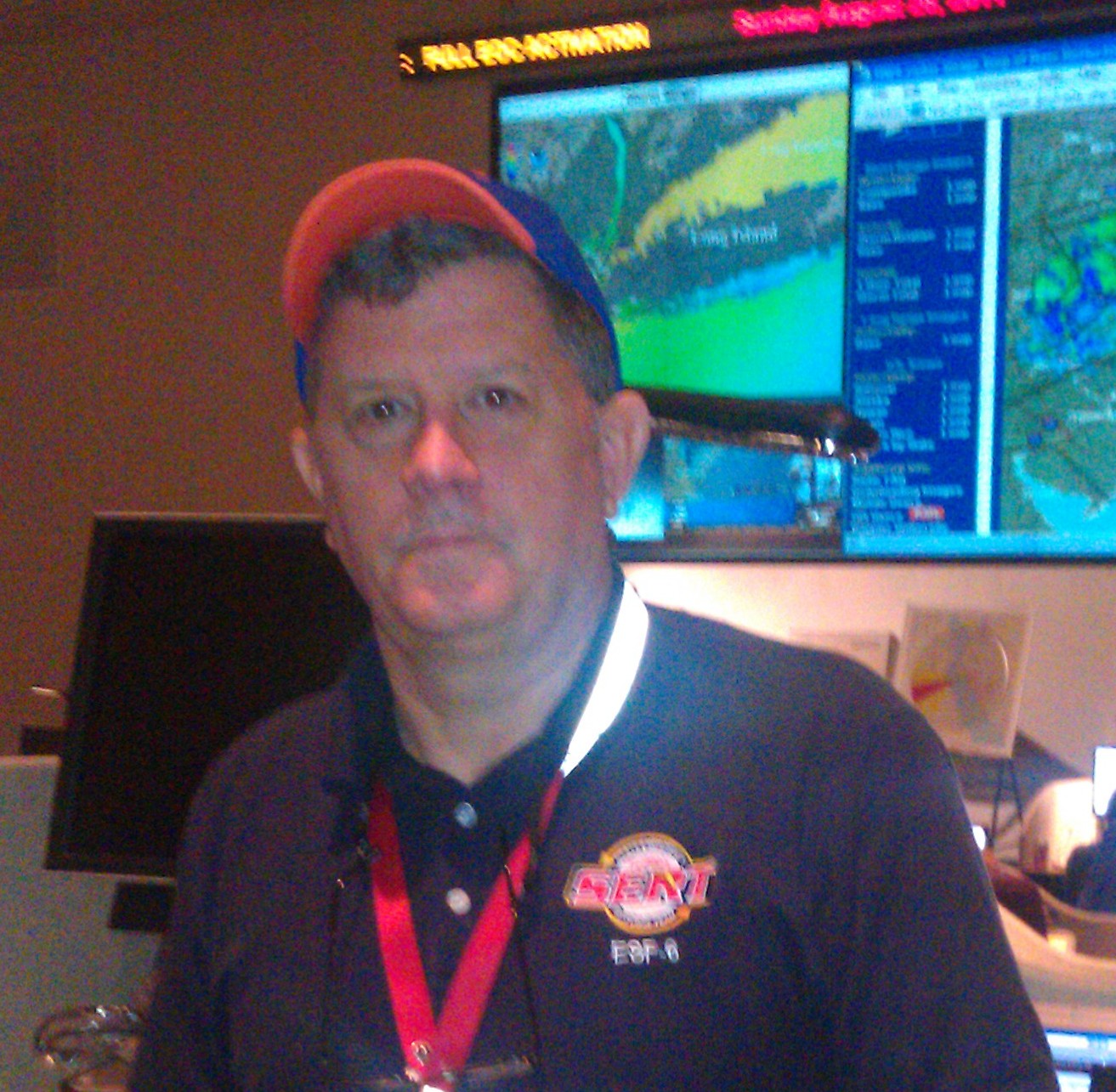 |
| Working Irene in the Rock |
The risks from a hurricane are from wind, surge and inland flooding. The old Red Cross adage is to "Run from the water and hide from the wind." New Jersey did that. The greatest effect that Irene had on them was from inland flooding, and that had a lot of practice with inland flooding.
The most impressive part (to me) was that NJ didn't ask for resources from FEMA during the response. With all 21 counties (for the first time) federally declared for Individual Assistance and Public Assistance under the Stafford Act, New Jersey will get their fair share of federal recovery funds. For a medium sized (by population) state they handled a big disaster (not a catastrophic, as some Jerseyites tried to tell me, or even a major disaster) using their own resources during the response. Good job.
But you're only as good as your last disaster. And they could be doing the same or a bigger hurricane again in two weeks. I told this to anyone who would listen. I also said that this wasn't their worst case scenario. And good wasn't good enough. The citizens of New Jersey want and deserve the best. I think that they can deliver it.
I discovered that I was the first individual to ever EMAC into New Jersey. I went there because I truly wanted to help the people of New Jersey in a big response. I also had an ulterior motive. I am the state Mass Care Coordinator for Florida but I have no staff and no budget. When the Big One hits Florida (and it will) I will be looking for help from other states. New Jersey assured me that they will be there when I need them.
Saturday, September 10, 2011
The hold that 9/11 still has on me
I watched the second tower fall on the giant screens of Florida's State Emergency Operations Center. At 10 AM I instinctively decided to head for the EOC and was already there when the alert notification was broadcast to all the state agencies that the EOC was moved to Full Activation status. As I walked out of my office a good friend told me that a plane had also crashed into the Pentagon. As I drove I was unable to stop myself from crying.
To this day I have wondered at my powerful emotional reaction to the attack at the time and since. I wasn't present at the WTC or the Pentagon. A great many of us witnessed the events on television but being AT the disaster is entirely different. As many who have been to large disasters can attest television cannot completely capture the experience.
I did not know anyone who was killed that day, nor did I know anyone who had an emotional attachment to someone who died. So why, as I read and saw once again the images of that Day as they were surfaced for the tenth anniversary, did I feel tears welling in my eyes again?
The events of the day certainly changed my life. Eighteen months after the attack I was riding in a Humvee from Kuwait into Iraq. But they event that crystalized the whole experience for me occurred not on 9/11 but on Friday, 9/14, at the memorial service in the National Cahredral. Still in the EOC, I watched the assemblage of the President and the other senior leaders on a television in a side room. At the end of the service, as the crowd left, the chorus sang the Battle Hymn of the Republic.
The song hit me like a thunderbolt with the message that we were at war. Alone in a room I was filled with a terrible grief and tears welled in my eyes. I didn't grieve for a person, a place or a thing. I'm no sure what I grieved for then, or what I continue to grieve for now. I was consumed by an overwhelming sense of loss.
Something was taken away from all of us who lived through that day, no matter where we were. After ten years, I am still unable to put into words what it was that I lost. I sense the hole but cannot divine what used to occupy the space.
To this day I have wondered at my powerful emotional reaction to the attack at the time and since. I wasn't present at the WTC or the Pentagon. A great many of us witnessed the events on television but being AT the disaster is entirely different. As many who have been to large disasters can attest television cannot completely capture the experience.
I did not know anyone who was killed that day, nor did I know anyone who had an emotional attachment to someone who died. So why, as I read and saw once again the images of that Day as they were surfaced for the tenth anniversary, did I feel tears welling in my eyes again?
The events of the day certainly changed my life. Eighteen months after the attack I was riding in a Humvee from Kuwait into Iraq. But they event that crystalized the whole experience for me occurred not on 9/11 but on Friday, 9/14, at the memorial service in the National Cahredral. Still in the EOC, I watched the assemblage of the President and the other senior leaders on a television in a side room. At the end of the service, as the crowd left, the chorus sang the Battle Hymn of the Republic.
The song hit me like a thunderbolt with the message that we were at war. Alone in a room I was filled with a terrible grief and tears welled in my eyes. I didn't grieve for a person, a place or a thing. I'm no sure what I grieved for then, or what I continue to grieve for now. I was consumed by an overwhelming sense of loss.
Something was taken away from all of us who lived through that day, no matter where we were. After ten years, I am still unable to put into words what it was that I lost. I sense the hole but cannot divine what used to occupy the space.
Subscribe to:
Posts (Atom)