Showing posts with label FEMA. Show all posts

Tuesday, November 21, 2017

What I learned in Puerto Rico

There’s an old saying in emergency management, “There are no new lessons learned in emergency management, just new people learning the same old lessons.” Hurricane Maria in Puerto Rico was the 21st hurricane response in which I had participated, the first being Hurricane Opal striking Florida in 1995.

A much younger Michael Whitehead at the State Emergency Operations Center in Tallahassee during the Hurricane Opal response in 1995.
I traveled to Puerto Rico as a part of a Red Cross contingent mixed in on a charter flight with a Disaster Medical Assistance Team from Arizona. We landed at a darkened San Juan Airport at 2 AM on September 23, a few days after the storm struck the island. I was the second Red Cross person to arrive at the federal and state operations center in the San Juan Convention Center.


September 22, 2017: Red Cross volunteers and staff in Atlanta boarding a FEMA chartered flight for San Juan, Puerto Rico.
Many people asked me what I learned as a result of my participation in the initial response. On the spur of the moment I made a quick list of takeaways from my time in Puerto Rico. And I'm not speaking here about the Red Cross response in Puerto Rico, but about the overall response by the federal, state, local, and nongovernmental organizations that were involved.

This response was so unique and different from the others that I learned some new lessons while re-learning some of the old ones:
  •        There was no power, no communications, no water and no sewage almost anywhere on the Island when I arrived. In a situation where resources are in such short supply and distribution is a challenge the mass care Priority #1 is to resource the shelters. The shelters then become a Point of Distribution and the local community comes to that location to get food and water.
  •          “We were stuck on Day 2 of the response.” By days 3-4 in most responses power starts coming back on and the influx of outside resources catches up with demand. In PR we couldn’t get past Day 2 – the power didn’t come on and the terrible logistics of an island response kept FEMA from getting enough food and water on the island. In fact, in much of PR we are still in Day 2 of the response.
  •          The lack of communication was unprecedented in my experience. We had difficulty emailing or even making a cell call in the San Juan Convention Center where the Joint Field Office was established. At times, we couldn’t email or call someone on another floor or even across the room! We took pictures of each other’s pieces of paper, or their computer screen or their iPhone to capture the information that we needed.
A picture that I took of a piece of paper in order to capture the addresses because our email was limited.
  •          Large earthquakes like the New Madrid and San Andreas will create islands like PR, filled with millions of people unable to get power, communication, food or water. And with the bridges down, they will be unable to leave. Ironically, the many lessons learned from this response will apply to large earthquake responses.
  •          With populations this large (there are over 3.5 million people on the Island), we cannot bring enough shelf stable meals and bottled water on the island fast enough to meet demand, much less get it distributed in an equitable manner. We needed water purification tablets, straws and large Units capable of producing water in bulk, which is what they started bringing on the Island. Then they brought in containers for the populace to carry the water. And propane cooking stoves so that they can distribute food boxes with food that can be cooked.
  •          And finally, more of the responders got traumatized than in other disasters. I was.

Traumatized? Me? Yes.

I've traveled and been and seen things like this before. I was in a war zone for a year. I arrived in southern Mississippi 3 days after Hurricane Katrina slammed into Bay St. Louis and Waveland and Biloxi and all the other towns that were devastated. I spent 2 weeks in Manhattan after Hurricane Sandy. I've seen acres of carbonized homes with solitary chimneys left standing in mournful protest after wildfires.

But Puerto Rico was different.

I didn’t travel about the Island. Like during Katrina, I was working long hours so I missed all the terrible television images that many of you saw. For 3 weeks, I sat at a table that was one of many identical tables on the 3rd floor of the Convention Center. In the first weeks that I was there a parade of people with problems and questions for the Red Cross came to see me and my partner. Sometimes they were lining up to see us. Some of these problems and questions we were able to resolve. For most of the problems and questions we had no ready solutions nor answers.

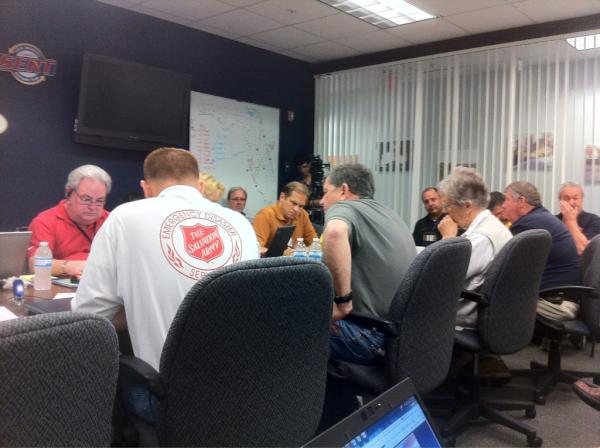
The Joint Field Office on the 3rd floor of the San Juan Convention Center where I worked for 3 weeks responding to Hurricane Maria in Puerto Rico.
What follows is a brief but representative collection of the information that came to me by message, phone or in-person:
  • Search and Rescue reported finding dead bodies and live people in the same house.
  • A request for assistance from a nursing home, saying that they had no food or water for 2 days.
  • The Puerto Rican Red Cross volunteer who burst into tears mid-sentence as she was talking to me and sobbed, “I have been trying to bring food and water to my family, but I can’t.”
  • The man from Dominica who saw my Red Cross hat and stopped me as I left the Convention Center. He said that he had been living at the airport for 3 weeks trying to get home. I could see the desperation in his eyes.
  • A family of tourists in a hotel who needed food for their children because they had run out of cash and no store could take a credit card.
  • A family who needed a generator because their child would not survive without electricity.
  • Hospitals that couldn’t get diesel for their generators because the tanker drivers were afraid of being hijacked.
  • A message: “I have not heard from my elderly parents for a week. Can you tell me if they are okay?”
  • A message: “My father lives alone and needs insulin. Can you help me get him a resupply?”
  • An overheard conversation:
“These two elderly women live near my house. How can they get some food and water?”
“They need to go to the point of distribution for the municipality.”
“That’s a 30-minute walk from their house and we live on top of a hill.”
“You need to talk to the Mayor of the municipality.”
“We never know when the distribution site will be open. And by the time we get there everything is gone.”
“You need to talk to the Mayor of the municipality.”
“Isn’t there any other way to help these people?”
“This is the system that the Puerto Rican government has established. Go talk to the Mayor.”

We had lots of electronic communications devices but very little communications.
  • There was the young guy in the nice, blue U.S. Public Health Service uniform: 
He was on the Disaster Mortuary Team. “Red Cross workers in the field discovered some dead bodies,” he said. He wanted to make sure that if we discovered any more that we recorded the precise location and passed the information on to him. “We need to pick up the bodies,” he explained, almost apologetic. “It’s our job.”

There were more stories. Many more. I can’t remember them all, but I can’t seem to forget enough. The daily onslaught of messages from desperate people who I knew would die or suffer greatly if we could not help them, and we could not help all of them, took an emotional toll. I didn't need to travel to the cities or the shelters to know what was going on. I had enough disaster experience to know what the conditions were like on the island based on the reports I was seeing.

I think that I was traumatized by the fact that I traveled to the Island to help but I found out when I got there that I was unable to help everyone. In the other disasters I felt like we were behind but we were catching up and eventually we would get to everyone. In Puerto Rico, standing on the 3rd floor of the San Juan Convention Center, I didn't feel that way. I felt like I was in an alternate disaster universe, or in the disaster version of Groundhog Day, where we performed the same tasks with the same unsatisfying results.

I was deeply saddened by this knowledge, and still am to this day. I did the best I could. In fact, I think that I did one of the best jobs that I've ever done in any disaster. And I'm so very sorry that it wasn't enough.


Monday, May 30, 2016

At the National Response Coordination Center

The National Response Coordination Center (NRCC) is housed on the Mezzanine Level of FEMA Headquarters on C Street in Washington, DC. "When activated, the NRCC is a multi-agency coordination center located at FEMA Headquarters. Its staff coordinates the overall Federal support for major disasters and emergencies, including catastrophic incidents and emergency management program implementation." I've been in the NRCC many times but last month I got the opportunity to work in the NRCC when it was activated for an exercise.

The National Response Coordination Center.
Unlike the emergency operations center in Tallahassee, FL where I spent numerous hours over the last 18 years, the NRCC has a low ceiling. Like the State EOC in Florida, however, every chair in the NRCC is assigned to a role and the agency designated to fill that role. My job was to serve as the American Red Cross liaison to the NRCC. 

The State EOC in Tallahassee
FEMA provides the trained staff to operate the NRCC when activated. Most of the various federal agencies and nongovernmental organizations identified in the National Response Framework provide representatives to the NRCC so that we can perform the emergency management form of alchemy called multi-agency coordination. Because of the inevitable turnover in staff, and the fact that the NRCC is rarely activated, these agency representatives show up in the NRCC knowing something about their own agency but very little about how to operate in a multi-agency coordination center.

My case was a little different. Because of my background and the fact that I had been in my new job less that 6 months I knew more about how multi-agency coordination centers operate that I did about the Red Cross. That was okay. It was an exercise. We were all there to practice and learn.

When I was at the State EOC my view of the disaster was like flying over in a helicopter. Working in the NRCC was equivalent to viewing the Atlantic Ocean from a transcontinental flight to Europe. We took the Long View of the Big Picture.

Most of our activities revolve around responding to resource requests (provided to us by the FEMA Region) from the affected state or states  and creating reports for the Big Bosses about What Is Going On. The information we collect is built into reports that inform decision makers like the FEMA Administrator and ultimately the White House. 

I enjoyed working in the NRCC. Part of the reason is that the exercise had an interesting scenario. If I had spent 3 days waiting for a hurricane that fizzled my sentiments would've been different. What was really interesting was the perspective that I got from looking down on the disaster from the transcontinental airliner and how this affected my opinion about how state mass care coordinators should act when faced with large or catastrophic disasters. And that is what I want to talk about.

Most normal emergency manager people when faced with an overwhelming event naturally focus on the part of the job that is familiar to them. They see the situation getting out of control and struggle to wrest it back. They work with the resources that they have available to get the situation back under control. In most disasters this is the correct course of action.

In a large or catastrophic event the resources available are inadequate for the tasks. Getting these resources deployed is important but an even more critical task is communicating the type, kind and quantity of resource shortfalls to those outside the affected area who are able to provide those resources. If you're at the county level you need to let the state know what you need. If you're at the state you need to concentrate on getting those Resource Request Forms completed and submitted to the right FEMA person as soon as possible. 

In other words, if your jurisdiction is affected then you need to direct more of your attention to those external agencies who are mobilizing to provide support. If you're not telling these external agencies what you want, when you want it and where you want it sent they aren't going to wait on you. And you may not be happy with what you end up receiving. 

After requesting resources the second most important task on the state mass care coordinator's list in a catastrophic event is to help ensure all the stakeholders have a common understanding of the situation - a Common Operating Picture. The way to achieve this common understanding is to get everyone with a need to know on the same conference call every day. The state mass care coordinator is in the best situation to do this.

The purpose of the state mass care conference call is to gather and share information with all the mass care stakeholders within and outside the State EOC. Holding this conference call daily with the right agencies is critical to an effective mass care response. I cannot emphasize this point to much.

Mass Care Conference Call
When I was the State Mass Care Coordinator in Florida I always held the call daily at the same time: 10 AM. This allowed everyone to adjust their own meeting and conference call schedules so that they could participate in the state call. I also developed a State Mass Care Conference Call agenda/report that I emailed to all the conference call participants before the call. This document identified who I wanted to report on the call and also contained the latest mass care information from the State EOC. That way precious conference call time wasn't used reporting on information that was already shared in the document.

After requesting resource shortfalls and ensuring that all stakeholders have a common operating picture the third way that the state mass care coordinator can help his/her cause is by working to establish the mass care priorities for the response. The best way to do this again is through the mass care conference call. The means to this end is not by dictating priorities but by soliciting input from the key stakeholders and then working to achieve consensus. This is a tall order but the state mass care coordinator is in the best position to achieve this goal.

The sooner that the state mass care coordinator can establish a mass care conference call in order to 1) determine mass care resource shortfalls, 2) gather and distribute a common operating picture, and 3) establish mass care priorities the better the response will be. Achieving these objectives will enable those of us outside the affected area (in the NRCC, the Regional Response Coordination Center and the Red Cross Disaster Operations Coordination Center) to do a better job of suporting the survivors on the ground in the midst of the disaster.


Sunday, April 24, 2016

Estimating mass care resources: the example of the Kumamoto earthquake

I've been trying for over 20 years to estimate the amount of mass care resources that would be required in a disaster. In 2004 when Florida was hit by 4 hurricanes in a 6 week period I had multiple opportunities to try and figure this thing out. One thing I learned pretty quick in the 6 weeks was that when someone wanted me to provide a mass care resource they wanted it RIGHT NOW. Or, preferably, yesterday.

I also learned that in the State Emergency Operations Center during a hurricane response we weren't able to do "right now." For certain things that were already in the State Logistics Staging Area (like bottled water) we might even be able to do "tomorrow." More likely it was going to be day after tomorrow. And if they wanted something that we hadn't already ordered it would be, well, days until they would get it. That is if the requester was lucky and everyone, including me, did everything right.

There was a lot of things that I remembered and a lot of things that I forgot after Charlie, Francis, Ivan and Jeanne paid us all a visit. My big takeaway was that we needed to be able to estimate mass care resource requirements before the damage assessments were completed and in some cases, before the event actually happened.

How in the world are you going to do that? you may ask. Think about it. If a Category 5 Hurricane is lined up on Miami and forecast to hit there tomorrow we don't need to say, "Well, as soon as the damage reports are compiled, probably a few days after the storm hits, we'll know what we need to order. We'll just have to wait until then to figure out what we need."

We have to do better than that.

The things we need to order are always the same: cots, field kitchens, shelter managers, bottled water. What we don't know are what numbers we need to put in the quantity blocks of the requisitions. What frequently happens are conversations like this:

MASS CARE GUY: I need cots.
LOGISTICS GUY: How many?
MASS CARE GUY: I have no idea.
LOGISTICS GUY: "I have no idea" doesn't fit in the quantity block of the requisition.
MASS CARE GUY (MAKES UP A NUMBER): What about 10,000?
LOGISTICS GUY (WHO DOESN'T CARE WHAT THE NUMBER IS BECAUSE YOU'RE JUST ONE MORE PROBLEM BETWEEN HIM AND THE END OF THE DAY): OK.

I've had those conversations during a disaster. More than once, I'm afraid to say. But what could I do? There wasn't a manual or instruction book explaining how to do all this stuff I was doing. I decided that there had to be a better way of doing things than making up the numbers.

After 10 years of talking, explaining and arguing with some knowledgeable mass care people we've come up with a process to estimate mass care resources. The process is crude and needs a lot of refining, but guess what? Doing it this way is better than making it up.

The demand for mass care resources after an event is based on three factors: population, intensity and vulnerability. The population numbers we can get from the Census. To estimate intensity levels we developed this chart:


Table to estimate event intensity.
What we do next is estimate the number of people who were affected by each intensity level. For hurricanes we have the Saffir-Simpson Scale.  The U.S. Geological Service puts out PAGER Alerts after significant earthquakes. The basis for measuring earthquake intensity in these Alerts is the Modified Mercali Intensity Level:


The PAGER system provides fatality and economic loss impact estimates following significant earthquakes worldwide. This information is usually available within hours of the quake and provides an immediate estimate of the number of persons affected.  The USGS put out a PAGER ALERT for the Kumamoto, Japan earthquake that happened several weeks ago. The PAGER looked something like this:


The PAGER showed estimates of the number of persons affected by MMI level. Using the Event Intensity Table I came up with the number of persons affected by High (194k), Medium (1,410k) and Low (2,865k) intensities. I entered these population numbers into the Mass Care Planning Tool spreadsheet that we've developed to estimate mass care resource requirements

Remember: the demand for mass care resources is a function of population, intensity and vulnerability. Using the Intensity Table and the PAGER we were able to estimate the population affected by intensity. From these numbers we need to estimate the % of people who need to be fed and sheltered, for each intensity level. The percentages would vary according to the vulnerability of the people.

In some places, for example, the percentages for sheltering would be 10% for High, 5% for Medium and 1% for low. There are different percentages to estimate the feeding numbers. I had no idea what %'s to use to make a shelter estimate for a Japanese earthquake so I used the 10/5/1 that I had. The estimate using those percentages for the Kumamoto earthquake was 118,550 persons needing shelter (see Table below). Then I waited for the off chance that I might actually be able to get an estimate of the number of persons requiring shelter.


Weather.com also reported that: “Local media reported that nearly 200,000 homes were without power and an estimated 400,000 households were without running water…[and] 180,000 are without shelter.”

Now that I had some actual numbers of people needing shelter I could see that the estimate of 118k needing shelter was low.  The 10/5/1 shelter percentages that I used weren't high enough, and probably should have been higher.  In other words, their vulnerability to the hazard was greater than I estimated.

As we socialize this estimation process in the mass care community and people start using it in disasters our ability to estimate these vulnerability percentages will improve. The conceptual framework for this estimation process has been included in the new FEMA L418 Course: Mass Care/Emergency Assistance Planning & Operations Course. This concept is also included in the new (soon to be released) Red Cross Feeding Standards & Procedures.

 Like I said, the process is crude and needs a lot of refining. But take my word for it: estimating mass care resource requirements this way is one HECK of a lot better than making up the numbers.

Sunday, March 27, 2016

The 2016 National Hurricane Conference in Orlando

This is the 11th National Hurricane Conference (NHC) that I've attended in a row. I missed the 2003 and 2004 Conferences because of my involvement in the Iraq war. I enjoy the Conferences not only because of the information disseminated in the sessions and exhibits but because of the opportunity to network and meet new people in the mass care community.

Red Crosser Katherine Galifinakis (l) and I presenting at the Shelter Transition Workshop
 on Thursday, the final day of the Conference.
On Monday I participated in a day long session on the Shelter Field Guide (follow the link to the National Mass Care Strategy website to obtain an electronic copy). This class wasn't on how to be a shelter manager but on how to best utilize the Guide to solve common problems presented during sheltering. We worked in groups to solve injects involving a church that decides to shelter survivors of a large local disaster. I learned a lot about not only sheltering but how useful the Guide could be.
Al Vliet from FEMA (standing) was one of the instructors for the Shelter Field Guide Training.
Tuesday, the second day of training offered at the conference, was meteorological day for me. Three of the four sessions I attended were taught by our friends at the National Hurricane Center and the National Weather Service. The highlight of the day was the session on Atlantic hurricane forecasting taught by noted Colorado State University forecaster Phil Klotzbach (see a copy of his presentation here). Phil gave us some hints on the upcoming hurricane season but is saving his final judgment for his soon to be released April 14th forecast.

My good friend from the Salvation Army Kevin Smith (seated, near right) listens
with me to noted hurricane forecaster Phil Klotzbach.
The highlight for Wednesday was our "Voluntary Agency Rap Session." The session was well attended and the discussion was dominated by the obscure, but important, process for using the value of donated resources and volunteer hours to aid state and local jurisdictions during federally declared disasters. When the President declares an emergency under the Stafford Act the federal government helps defray select costs of the disaster (normally 75%). In some disasters the expenses are so great that some local communities are hard pressed to pay their share of the remaining 25%.

This is where the voluntary agencies can help these communities by documenting the donated resources and volunteer hours that they contribute to the response and recovery. In some disasters this contribution can mean a lot of money to the beleaguered local jurisdictions. But like everything else with the federal government when it comes to money this means documentation, documentation and more documentation. The discussion in the Rap Session was centered around how the voluntary agencies could meet this documentation requirement. An example of a form developed in Colorado to document volunteer hours is shown below.


FEMA, who must accept and validate whatever  the voluntary agencies provide, does not want to be prescriptive about how the documentation is submitted. This is understandable but leaves the voluntary agencies guessing as to how they are going to meet this requirement. Everyone needs to come up with a process that FEMA will accept, but no one wants to take the time and effort during a disaster to gather detailed information that will be denied by some FEMA Reservist in a Joint Field Office 9 months later.

Thursday, the final day of the National Hurricane Conference, offered multiple mass care workshops. My favorite, of course, was the one that I offered as a topic last December and was accepted: Shelter Transition. Shelter transition is the multi-agency process by which survivors in a congregate shelter are moved to some sort of appropriate housing.

Shelter transition is an important and vital part of concluding a mass care response and yet there is no written guidance or instructions to aid the local emergency manager in performing this task. To help fill this void the Red Cross and FEMA are creating a multiagency working group to address this issue. I will be one of the Project Leaders for this effort. I will have more to say about this project at a future date.

This year's National Hurricane Conference was a success from my point of view. I learned a lot, cemented some mass care relationships and made some new ones. My farewell to everyone as I left the last Thursday session was one that I have made many times before:

"I hope that I don't see you this summer!"


Sunday, September 27, 2015

Shelter types


There has been a considerable effort within the national mass care community during the last five years to classify shelters.  In 2009 FEMA, at the suggestion of the mass care community, assembled a working group from within the mass care community to undertake to type mass care resources. The group was called the National Incident Management System (NIMS) Mass Care Working Group. I wrote about a lot of this in a post last November.

The Working Group consisted of representatives from the VOADs, the private sector, state and local governments. FEMA personnel from the National Integration Center (NIC) monitored the activities of the Workgroup but did not serve as a part. A contractor, paid for by FEMA,  provided administrative support. As the State Mass Care Coordinator for Florida I was asked to Chair this Working Group and I accepted. 

Among the VOAD representatives were Lynn Crabb, the Mass Care Lead for the American Red Cross National Headquarters and Richard Hinrichs from the San Diego Chapter. Richard became the Chair for the Shelter Subcommittee of the Workgroup. The Shelter Subcommittee members included Randy Linthicum from California, Lynn Crabb and Doug Sandy from ARC, Tonya Roberts from Arkansas, Kevin Rawson from the US Navy and Harold Hansen from the International Association of Venue Managers. 

The product of their efforts was the document entitled The Shelter Guidance Aid and Staffing Matrix. This product was and has been the only shelter document of its kind and now resides as a resource on the National Mass Care Strategy Website. The shelter classification outlined in this document was the basis for the Shelter Manager Job Title that was drafted by the Subcommittee and ultimately adopted by FEMA in June 2014.

The Shelters were classified in the document according to the kind of facility, with the criteria based on the expected length-of-stay of the occupants. The classifications by length-of-stay were: Evacuation (up to 72 hours), Standard/Short-term  (up to 2 weeks) and Long-term/Mega-Shelter (longer than 2 weeks). A characteristic of each of these kinds of shelters was that the amount of resources available increased as the length-of-stay increased. A Table outlining this classification can be found on pages 2 and 3 of the Shelter Guidance Aid. The graph below is a pictorial representation of the concept.


The efforts of the NIMS Mass Care Working Group were terminated in June 2012. After some bureaucratic delays the NIC returned to typing mass care resources in 2014.  As a part of this effort Chris Darlington with the NIC assembled another working group to advise FEMA on typing shelters. Uma Hiremagalur of the Red Cross and I, among others, were asked to serve on this group. We were invited to a meeting at FEMA HQS in Washington, D.C. in September 2014. Uma represented the Red Cross at this meeting.

There were very heated discussions during this day-long meeting. The conclusion and general agreement among the participants by the end of the day was that shelters should be classified by kind and type. There would be 3 kinds of shelters using the length-of-stay criteria outlined in the Shelter Guidance Aid. In addition, each kind of shelter would be classified according to type (capability).  Thus, each kind of shelter could be a Type 1 through a Type 4, based on the expected population.

Of course, none is this is etched into stone yet. As the national conversations proceed I wanted to give everyone some background information on where we've been before so that we can move forward with a common understanding.


Friday, August 28, 2015

How Florida saved southern Mississippi after Katrina

I am still amazed at how few people across this nation are familiar with the amazing and historic story of how the state of Florida, at the request of Governor Haley Barbour, assumed emergency management responsibility for the six southern counties of Mississippi before Hurricane Katrina had even exited their state. Under the direction of then Director of Emergency Management Craig Fugate Florida moved over 6,000 local and state responders into the affected counties and purchased in excess of $180 million of supplies for the affected counties.

I participated in this event and wrote an account of what I saw that was published in the Orlando Sentinel when I returned. This past week I have been posting pictures in social media to educate the public that New Orleans and Louisiana weren't the only places affected by Hurricane Katrina. Someone needs to write a book about what Florida did in Mississippi after Katrina and I have that task on my list of "Things to Do."

My friend Rand Napoli, at the direction of Craig Fugate, led the initial "Task Force Florida" element down I-10 into southern Mississippi in the early hours of August 30th, 2005, the day after Katrina impacted the coast. Rand allowed me to publish the following pictures and an account of those hectic first few days:

Rand Naopli and Jeanne Pincha-Tulley, the Incident Command for Calif. Task Force 3, our U.S. Forest Service logistics partners, discuss plans in front of the Florida Mobile Command Vehicle.
"Task Force Florida search and rescue teams, firefighters, law enforcement, ambulance transport capability and Florida Forest Service assets left long before sunup on the 30th and were on the ground and rescuing folks in Biloxi and Gulfport mid-day on the 30th. Everything that we had staged in and around Tallahassee that was meant for the Florida panhandle (which is where we thought Katrina might make landfall) went with us to MS."

Morning briefing for fire and Emergency Medical Service crews headed
to rural areas to treat survivors and provide water.
"The search and rescue task forces were directed to drop off in Biloxi and Gulfport and got to work while the command team and other assets continued on to Stennis. We had been told that FEMA and the Mississippi Emergency Management Agency (MEMA) would be meeting us there and they would have their command established. It was several days before FEMA and MEMA had an operational presence on the ground in southern Mississippi."

"Beginning the morning of Day 2 (August 31st), we sent dozens of units (usually a Fire Engine and an ambulance together) loaded with as much water and commodities as they could carry out into the 6 counties to treat survivors as needed and to leave water for them."

"The plan was to stay for a few days, do primary search, treat any injuries and other medical issues we found, distribute the water and other commodities that we brought and come home when MEMA and FEMA were able to take over. That didn’t happen very quickly, and Task Force Florida turned into the Florida Area Command and stayed for months"

Some of the 300 trucks of water, ice and commodities that were staged at the Stennis Space Center and then distributed into the affected areas in the first days of the Florida Area Command.. 
"It became obvious immediately when we arrived that this was a long term event and that’s when I advised leadership at the Florida State EOC on a satellite call late that first night that southern Mississippi was hit much worse than even the folks at MEMA and FEMA realized (not to mention that the nation's focus was on New Orleans) and “we needed a bigger boat,” lots more people and that this would be a long term deployment."

Because of Rand's phone call and other reports from the area, Mike DeLorenzo, the State Emergency Response Team Chief, and I spoke after the morning briefing September 1st at the Florida State EOC. Mike told me that there were considerable human services problems in the affected area and that he was going to recommend to Craig Fugate that I be deployed to the Florida Area Command at the Stennis Space Center to coordinate the mass care response.

Later that morning I was directed to proceed to Mississippi. I recruited two other employees from my Department, Peter Newman and Candace Bunker, to come with me. We left Tallahassee on the morning of September 2nd and arrived at Stennis that afternoon into the middle of a catastrophic event, with instructions to try and make things better.

We immediately had our hands full. But that's another story. I guess I'll talk about it when I write the book.


Sunday, June 14, 2015

Who pays for mass care?

A good friend has a saying: "Whenever anyone says that it's not about the money, you better believe that it's all about the money."

At the Hot Wash discussion at the end of last week's 2015 National Mass Care Exercise in Austin, TX we started a discussion about how mass care responses in large or catastrophic events are paid for. Actually, I made some statements about the topic and this generated a discussion.

Chad Ostlund from Minnesota Emergency Management briefs Texas senior leadership during the National Mass Care Exercise in Austin, TC, June 2015.
I'm going to lay out what I said but first the general reader (i.e. one who isn't a mass care or emergency management professional) will need some explanation to provide context for the discussion. By mass care we mean the provision during disaster of food, shelter, emergency supplies and family reunification. By disaster we mean the range of natural and man made incidents from a house fire to a Category 5 hurricane.

Most of the time mass care resources are provided by the Voluntary Agencies Active in Disaster (VOAD) using funds that have been donated to them for that purpose. During blue skies the VOADs receive donations that they use to pay for salaries, training and exercises so that during gray skies they will have the capability to respond. When disasters happen the appeals go out to the public for donations to pay for the additional costs of the response. Big responses, with lots of exciting video footage of destroyed buildings and dazed survivors, generate a much broader and deeper response from the public than a smaller incident that may only make the  newspaper in their community. The result is that the VOADs often pay the mass care response costs for the smaller or less publicized disasters with blue sky money.

The old emergency management joke defines a disaster as when a tree falls on your neighbor's house and a catastrophe is when a tree falls on your house. Regardless of whether the disaster is federally declared or not, or whether the storm made good video for the Weather Channel, when the tree falls on your home and you're poor and uninsured you've got troubles. And if your county ended up on the list as declared for federal Individual Assistance, the maximum amount that FEMA can give you is $31,000. The average handed out by FEMA is only about $5,000. The VOADs are left with the task of matching the donated dollars they've received with the unmet needs of the survivors.

The gray sky money donated by the public, whether through the "Text $10" appeals or by other means, must pay for response costs as well as the unmet needs of individual families that are uncovered  through case management during recovery. One VOAD indicated that two thirds of the gray sky money that they receive arrives within 5 days of the event. The pot of money that each VOAD can devote to a disaster is therefore fixed and finite, and most of the donated dollars arrive early in the disaster.

Some state and local government aren't inclined to help out during the mass care response. In one of the many storms of my past a member of the Governor's staff, who shall remain nameless, asked me, "Why are we giving truckloads of bottled water to the Red Cross?"

"Because they're handing out the water to our citizens," I replied.

"They should buy their own water with the money the federal government gives them," said the staffer.

"The federal government isn't giving the Red Cross money."

"Oh, yes, they are."

"But really, they're not."

"Oh really, they are," said the staffer in a tone that was meant to conclude the conversation.

Fortunately, someone other than me was able to educate the staffer and the Red Cross got their truck of water.

In another state and another disaster I had an emergency manager question my request to send a truckload of water to the Salvation Army. "Why should we send them a truck of water?" he asked.

"Because they're handing out the water to your citizens," I replied.

The EM frowned. "That community already has ways to get their own water."

I nodded my head and walked away. Fortunately, someone other than me was able to educate the EM and the Salvation Army got their truck of water.

This sets the context for the statements that I made at the conclusion of the National Mass Care Exercise. My contention (and I am not alone in this belief) is that during a federally declared disaster the state government, to the extent responsible, should support the activities of the mass care VOAD agencies through the purchase of logistics and supplies. Examples of logistics that can be provided are forklifts, pallet jacks, portalets, dumpsters, bulk water, propane and diesel. Examples of supplies are bottled water, ice, shelf stable meals. baby supplies, shelter supplies and food for preparation at the field kitchens.

In a large disaster the costs for these items would be millions if not tens of millions of dollars. Whether the state purchases the resources or asks FEMA to do so 75% of the costs are a federal responsibility. And for every dollar of response costs absorbed by government there is another dollar available to the VOADs weeks later to help meet the unmet needs of the survivors.

"So why should the states help out the VOADs during the response?" you ask.

So that they can use the money they save to help the survivors when the government is not in a position to do anything more. And that's a good strategy for any government to follow.

Monday, May 25, 2015

My visit to the Red Cross Mass Care and Logistics Institute

I have been invited to present at a training event for the Red Cross next month. The 2015 Disaster Mass Care and Logistics Institute will be held at West Chester University in West Chester, Pennsylvania, on June 4- 6, 2015. Hosted by the Mid-Atlantic Division of the Red Cross, they are expecting approximately 100 participants from South Carolina through New England. The audience will be composed of Red Cross staff, volunteers, partners and stakeholders.

The intent of the training is to prepare the participants for the upcoming hurricane season. The panel on which I will present will focus on large scale disaster responses similar to events such as Hurricane Sandy. This post is a preview of what I intend to talk about during my presentation. The statements that I make here apply to coordinating a mass care services response at the state level when affected by a large, federally declared disaster that overwhelms the capabilities of the state.


Red Cross staff receive a morning brief from Eric Jones (r) at the Disaster Relief Operation in Manhattan during Sandy.
The public now expects a World Class, Olympic Gold Medal response for every disaster. This is the new standard to which we all must aspire. We're not going to be able to modify this standard so we have to do the best we can to plan, train and exercise ourselves to success.

The state mass care response works better when the responding staff operates in accordance with well understood and rehearsed operational procedures. During the State Hurricane Exercise in Tallahassee last week the Emergency Support Function (ESF) 6, Mass Care staff practiced using our procedures in response to a large, federally declared disaster. The State ESF 6 Standard Operating Guide (ESF 6 SOG)  divides the work into Operations and Planning. Most of the ESF 6 staff in the EOC performs Operations related duties. The Time Horizon of the tasks that they are performing are for TODAY and TOMORROW.


The ESF 6 Planning tasks are managed by the State Mass Care Coordinator. The Time Horizon for these tasks are 48 hours from NOW and beyond. The diagram below, reproduced from the ESF 6 SOG, lays out the two critical tasks related to ESF 6 Planning: the Initial Estimate and the Situation Analysis.


A state can call these tasks by different names and use their own processes to complete them but they must address these tasks because they provide the answers to two fundamental questions faced by the State Mass Care Coordinator in a large, federally declared event: 1) Do I have enough stuff? and 2) How are we doing?

Question #1 addresses whether there are sufficient resources (personnel, equipment, teams and supplies) on hand or en route to feed, shelter, distribute supplies and reunify families in the affected area considering the size of the disaster. If the answer is YES then the State Mass Care Coordinator monitors and reports. If the answer is NO then she needs to do something about it. The way to get to YES/NO is to use the Initial Estimate Process (see diagram below).


This diagram comes from a brand new FEMA course that has been in development for over 5 years. The course, called the Mass Care/Emergency Assistance Planing and Operations course, is 2.5 days long and will go a long way toward standardizing how we approach the state response to large, federally declared disasters. Every state should be talking to their FEMA Region about scheduling this course in a convenient venue.

Once the State Mass Care Coordinator finds out whether the answer to the first question is YES or NO he can direct attention to answering the 2nd question: How are we doing? If you want to know how you're doing you have to know where you're going and when you expect to get there.  


In most disasters when asked how we're doing we point to the number of people fed or sheltered, two reports that are readily available in most disasters.  But activity doesn't signify progress. During Planning we need to define our Operating Priorities, the outcomes expected from those priorities and a metric to use to gauge our progress. When the disaster starts we agree on dates at which these outcomes will be accomplished. The table on page 13 of the ESF 6 SOG shows the Mass Care Operating Priorities, Outcomes and Metrics that we have assigned in Florida. States should work with their partners to establish priorities, outcomes and metrics suitable for their jurisdiction.

How is the State Mass Care Coordinator supposed to be figuring out all of these estimates and metrics in the middle of what is likely to be the biggest disaster of her career? To get the job done at the Olympic Gold Medal standard that is expected she needs to bring in more staff through mutual aid as well as the voluntary agencies and FEMA. How are all these new people going to be organized and put to good use? They will be grouped into mass care task forces, by function.


For the last 3 years the national mass care community has been conducting National Mass Care Exercises (NMCE) in order to figure out how to organize these task forces and integrate them into the state mass care coordination process. This year the NMCE will be held in Austin, TX, June 7-11. Next year the Exercise is planned to be held in Missouri.


The role of the mass care task forces is to assist the State Mass Care Coordinator to perform the necessary planning and coordination. The diagram below, extracted from a document entitled White Paper – Mass Care Task Force Structure and Function, shows the different actors in the state coordination process and how they are supposed to interact.


The key word in that last sentence is "supposed." This state coordination process is not only complex but new and not totally refined. We're doing better with each exercise and we hope to improve our understanding of the process even more next month in Texas.

This state coordination process diagram does show some concepts that I have previously laid out in this post. The tasks in this process are divided between operations and planning. The mass care task forces perform coordination and planning under the direction of the state mass care coordinator. The objective of this process is to acquire, prioritize and allocate resources and information to the Supported Agencies.

A concept that has been difficult for many people to grasp is that when the disaster comes the task forces will be staffed primarily by personnel brought in from out of state. The affected state has little choice in this matter because all of their available mass care personnel will be swept up in the response. There are few people in the nation with the knowledge, expertise and experience to work in a mass care task force during a large disaster. But with every NMCE we conduct the pool of people who are familiar with the proposed state coordination process grows.

To further grow this pool of mass care specialists we must standardize the organization and processes by which we run these task forces. Once standardized, and we are achieving that goal with every NMCE we conduct, we can teach a growing cadre of mass care Jedi Knights so that they will be available to respond to requesting states when the Big One hits. 

The diagram below, from the same White Paper, shows a sample organization for a mass care task force. This organization was incorporated into a Generic Mass Care Task Force Operational Procedure that can be utilized by responding task force leaders who arrive to assume a position in a state that does not have their own procedures. Right now, that is the situation in most of the states in the nation.

As you can see, state mass care coordination in a large, federally declared disaster is not a simple process. We have made a lot of progress but we still have a long way to go. To facilitate the way forward three things must happen: 1) States must identify a State Mass Care Coordinator, 2) the new Coordinators and their voluntary agency liaisons need to be trained in the FEMA MC/EA Planning and Operations Course, and 3) Trained State Mass Care Coordinators must be given priority by FEMA Headquarters for funds to travel to future National Mass Care Exercises.

With the proper encouragement I see no reason that the national mass care community cannot get this done.

Sunday, November 16, 2014

What Types of Shelters should we have?

FEMA invited me to come to the District on their dime and the State said I could go. This was my idea of a good time: a whole day in a room full of people talking about mass care sheltering. And the best part of it was that they invited the right people, as in the ones with knowledge and experience on the subject at hand.

The meeting focused on the arcane but important subject of mass care resource typing. I have written about this before, so if you want a longer winded explanation of the topic you can go here and here. The short version runs like this: if you're in a disaster and you need more resources, you want to be sure that when you ask for something you know what you're going to get. Resource typing helps solve this problem. For example, field kitchens cook food but not all field kitchens are the same. The Field Kitchen Resource Typing document categorizes the kitchens according to how many meals per day they can produce. A Type 1 Field Kitchen can produce over 20,000 meals a day. A Type 4 can produce up to 5,000 meals.day. When a disaster happens I ask the voluntary agencies how many field kitchens they have available, by Type, so I can calculate the total capacity available.

The focus of our discussion in a conference room on the 8th floor of FEMA Headquarters on a rainy day in the District was on resource typing shelters. When I was Chairman of the Mass Care Resource Typing Workgroup from 2008-2012, we formed  a Shelter subgroup to tackle this exact problem. I didn't have a lot of experience working in shelters but I did listen to their conversations and reviewed the documents that they created. The first resources they tried to Type were Shelter Managers and Shelter Management Teams.

They immediately ran into a problem: the Type of Shelter Manager or Shelter Management Team depended on the Type of shelter they were running. That means they had to back up and categorize shelters by Type. Resource types are an indicator of capability. A Type 1 has more capability than a Type 2 or a Type 3.

So how do you define the capability of a shelter? By the number of people it could hold? That should depend on the available square footage in the shelter. But the available square footage fluctuates, in general, according to the expected length of the shelter stay. An evacuation shelter, expected to operate for 72 hours, is based on 20 sq/ft/person. A short term shelter, established to operate for up to 2 weeks, is based on 40 sq/ft/person. A long term shelter is established to operate for over 2 weeks and uses 60 sq/ft/person.

You might say that the capability of these different shelters was based on the square footage available to the individual sheltered. But it was more than that. As the length of the expected shelter stay increased the quality of the services available to the individuals sheltered also improved. The ratio of toilets and shower heads per person improved, as well as the availability of laundry services. A graphical portray of this relationship, taken from the Florida's Shelter Support Plan, is shown in the diagram below.

Resources available in Shelters over time

The Shelter Subgroup produced a beautiful document full of valuable information on shelters and shelter staffing. The document was called the Shelter Guidance Aid and Shelter Staffing Matrix. In 2010 we showed the Shelter Guidance Aid to FEMA, proud of our accomplishment, and FEMA said that they couldn't publish it. What? Why? They said resource typing was for resources that could be deployed and shelters were buildings. OK. In a major concession they agreed to let us post the document on a web site as long as we didn't say it was a federal document (which it wasn't). We put it up initially on the International Association of Venue Managers website, and later the National VOAD website.

With this document as a basis the Shelter Subgroup developed the Shelter Manager and Shelter Management Team documents that were almost identical to the documents adopted by the National Integration Center this year for use nationwide. The Type 1 Shelter Manager and Shelter Management Team were for Long Term Shelters, the Type 2 for Short Term Shelters and the Type 3 for Evacuation Shelters. This is not as clear as it should be in these Typing documents because any reference to the rationale for the Typing, the Shelter Guidance Aid, was stripped from the Typing documents before they were published.

When both of these documents were released for Public Comment in a NIMS Alert in October 2012 I could tell right away that people would be confused. Although I submitted detailed comments (basically a summary of this blog post so far) the confusion (in my opinion) wasn't cleared up when the two documents were posted as final in June 2014.

The problem was that neither of the documents defined what a Type 1 or Type 2 or Type 3 shelter was. The Shelter Management Team document had the following statement in the "Composition & Ordering Specifications" portion of the document:

"Specific types of shelters in need of a management team:
1. Temporary Evacuation Point
2. Emergency Evacuation Shelter
3. Standard/Short Term Shelter
4. Long Term/Mega Shelter"

Notice that the shelter types are numbered in inverse order of what the Shelter Subgroup intended. The only clue, an indirect one, comes from the fact that a Type 1 Shelter Management Team has a Type 1 Shelter Manager, and so on with a Type 2 and Type 3. If one has the patience and diligence one can read the fine print of the Shelter Manager document and see that a Type 1 Shelter Manager "is  responsible for providing leadership, supervision, and administrative support for a Long-Term, Mega-Shelter as defined through the American Red Cross Non-Traditional Shelter Concept of Operations Template." The Type 2 Shelter Manager "is responsible for providing supervision and administrative support for short duration shelter operations, a Standard, Short-Term Shelter." The Type 3 Shelter Manager is responsible for a, evacuation shelter.

So what is the American Red Cross Non-Traditional Shelter Concept of Operations Template? The opening pages of the document state that "This Non-Traditional Shelter Concept of Operations was created by the American Red Cross at the request of the City of Los Angeles." This is a fine and valuable document but it does not clearly define (nor, I suppose, was it intended to) the differences between a Long Term, Short Term and Evacuation shelters. I have no idea why this document was referenced rather than the Shelter Guidance Aid. I wasn't consulted when the decision was made.

I don't know. Maybe nobody else in the nation cares about this kind of stuff. The goal of FEMA is to get these new shelter typing documents out before next hurricane season. When the new documents come out next Spring, and you ask yourself, "Why in the hell did they do it this way?" maybe this blog post will give you an idea why.

I'm not saying anybody is screwing up. I spent 4 years complaining that FEMA wasn't publishing any mass care resource typing documents, in spite of the work that we were doing to create such documents. "Just publish the damn things," I said, "and hear what the community has to say about it."

So FEMA publishes documents that I don't like and I'm complaining about it. I guess FEMA is used to being complained about.