In almost all the disasters that I have worked my overriding concern has been: how much mass care resources do I need? And the corollary question: do we have enough? I say almost because during the earliest disasters I didn't have enough experience to even know that this was something that I should be worried about.
People with a lot of experience have these algorithms in their head. They look at the size of the storm, or the flood or the earthquake and their internal computer spits out how many meals per day or shelter managers they need. If you're lucky you will know and have available for consultation one or more of these guys when the Big One shows up at your door.
But what if you're one of those guys who don't have the algorithms? What if you ain't got no internal computer? What if this is the Big One? What if you've been on the job 5 months and the Big One is your first, biggest and last disaster? What if those guys that you were going to call and consult turned off their cell phones and went on vacation?
Ten years ago next month I was that guy. I was the State Mass Care Coordinator in Florida when Hurricane Charley plowed through the state. I had been on the job for 5 years and not 5 months. Yet I had no real experience, and knew so little about mass care that I didn't even know enough to know how much I didn't know.
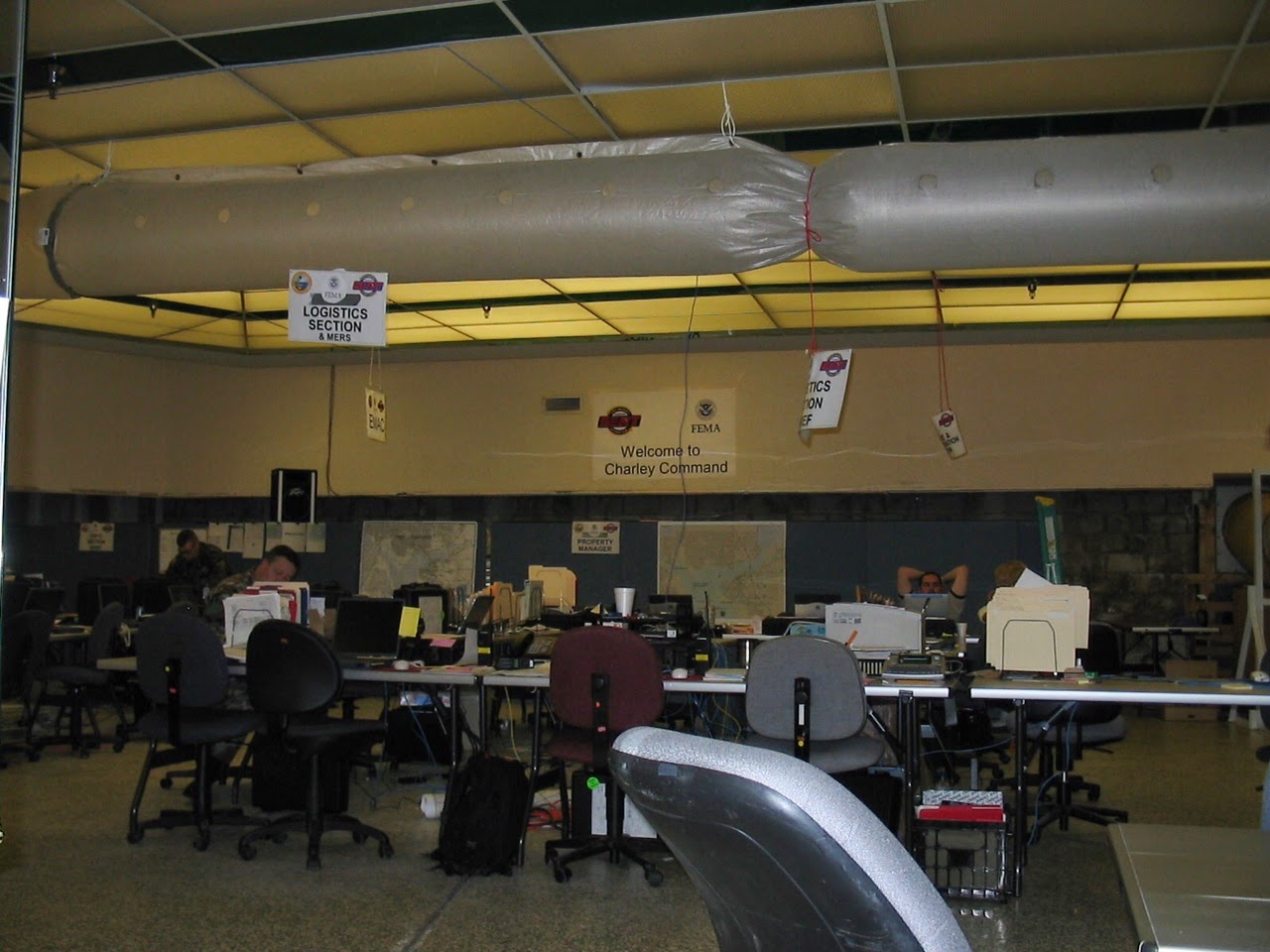 |
| Charley Command in Charlotte County, FL in August 2004 |
Where is it written down that if the storm or the flood or the earthquake is THIS BIG then you need this many meals/day day and this many shelter managers? You know what? It's not written down anywhere. So, after frantic scrambling to round up resources during the Charley response, and Hurricane Francis bearing on us for another impact, I needed some answers.
I turned to the greatest repository of mass care knowledge in the nation, the American Red Cross. Their liaison to the State EOC was Eric Jones, who I had just met (and is now my good friend).
"How do we know if we've got enough stuff for Francis?" I asked Eric.
Eric gave me his best Red Cross answer that they had lots of smart guys in the field with algorithms and computers in their head but I wanted more detail than that.
"What do you mean?" I asked Eric. "Haven't you guys got this down to a science, yet?"
No, they hadn't. Mass Care response was more art than science.
Thirteen months later I'm standing in Hancock County, Mississippi, 3 days after the eye of Katrina passed over, and with the responsibility of coordinating the Human Services response for the 6 southern counties of the State. The situation was not good.
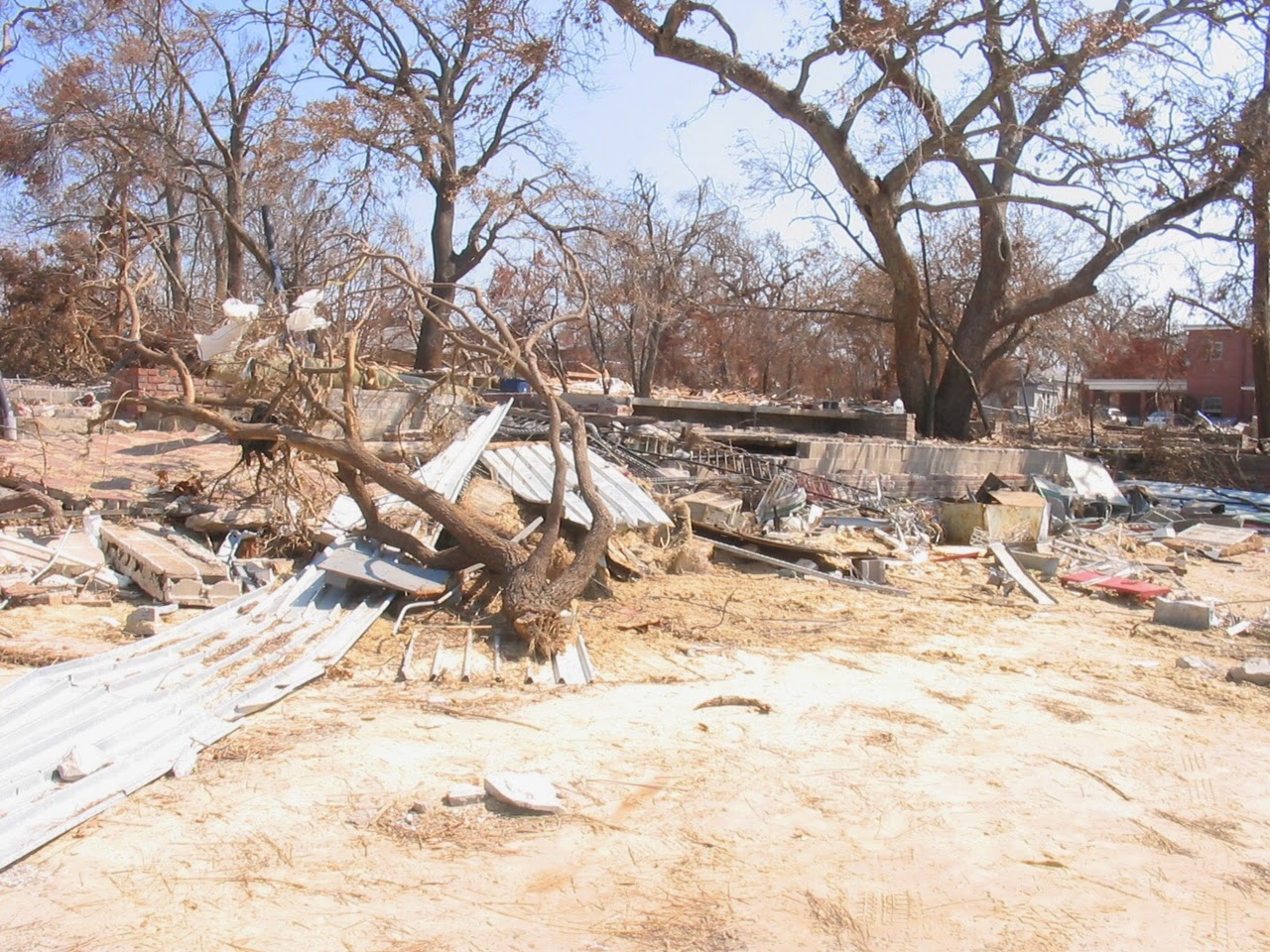 |
| What Bay St Louis, MS looked like when I arrived in Hancock County, MS in September 2005 |
I walked into a school gymnasium and noted the storm surge marks hallway up the basketball backboards. Boats and cars and houses were blocking the roads. Storm surge muck, a mixture of seaweed, chemicals, sewage, rotting vegetable and animal matter, covered everything from the coast up to the Interstate. People with babies were sleeping on the ground in this stuff because they thought that they had to be at their destroyed homes when FEMA came or they wouldn't get reimbursed. Others created ad hoc shelters in intact buildings because they had no where else to go.
I had not received any training on what to do in this kind of situation. I was smart enough to know that I couldn't fix everything but I had to fix something. Fortunately I guessed right and decided to start by resourcing the shelters. The weather was nice, with blue skies and the first hint of fall in the air, but I was concerned that the first heavy rain would mix with the storm surge muck and drive those in the open into the under-resourced and over crowded shelters. We needed cots to get these people up off the ground.
I was part of the Florida Area Command, an organization of Floridians from municipal, county, and state agencies plus the Florida Guard. Over 6,000 Floridians responded to Mississippi after Katrina. The State EOC in Tallahassee was fully activated and responding to our requests for resources for the people of Mississippi.
When I got there this organization was building but was still in its infancy. The Florida Area Command would end up housed in a building with all the responders sleeping in a tent city erected at the Stennis Space Center there in Hancock County. But when I arrived everything was being coordinated from the SERT Mobile Command Vehicle and I was sleeping on the ground by my car.
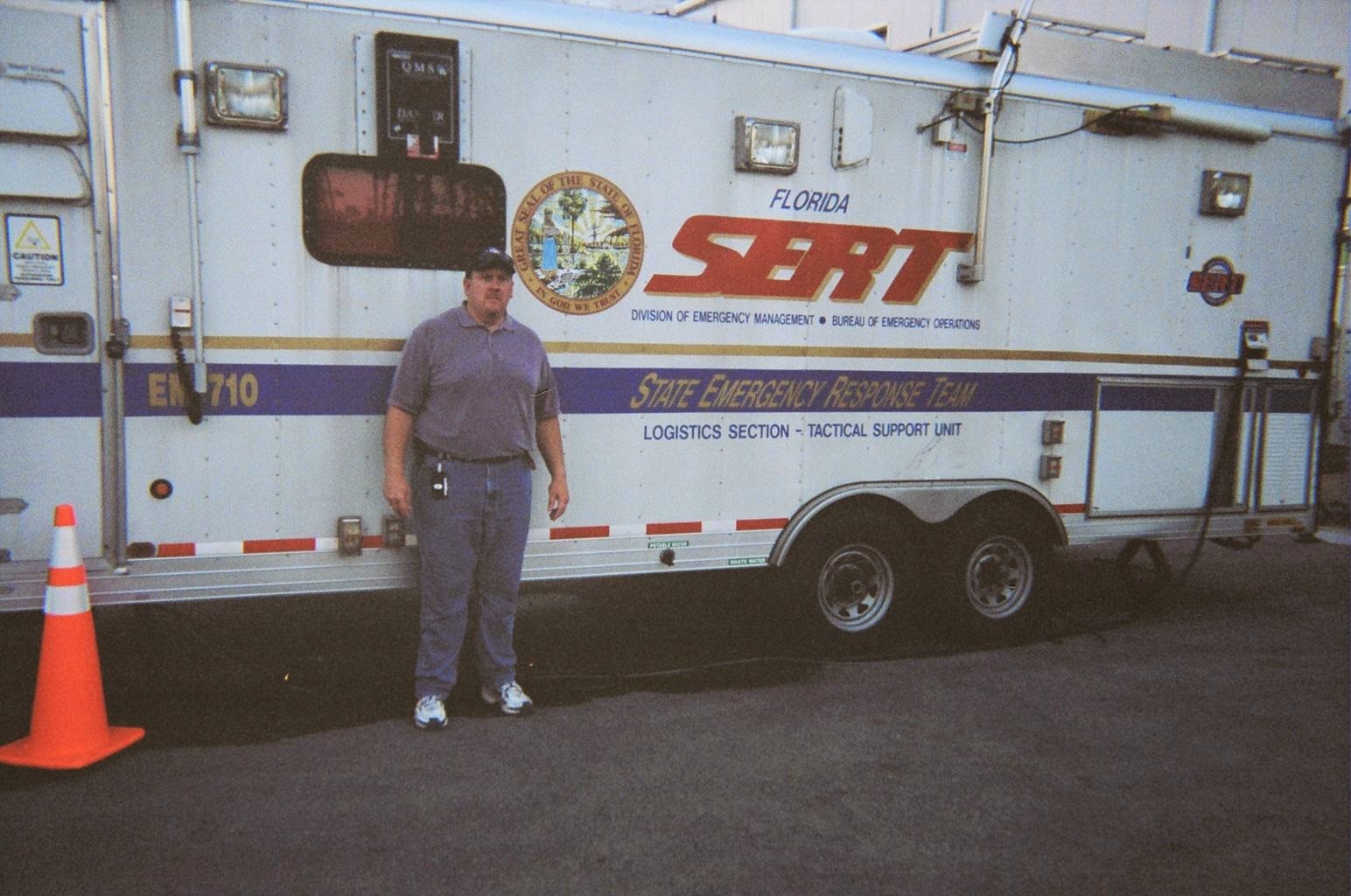 |
| My friend Matt Howard in front of the Mobile Command Vehicle in Hancock County, MS in September 2005 |
The meeting room in the Command Vehicle had room for 4 people but 8 of us crammed in there for a conference call with the State EOC that first night. I was sitting on the floor, wedged between the table and the passenger seat at the front of the vehicle.
Chuck Hagan, the State Logistics Chief at the EOC in Tallahassee asked me what I needed.
"Cots," I yelled at the conference call phone on the table above my head.
"How many?" he asked.
I had no idea. "Ten thousand," I yelled, giving him the first number that came into my head.
"OK," Chuck replied, and he dutifully filled out an Action Request Form to FEMA for 10,000 cots. Truckloads of cots began arriving at our warehouse a few days later.
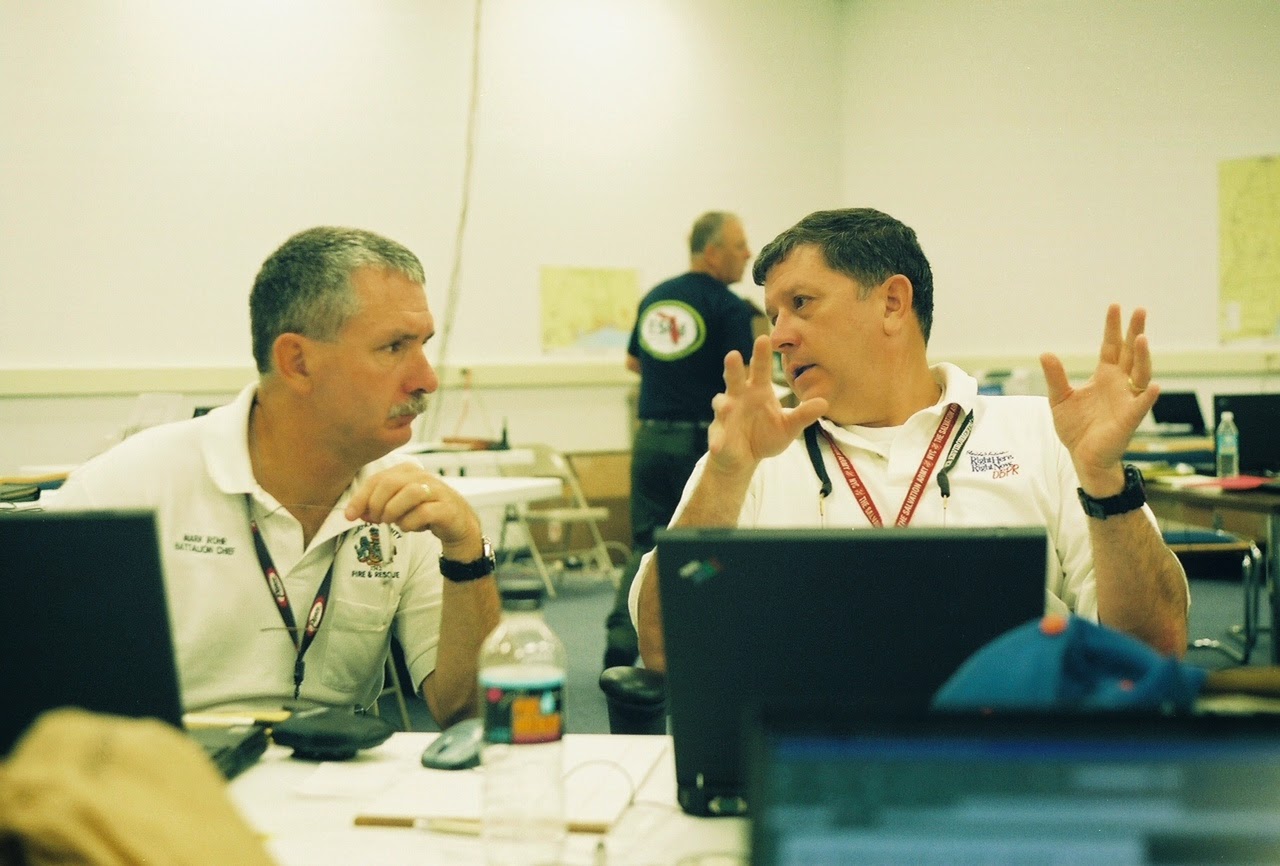 |
| Briefing my replacement, Mark Rohr, a Virginia Fire Chief, at the Florida Area Command in Hancock County, MS in September 2005 |
This isn't the only example of how, in my ignorance, I was forced to forecast mass care resources by making up a number. And I am sure that there are a number of other people out there who were forced to do the same thing. There has to be a better way.
After 10 years of noodling on this problem I think that we've come up with something. We put together a presentation that demonstrates a mass care resource forecasting process. The process will work in any jurisdiction. In this early stage we can forecast for feeding, sheltering and distribution of emergency supplies for a hurricane, flood or earthquake.
Wow. That's pretty cool stuff. We got some smart guys with algorithms and computers in their heads going over the presentation now. Once we get it ready we're going to send it out to the mass care community to solicit comments/suggestions and socialize the idea. Then we 're going to build a spreadsheet to automate the process.
I'll keep you posted on how we're doing. Maybe we can help those people we don't even know their first, biggest and last disaster is lying in wait for them in the future.


