Showing posts with label NIMS. Show all posts

Sunday, September 27, 2015

Shelter types


There has been a considerable effort within the national mass care community during the last five years to classify shelters.  In 2009 FEMA, at the suggestion of the mass care community, assembled a working group from within the mass care community to undertake to type mass care resources. The group was called the National Incident Management System (NIMS) Mass Care Working Group. I wrote about a lot of this in a post last November.

The Working Group consisted of representatives from the VOADs, the private sector, state and local governments. FEMA personnel from the National Integration Center (NIC) monitored the activities of the Workgroup but did not serve as a part. A contractor, paid for by FEMA,  provided administrative support. As the State Mass Care Coordinator for Florida I was asked to Chair this Working Group and I accepted. 

Among the VOAD representatives were Lynn Crabb, the Mass Care Lead for the American Red Cross National Headquarters and Richard Hinrichs from the San Diego Chapter. Richard became the Chair for the Shelter Subcommittee of the Workgroup. The Shelter Subcommittee members included Randy Linthicum from California, Lynn Crabb and Doug Sandy from ARC, Tonya Roberts from Arkansas, Kevin Rawson from the US Navy and Harold Hansen from the International Association of Venue Managers. 

The product of their efforts was the document entitled The Shelter Guidance Aid and Staffing Matrix. This product was and has been the only shelter document of its kind and now resides as a resource on the National Mass Care Strategy Website. The shelter classification outlined in this document was the basis for the Shelter Manager Job Title that was drafted by the Subcommittee and ultimately adopted by FEMA in June 2014.

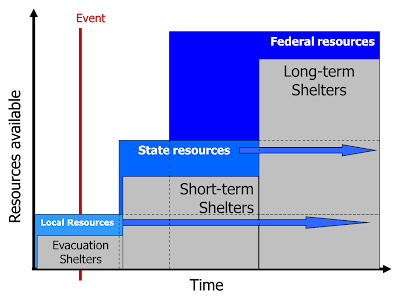
The Shelters were classified in the document according to the kind of facility, with the criteria based on the expected length-of-stay of the occupants. The classifications by length-of-stay were: Evacuation (up to 72 hours), Standard/Short-term  (up to 2 weeks) and Long-term/Mega-Shelter (longer than 2 weeks). A characteristic of each of these kinds of shelters was that the amount of resources available increased as the length-of-stay increased. A Table outlining this classification can be found on pages 2 and 3 of the Shelter Guidance Aid. The graph below is a pictorial representation of the concept.

The efforts of the NIMS Mass Care Working Group were terminated in June 2012. After some bureaucratic delays the NIC returned to typing mass care resources in 2014.  As a part of this effort Chris Darlington with the NIC assembled another working group to advise FEMA on typing shelters. Uma Hiremagalur of the Red Cross and I, among others, were asked to serve on this group. We were invited to a meeting at FEMA HQS in Washington, D.C. in September 2014. Uma represented the Red Cross at this meeting.

There were very heated discussions during this day-long meeting. The conclusion and general agreement among the participants by the end of the day was that shelters should be classified by kind and type. There would be 3 kinds of shelters using the length-of-stay criteria outlined in the Shelter Guidance Aid. In addition, each kind of shelter would be classified according to type (capability).  Thus, each kind of shelter could be a Type 1 through a Type 4, based on the expected population.

Of course, none is this is etched into stone yet. As the national conversations proceed I wanted to give everyone some background information on where we've been before so that we can move forward with a common understanding.


Saturday, February 18, 2012

The Shelter Guidance Aid and Shelter Staffing Matrix

When I deployed to the New Jersey State EOC for Hurricane Irene a state logistician asked me for assistance with a sheltering problem. The wind and storm surge had done little damage to southern New Jersey but the deluge of tropical moisture caused record flooding to northern New Jersey (as well as much of the rest of the Northeast). A county in the north requested from the state showers for their shelter occupants and the logistician had a good question: "How many showers should I give them?"

I knew just where to find the answer. I went online and consulted The Shelter Guidance Aid and Shelter Staffing Matrix. On the chart on page 3 I saw that for a standard or short term shelter (up to 2 weeks duration) the ratio was one shower head for every 48 survivors. He didn't ask but I also could have told him using the same chart that he would need one toilet and hand wash sink for every 20 persons. If someone wanted to know how many Mental Health Counselors the shelter needed, I could refer them to page 5 of the Shelter Staffing Matrix where it says that for a Standard or Short Term Shelter the ratio is 1:250 survivors in the shelter.

As you can see the Shelter Guidance Aid is a useful document, not only for mass care planning, but for response as well. The document came about as a result of the efforts of many mass care subject matter experts on the National Incident Management System (NIMS) Mass Care Working Group (MCWG). The Group has been in existence, and I have been the Chairman, since November 2008. The Group is made up of national experts on mass care, primarily from the voluntary agencies, but there are a few state and federal workers like me on the Group. FEMA created and funds the activities of the Group through a contractor and our mandate is to "type" mass care resources.

Resource typing is categorizing, by capability, the resources requested, deployed, and used in incidents." In 2010 the Shelter Subcommittee of our Working Group was working to type Shelter Teams. The Teams varied by capability, indicated by a number, with the lower the number the greater the capability. Thus a Type 1 Shelter Team has greater capability than a Type 2 Shelter Team. The Type of Shelter Team selected for use or deployment depended on the "kind" of shelter that needed to be staffed. The difference in the kinds of shelters was in the level of services provided to the occupants, and the level of services depended on the expected time that the shelter was expected to be open. 

This was too much information to stuff into a typing document for a Shelter Team so we created the Shelter Guidance Aid and Shelter Staffing Matrix. The Table that starts on page 2 of the document and continues onto page 3 defines the different kinds of shelters and explains the different levels of services. The emergency management community needs to learn these definitions because the resource requirements for an evacuation shelter are considerably different that the resource requirements for a long term shelter. And so, if you are asked to set up a shelter, the correct response is "What kind?" 

I would love to show you all the wonderful mass care products that our Working Group has created over the last two plus years: Field Kitchens, Mobile Kitchens, Shelter Teams, Shelter Managers, and (my favorite) State Mass Care Coordinator. But I can't. We all had to promise not to share what we had done until FEMA had reviewed the documents and released them.

Our Working Group's Resource Typing documents and Job Titles are now enduring what the Femites lovingly call the process of "concurrence." Which means everyone in the organization who might have an opinion on the contents of these documents will have their say. Hopefully, they will defer to the collective knowledge of the subject matter experts. When everyone has "concurred" the documents will be released in the Federal Register for public comment. Which means that those of us who have worked on them for so long will finally be able to show the world what we have done.

When that day finally comes (sometime in the next week to next year, according to reliable sources) I will shout it from the rooftops. I believe that they are excellent products that, like the Shelter Guidance Aid & Staffing Matrix. will assist the emergency management community and increase mass care capability nationwide.