Showing posts with label National Mass Care Exercise. Show all posts

Sunday, June 14, 2015

Who pays for mass care?

A good friend has a saying: "Whenever anyone says that it's not about the money, you better believe that it's all about the money."

At the Hot Wash discussion at the end of last week's 2015 National Mass Care Exercise in Austin, TX we started a discussion about how mass care responses in large or catastrophic events are paid for. Actually, I made some statements about the topic and this generated a discussion.

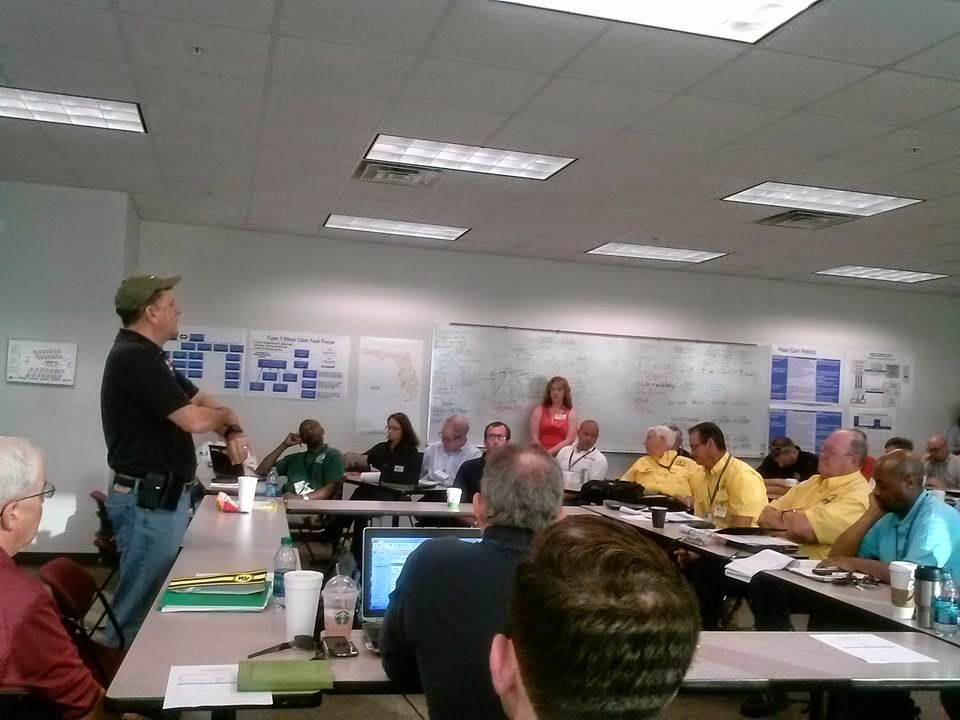
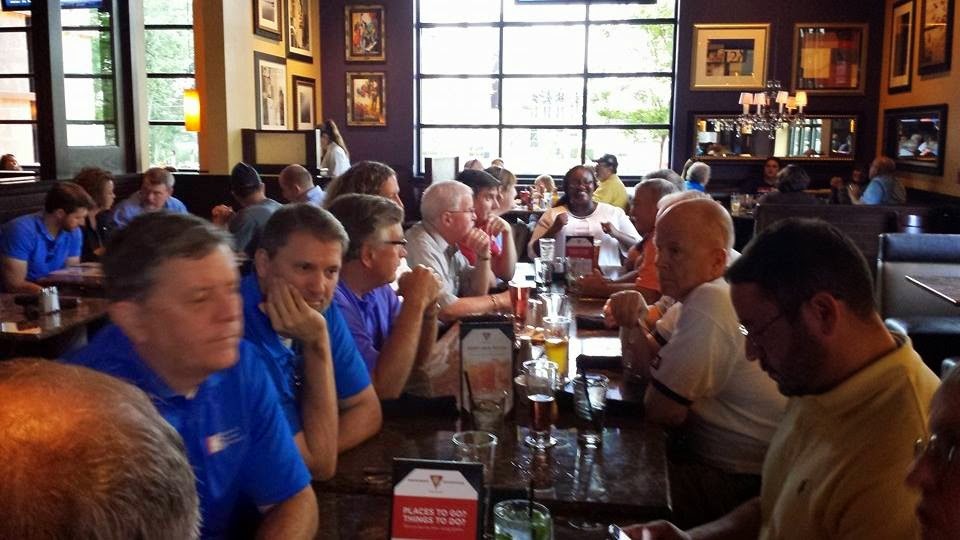
Chad Ostlund from Minnesota Emergency Management briefs Texas senior leadership during the National Mass Care Exercise in Austin, TC, June 2015.
I'm going to lay out what I said but first the general reader (i.e. one who isn't a mass care or emergency management professional) will need some explanation to provide context for the discussion. By mass care we mean the provision during disaster of food, shelter, emergency supplies and family reunification. By disaster we mean the range of natural and man made incidents from a house fire to a Category 5 hurricane.

Most of the time mass care resources are provided by the Voluntary Agencies Active in Disaster (VOAD) using funds that have been donated to them for that purpose. During blue skies the VOADs receive donations that they use to pay for salaries, training and exercises so that during gray skies they will have the capability to respond. When disasters happen the appeals go out to the public for donations to pay for the additional costs of the response. Big responses, with lots of exciting video footage of destroyed buildings and dazed survivors, generate a much broader and deeper response from the public than a smaller incident that may only make the  newspaper in their community. The result is that the VOADs often pay the mass care response costs for the smaller or less publicized disasters with blue sky money.

The old emergency management joke defines a disaster as when a tree falls on your neighbor's house and a catastrophe is when a tree falls on your house. Regardless of whether the disaster is federally declared or not, or whether the storm made good video for the Weather Channel, when the tree falls on your home and you're poor and uninsured you've got troubles. And if your county ended up on the list as declared for federal Individual Assistance, the maximum amount that FEMA can give you is $31,000. The average handed out by FEMA is only about $5,000. The VOADs are left with the task of matching the donated dollars they've received with the unmet needs of the survivors.

The gray sky money donated by the public, whether through the "Text $10" appeals or by other means, must pay for response costs as well as the unmet needs of individual families that are uncovered  through case management during recovery. One VOAD indicated that two thirds of the gray sky money that they receive arrives within 5 days of the event. The pot of money that each VOAD can devote to a disaster is therefore fixed and finite, and most of the donated dollars arrive early in the disaster.

Some state and local government aren't inclined to help out during the mass care response. In one of the many storms of my past a member of the Governor's staff, who shall remain nameless, asked me, "Why are we giving truckloads of bottled water to the Red Cross?"

"Because they're handing out the water to our citizens," I replied.

"They should buy their own water with the money the federal government gives them," said the staffer.

"The federal government isn't giving the Red Cross money."

"Oh, yes, they are."

"But really, they're not."

"Oh really, they are," said the staffer in a tone that was meant to conclude the conversation.

Fortunately, someone other than me was able to educate the staffer and the Red Cross got their truck of water.

In another state and another disaster I had an emergency manager question my request to send a truckload of water to the Salvation Army. "Why should we send them a truck of water?" he asked.

"Because they're handing out the water to your citizens," I replied.

The EM frowned. "That community already has ways to get their own water."

I nodded my head and walked away. Fortunately, someone other than me was able to educate the EM and the Salvation Army got their truck of water.

This sets the context for the statements that I made at the conclusion of the National Mass Care Exercise. My contention (and I am not alone in this belief) is that during a federally declared disaster the state government, to the extent responsible, should support the activities of the mass care VOAD agencies through the purchase of logistics and supplies. Examples of logistics that can be provided are forklifts, pallet jacks, portalets, dumpsters, bulk water, propane and diesel. Examples of supplies are bottled water, ice, shelf stable meals. baby supplies, shelter supplies and food for preparation at the field kitchens.

In a large disaster the costs for these items would be millions if not tens of millions of dollars. Whether the state purchases the resources or asks FEMA to do so 75% of the costs are a federal responsibility. And for every dollar of response costs absorbed by government there is another dollar available to the VOADs weeks later to help meet the unmet needs of the survivors.

"So why should the states help out the VOADs during the response?" you ask.

So that they can use the money they save to help the survivors when the government is not in a position to do anything more. And that's a good strategy for any government to follow.

Wednesday, June 25, 2014

How many meals do we need?

The first, critical task of an emergency manager at the beginning of an event is to determine the scale of the disaster. The scale of the disaster determines the resource requirements, which leads to an inventory of resources on hand and identification of what is short. A big first question in mass care is: How many meals do we need?

This is a basic, even fundamental, question for mass care practitioners at the beginning of a disaster. Yet, at the 2014 National Mass Care Exercise we spent an inordinate amount of time and energy on the first day of the exercise trying to answer that question. A lot of the practitioners at the Exercise had gained their knowledge and experience operating at the local level in the impact area. Most of my experience was gained at the State Emergency Operations Center (EOC). This variance in our backgrounds influenced how we viewed both the question and the answer.

The Mass Care Chief at a small disaster addresses the question of how many meals are needed by looking first at how many people are in the shelters. Job #1 in mass care is to resource the shelters. If 50 people are in the shelters then they need 2 meals/day and that's 100 meals. Next step is to address disaster feeding in the community through mobile feeding (Yes, I understand it's more complicated than this but bear with me). A Food Service Delivery Vehicle (check the link for the definition) normally carries 300 meals/trip. Based on our initial estimate of the scale of the disaster we need 300 + 100 meals or 400 meals/day. If the mobile feeding vehicle comes back empty then we send them out the next day on 2 trips and up our requirement to 700 meals/day.

At the State EOC I'm looking at this question in an entirely different way. Ten years ago this summer I worked 4 hurricanes in a 6 week period. I would've been pretty damn stupid if I didn't start figuring out what I was supposed to do after the 3rd or 4th hurricane. I learned pretty quick that my reaction time to a request that I hadn't planned for was at least 48 hours, and was more often 4 or 5 days. If you asked me for something and I had it on hand I could get it to you today or tomorrow.

If I didn't have it in hand I had to go get it and then physics got in the way. First, I had to convince someone else in the EOC that what you needed was both necessary and a priority. Next, if it had to come from FEMA, we had to wait breathless and unknowing while our request circumnavigated the federal approval process. Then, someone not under my control had to buy whatever it was you needed, arrange to load it on a truck somewhere in the United States and then drive it to wherever I had designated as the delivery location.

As you can see, 4 or 5 days sounds about right.

But if you're in the middle of a BIG disaster (and believe me, if you're involved in the disaster and the one making the request, it's BIG) and you ask the State for something you want it delivered yesterday, not in 4 or 5 days. That means that if I want to do a good job then I have to figure out what you need, order it, and have it on hand ready to deliver to you by the time you get around to figuring out that you need it. And you'll still complain that I didn't get it to you yesterday.

As a result of this experience I learned to look at the question of how many meals needed in a different manner. I don't know and don't care how many people we need to feed. I need to know how many meals/day of production and distribution resources are required to meet the estimated scale and scope of the disaster.

Furthermore, we need to estimate this meals/day requirement 24 hours before landfall on a Noticed Event, or within 12 hours on a No-Notice Event. Why so early? Because if we don't have enough we need to give FEMA the 4 or 5 days to get and deliver whatever it us we're short of.

So - how do we estimate the meal requirement before the hurricane has even made landfall? All mass care resource requirements are a function of the size of the population affected, the intensity of the event and the geography of the affected area. When estimating the requirements for a hurricane, for example, we use the Hurricane Center forecast to determine the geography of the affected area and the intensity of the event. The population affected can then be determined using census data.

But everyone affected by the disaster has not been impacted by the same intensity. Some people were hit by Category 4 winds while others by Category 1. Their disaster meal requirements would be different so we need to estimate how many people are affected by different intensity levels. So how do we do that? We looked at different factors associated with Low, Medium and High Intensity and put them in Table 1 below.


Table. 1. Estimating Disaster Intensity for use in
forecasting mass care resources
Intensity Level
Factors
High
  • Structural damage to buildings characteristic of a Category 4/5 hurricane or Mercali Intensity levels of X/XI/XII.
  • Up to 80% or more of customers without power
  • Up to 50% or more of  Potable Community Public Water Systems inoperable
  • Wastewater collection system is NOT providing wastewater treatment in accordance with permit conditions and regulations.
Medium
  • Structural damage to buildings characteristic of a Category 3 hurricane or Mercali Intensity levels of VIII/IX.
  • Up to 50% or more of customers without power
  • Up to 30% or more of  Potable Community Public Water Systems inoperable
  • Wastewater collection system is properly conveying and providing wastewater treatment, but at a compromised capacity.
Low
  • Structural damage to buildings characteristic of a Category 1/2 hurricane or Mercali Intensity levels of VI/VII.
  • Up to 20% or more of customers without power
  • More than 10% or more of  Potable Community Public Water Systems inoperable
  • Wastewater collection system is properly conveying and providing wastewater treatment with limited disruptions.

Once we have determined the population affected by each intensity level using Table 1, we use Table 2 to calculate an estimate of the meals/day in production and distribution capability required.

Table 2. Estimating Disaster Meals/Day required
Intensity
Estimate procedure
Output
Low
Sum of population affected by Low Intensity event X 5%
X
Medium
Sum of population affected by Medium Intensity event X 15%
Y
High
Sum of population affected by High Intensity event X 25%
Z
Estimate of Meals/Day production & distribution capability required
X + Y + Z

These percentages are a crude approximation but they are based on meal counts we collected during the 2004-2005 hurricane season. Experienced mass care practitioners have some version of this algorithm in their head. The result of this estimate process is not the final answer but the starting point of the discussion on the daily state mass care conference call.

The state and the voluntary agencies reach a consensus on the meals/day disaster feeding requirement during the daily state mass care conference not later than 24 hours before a Notice Event or not later than 12 hours after a No-Notice Event. This consensus meal estimate becomes a very powerful tool. Once we agree upon what is required, then we can look at what is available to meet that requirement.

If the requirement is 100,000 meals/day and we have 5 Type II Field Kitchen Units available then we know that we have sufficient production capacity to meet the requirement. Furthermore, if we assume that a Food Service Delivery Vehicle can distribute, on average, 1,000 meals a day then we know that we will need at least 100 vehicles for this event.

As you can see the number of people in shelters and the number of meals that we are feeding each affected person in the community plays no part in my calculations at the state, or macro level. At the micro level, where the Mass Care Chief is preparing a Feeding Plan, those numbers come into play.

Job #1 for the State Mass Care Coordinator is to determine if the voluntary agencies have sufficient resources on hand to meet the consensus meals/day estimate. If the answer is no, then Job #2 is to figure out what is short and go get it. And you better hurry.

Saturday, May 24, 2014

Lessons from the 2014 National Mass Care Exercise

We will write a After Action Report (which we hope to have out to the public by July 4) but I had a number of first impressions:

1) We did better than last year, which was better than the year before. This shows that we are trainable and there's hope.

Michael Whitehead, State Mass Care Coordinator for Florida, briefing the 2014 National Mass Care Exercise participants on the morning of the 3rd day.
2) I had a personal goal of not getting overwhelmed during the Exercise and I succeeded. In last year's exercise, as well as the year before, I was called upon to be everywhere at once and solving multiple, complex crisis of misunderstanding within the Mass Care Task Forces. I failed in my ability to simultaneously act as a Player, Controller, Evaluator and Coach. This year a number of people besides myself who understood the Big Picture and were able to step in and resolve these crisis without my direct assistance.

One of many visual displays on the walls of the Shelter Task Force during the 2014 National Mass Care Exercise.
3) We validated the State Mass Care Coordination process (see diagram below). Not everyone even  understands the diagram, much less the process, but that's an education issue. The process works and can work in any state that needs to expand their mass care coordination capability in a large disaster. Doctrine is defined as accepted knowledge that can be taught to others. We now have that accepted knowledge and can go teach others.

4) The organization that we developed in order to coordinate 4 Mass Care Task Forces at once (see chart below) was not effective. I wrote about this organization in my March 2014 blog post. Everything worked except the part about using a Task Force Coordinator to coordinate with the four Task Forces. Larry Shine, the Texas State Mass Care Coordinator, and I tried to figure out how to coordinate the activities of the 4 Task Forces and we got some things right and, for multiple reasons, we got some things wrong.

Getting things wrong in this Exercise is not a crime. We deliberately tried to stretch the horizon of what we knew so that we could learn what did and didn't work. We found out that this organization didn't work but discovered what we think is the solution. What's the solution? See #5 below.

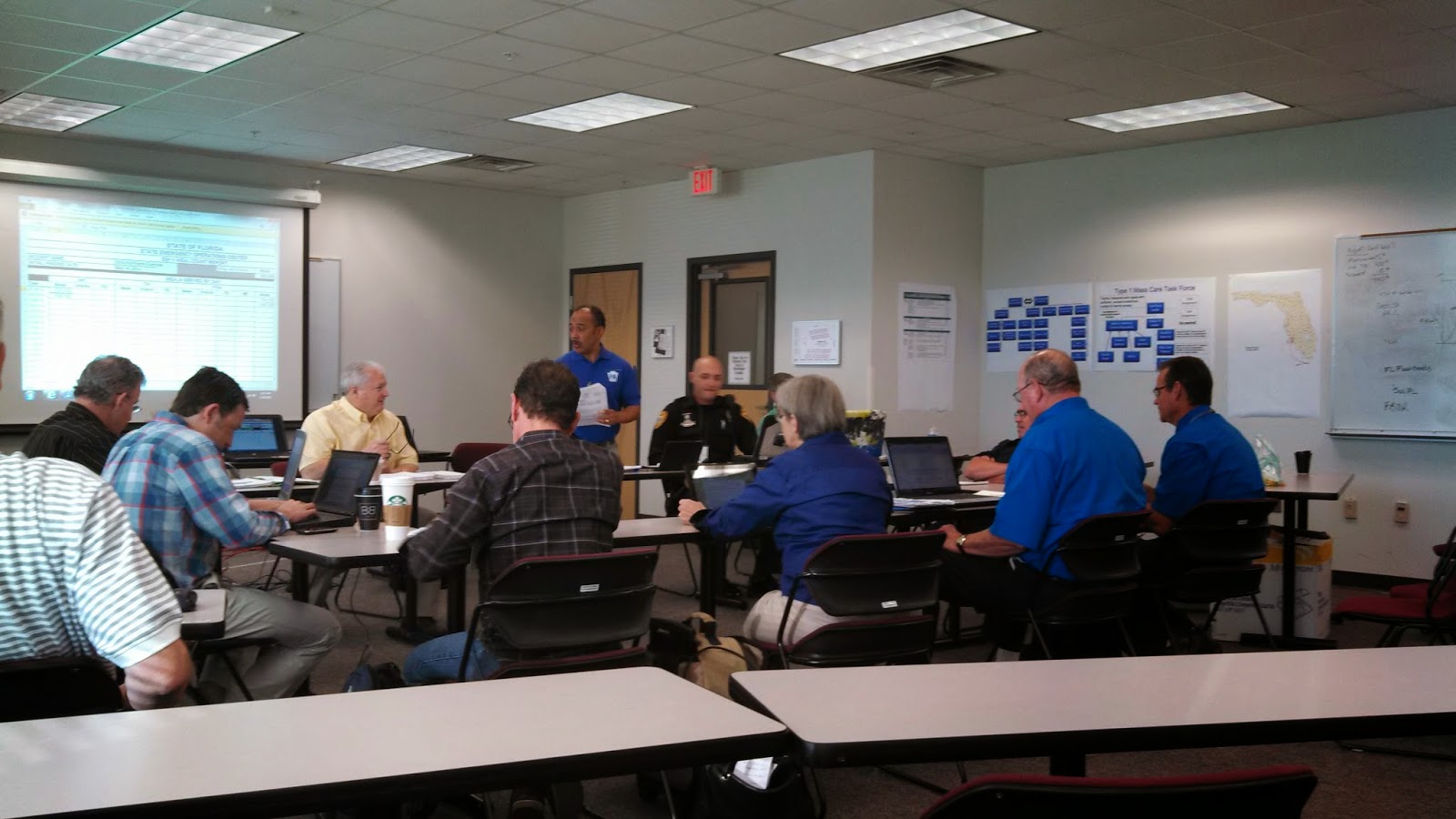
The Feeding Task Force conducting business during the 2014 National Mass Care Exercise
5) We need more trained Mass Care Planners and more people trained in mass care planning. These are different requirements. The new FEMA Mass Care/Emergency Assistance Planning & Operations Course (which we delivered at the Governor's Hurricane Conference last week) will take care of training more people in mass care planning. We will deliver this course at the National Hurricane Conference in Austin, TX next year, as well as at the Florida Governor's Conference.

Identifying and training Mass Care Planners is another matter. I first identified this problem in my October 2013 blog post. The issue is that in smaller disasters (where we are assisting thousands or tens of thousands of survivors) a failure to adequately plan can be overcome by pouring more resources on the problem. In disasters involving hundreds of thousands or even millions of survivors this isn't possible. The physics of time and distance interfere with our lack of planning.

We need people with the skills to project how many #10 cans of green beans, wheel chairs, and clean up kits we will need in 5 days for a population of 5 million impacted  by a Category 3 hurricane or a Modified Mercali Intensity of X. We can't train people to perform this function until we agree upon a doctrine.  At the 2014 NMCE we advanced the cause in this area and are close to a crude spreadsheet to give us these answers (and by crude I mean better than making up the answers).

The mass care discussions continued on into the evening at the 2014 National Mass Care Exercise
I had a great time at the Exercise and the feedback from the 100+ participants was that they learned a lot. We increased Mass Care Services capability in the nation as a result of this Exercise. Next year in June 2015 Texas will host the Mass Care Exercise in Austin. I can't wait.

Tuesday, March 25, 2014

How to manage 4 Mass Care Task Forces at once

A FEMA friend who works in mass care emailed me recently with her comments about the Mass Care Task Force White Paper. "This is all very interesting," she said, "but none of the states in my Region have the personnel to set up even one of these Task Forces."

I saw from her comment that she had failed to grasp a key tenet of the White Paper. No state has the organic capacity to set up one or even multiple mass care task forces in a large disaster: not even Florida. As the White Paper clearly states on page 3, "Additional staff must be requisitioned prior to a Noticed Event or immediately after a No-Notice Event." And people with the necessary skill sets are only available out-of-state.

Which is why one of the objectives of the National Mass Care Exercise that we are holding in Tallahassee May 19-22, 2014 is to practice bringing in mass care staff from other states and integrating them into our State mass care operation. This year we are bringing to the Exercise mass care practitioners from multiple states, Femites from multiple Regions, and mass care voluntary agency staff from across the nation. Our Goal is to practice and refine the State Mass Care/Emergency Assistance process that I have outlined in a prior blog.

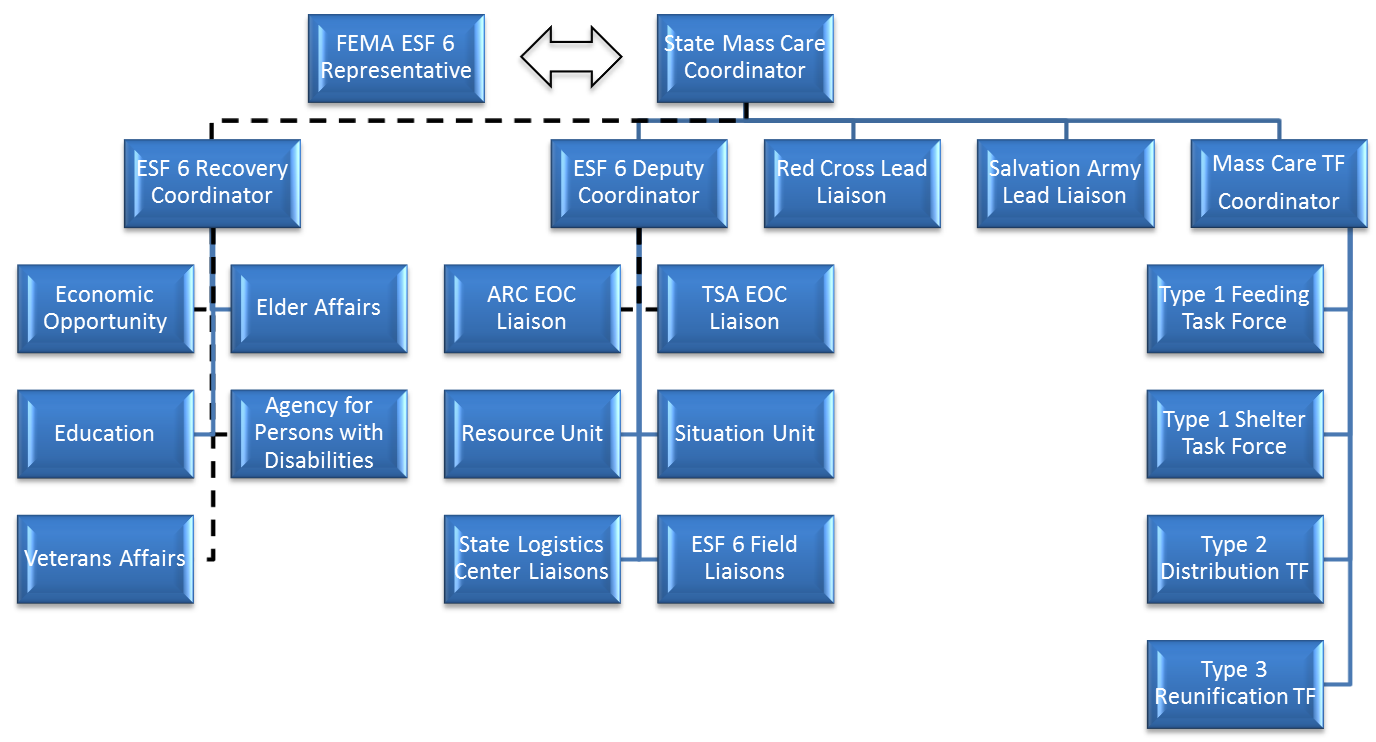
In fact, we have so many people coming we are going to establish 4 mass care task forces for the exercise: Sheltering, Feeding, Distribution of Emergency Supplies and Reunification. A big question for this exercise will be how the State Mass Care Coordinator (that would be me) will be able to coordinate the activities of the 4 Task Forces. As an experiment, we came up with the organization chart below.


This chart is NOT a hierarchy of command but a diagram showing the recommended flow of information (up & down). In modern parlance, the State Mass Care Coordinator only has so much bandwidth. The information flowing to/from the State Mass Care Coordinator must be controlled so that he/she doesn't become overwhelmed.

When we expanded to 4 task forces we created a Mass Care Task Force Coordinator position. Yes, we have that power. This new position will manage the flow of information between the SMCC and the 4 Task Force Leaders. We will have to see how it works.

As I said when I first showed this chart to the planning team: At the end of the exercise we will be able to say: "Well, at least we now know THAT way doesn't work."

Saturday, February 22, 2014

On Draining the Swamp

"When you're up to your ass in alligators, it's hard to remember that your original objective was to drain the swamp."


State of Florida EOC at the opening of the 2013 National Mass Care Exercise
I plan to make this quote the unofficial motto of the 2014 National Mass Care Exercise that will be held in Tallahassee May 18-22, 2014. I also may have to re-phrase it a bit in deference to whatever tender ears may be in attendance.

The central focus of the exercise will be testing the concepts laid out in the White Paper on Mass Care Task Forces that was published in December 2013. And the White Paper is all about developing a doctrine for the state mass care coordination process. I know, for some people the word "doctrine" is a dirty word, but they have to get over it. Doctrine is simply a commonly understood way of doing something that is taught to other people. And the mass care community (the states, the voluntary agencies, the feds, even the private sector) need to have a common understanding of the state mass care coordination process so that when we are all assembled in an affected state during a big disaster we can work together more effectively.

Regular readers of this blog will have noticed that I obsess on the big, even large and at times catastrophic disasters. I focus on these disasters because those are the ones with the complex problems, the biggest consequences and that are the least understood because they happen so infrequently. In Florida, disasters have to be big to elevate to the state level because our counties and voluntary agencies are capable. The state doesn't get involved in any serious manner unless they are overwhelmed.

When the disaster grows big the mass care staff at the state Emergency Operations Center (EOC) get overwhelmed trying to fight all the alligators. The State Mass Care Coordinator needs to expand the staff to meet the increased number and complexity of the coordination tasks that they must complete. Staff with the training and experience to step in and help us aren't hanging out in Tallahassee waiting for an opportunity: they must be identified and brought in at the time of the disaster. We must have a structure and processes constructed, in place and in writing for these new arrivals. This structure is the mass care task force. When they get there the people in the task forces work on draining the swamp.

We've been trying to figure out how mass care task forces are supposed to drain the swamp since 2009, when we set up a Feeding Task Force for the Hurricane Suiter exercise (Craig Fugate's last State Exercise before he became a Femite). In 2012 we set up 3 TF's: Feeding, Sheltering and Distribution. In 2013 we had 2 TF's: Feeding and Sheltering. In what turned out to be a trial and error process we had lots of trials and even more errors.


The Shelter Task Force in operation during the May 2013 National Mass Care Exercise in Tallahassee.
The crux of the issue was that this was a complex problem and nobody really knew how these task forces were supposed to work. Oh, we THOUGHT we knew. Last year I thought I was so smart and had this problem ALL figured out and then 2 hours into the exercise I told myself, "Well, this isn't going to work, either." And we had plenty of criticisms from the participants. Read the After Action Reports, here and here.

But we're getting better. And the best part is that all these mistakes we're learning from are happening in an exercise and not a disaster. The really best part is the Exercise this year will show that we've got it all figured out.

Maybe.

Sunday, October 20, 2013

Once upon a time ... a mass care story

Once upon a time, in the land of hurricanes, King Craig Fugate brought together all the emergency managers and all  the voluntary agencies and the private sector and even some Femites to devise a plan to save the kingdom from the evil Big One that they all knew would some day threaten their very existence. Just as all good stories have a villain, so must all good emergency plans have a scenario. The scenario offered up was called Hurricane Ono, a Category 5 hurricane that struck southeast Florida, rampaged across the peninsula to Tampa, renewed strength in the Gulf and hit the state again in the Panhandle. As an added prize, the scenario included a failure of the Herbert Hoover dike around Lake Okeechobee, with the total inundation of the adjacent communities.

The Evil Stepmother who first presented this scenario to the assembled State Emergency Response Team (SERT) in Tallahassee in 2007 was Carla Boyce, at that time the SERT's Plans Chief (and now an Important Person at FEMA Headquarters). Her presentation had a profound affect on me. In one way or the other most of my thoughts and actions in emergency management and mass care since that moment have been directed toward preparing for such an event.

We worked on the plan for two years. We brought in some smart people from the Red Cross, Salvation Army and the Southern Baptists with hard earned experience and I learned a lot of mass care from them. We spent a lot of time trying to answer some pretty basic questions. How many meals per day would we need to produce and distribute? Who would provide them? How many shelter teams would we need? Where would they come from?

I remember thinking that the mass care community has been doing this for a long time. Why haven't they come up with a standard process to make these kinds of calculations? I mean, we were coming up with astronomical meal and shelter requirements. How do we know these numbers are right? We didn't, and still don't. Plus, I had a nagging problem that wasn't solved in the plan. When you ask for the WORLD and the WORLD shows up, you're going to need a helluva lot of people to tell all those trucks where to go.

We tested our plan, using the Hurricane Ono scenario, during the May 2009 State Hurricane Suiter Exercise. This was the last State Exercise for King Craig. He had been nominated, but not yet confirmed, as the new Director of FEMA during the time of the exercise. For some reason we had massive, and unprecedented, participation from FEMA Region 4 during that exercise.

Hurricane Ike, which had struck Texas in September of 2008, had already had an influence on the plan and the 2009 exercise. The disaster feeding in Texas during Ike, according to multiple, conflicting reports, had been ugly. I had a number of long conversations with FEMA, state and voluntary agency participants with first hand knowledge of the events. The root cause of the problem was a lack of coordination.

I was determined to do whatever I could to make sure that such a problem did not happen in Florida. In January 2009 I emailed Lynn Crabb, at that time the lead for Mass Care at Red Cross Headquarters, that we needed to get the mass care voluntary agencies together with FEMA and the states (well, at LEAST Florida) and do a "Vulcan mind meld" to resolve this problem. Mickey Caison, the disaster lead for the Southern Baptists, had the same idea and was in a better position to do something about it.

At Mickey's behest, FEMA Headquarters Mass Care assembled a team of subject matter experts from multiple stakeholders on a series of conference calls with the objective of creating a Multi-Agency Feeding Plan Template. I was fortunate to be a part of these conference calls, which ultimately grew to over 40 participants. This document was the first big step toward creating some kind of state mass care doctrine.

Before the Feeding Plan Template was even finished I drafted a State of Florida Multi-Agency Feeding Plan and sent it out to all of our stakeholders for comments. What was significant about this plan was that we included the private sector food suppliers (Sysco & US Foods) in the planning process. As a result, and as was my intention, Florida published the first Multi-Agency Feeding Plan in the nation.

I rushed to get the plan completed because I wanted to test the plan during the 2009 Hurricane Suiter Exercise. There was just one problem. Both the Feeding Plan Template and the State Feeding Plan called for the creation, under specified circumstances, of a Multi-Agency Feeding Task Force (FTF). What was a FTF supposed to do? The Plan wasn't real clear about that. Some kind of multi-agency coordination involving feeding. We think.

So I decided that we were going to establish a FTF during the 2009 Hurricane Suiter Exercise. I was able to round up a bunch of smart guys who knew a lot about their little piece of disaster feeding and I put them all in a room on the third floor of the building next door to the EOC during the exercise. I got Rick Hinrichs from the San Diego Chapter of the Red Cross, and Fritz Wilson from the Florida Baptists, and Kevin Smith from the Florida Division of the Salvation Army, among others. The hardest part was to get Sysco and US Foods to agree to be in the same room together. They eyed each other during the exercise until they realized that we could generate more business than either one could handle.

We all learned a lot about how we should and shouldn't coordinate mass care at a state EOC during the 2009 Hurricane Suiter Exercise. I learned that no matter how smart I thought I was, that no matter how much knowledge and experience that I had coordinating mass care at the state level, and no matter how hard I was prepared to work at getting my job done right, I couldn't be in three different critical EOC meetings at the same time. And we learned that a feeding task force was a good idea but wouldn't be effective unless it had an operational procedure that defined internal TF roles, tasks and processes.

I had participated in a dozen state hurricane exercises and I had learned more in the 2009 exercise than I had in all the other exercises put together. I was eager to do it again in 2010. But the Deepwater Horizon disaster blew the 2010 exercise out of the water and the EOC Continuity of Operations exercise scheduled for 2010 was rescheduled for 2011. In the Fall of 2011 I started thinking about what kind of mass care exercise we needed to have in 2012.

Another big thing that I learned from the 2009 exercise was that when the Big One hit Florida we would need a lot of help in the EOC. And we couldn't fill the gap by grabbing state workers off the street and thrusting them in the EOC in half-day increments like we did in 2004-2005. We needed people who knew mass care and were able to step into an EOC and be effective with some preliminary training.

Where could we get these kind of people? The voluntary agencies, like the Red Cross, didn't train their people to perform these roles. Neither did the Salvation Army. There were few, if any, State Mass Care Coordinators out there. And those that had the experience were on the hurricane prone coastal states and not likely candidates to be released to come help me during hurricane season.

The big disaster event in 2011 was Tropical Storm Irene. I benefited from an EMAC deployment to New Jersey during Irene. When I returned to work I developed a Power Point presentation saying that Florida was going to hold a National Mass Care Exercise in Tallahassee in conjunction with the State Hurricane Exercise in May 2012. I emailed this presentation to everyone I knew in the national mass care community and said that anyone willing to pay their way to Tallahassee was welcome to play in my sandbox.

But who I really wanted to come to the Exercise were my state counterparts and I knew that they wouldn't be lining up to come because they had no money. I contacted Waddy Gonzalez, the head of FEMA Mass Care, and explained how I was doing him a BIG FAVOR by putting on this National Mass Care Exercise, and was helping him do his job of increasing mass care capability in the states. All he had to do was find the money to pay for some state people to come to the exercise. Waddy, to his great credit, came up with the money for 5 state people to attend.

Thus we were able to get the participation of Wendy Stewart from Georgia, Daniel Porth from Arizona, Dennis Dura from New Jersey, Dante Glinecki from Missouri and Ed Lyons from Arkansas. Ultimately we were able to get 64 participants from 26 federal, state, nongovernmental, private sector and academic agencies. Arguably, this was the largest mass care exercise ever conducted in the nation.

I had no budget and no staff available to make this happen. Fortunately, I had lots of friends in the mass care community who saw the inherent benefits to the nation of the exercise and agreed to help. Jono Anzalone with FEMA Region VII (now with the Red Cross) volunteered to be the Lead Controller for the Exercise and offered Cory Fast and Kam Kennedy from his staff to help with the project. Ryan Logan, the Mass Care Lead for FEMA Region IV (also now with the Red Cross) pitched in to help with the planning for the exercise. More people, too many to name here (I'll forget somebody and be in trouble) were instrumental in the success of the exercise.

As more and more people started saying that they were coming I started to get worried. How was I going to productively utilize all these people? And a bigger problem, where was I going to put them all? They wouldn't fit in the EOC.

Based on feedback from the 2009 exercise we updated the State Feeding Plan and drafted a Feeding Task Force (FTF) Standard Operating Guide (SOG). One of our objectives for the 2012 exercise was to test the new plan and to establish a Feeding TF to test the new SOG. So why not set up a Sheltering TF? And as the number of participants grew higher we added on a Distribution of Relief Supplies TF. And I had to scramble with the Florida Division of Emergency Management Exercise people to find rooms for these TFs within easy walking distance of the State EOC. In the end, this was good preparation for us because we would need to do the same thing if the Big One were ever to happen.

The 2012 Hurricane Gispert Exercise was a success, but not because we did everything perfectly. We allocated a lot of resources to capturing the lessons we were learning and we had a long list of things that we screwed up. Some of the horde of people who arrived were put to work as Evaluators and Kam Kennedy was assigned to be in charge of Documentation. To that end, we had Hot Wash meetings at the end of each day and Kam made everyone do daily written critiques. All of the information that she collected was put into the After Action Report (AAR).

A significant source of the problems we encountered in the exercise was that what we were trying to do was hard and few participants had the training or the experience to have a clear idea of what we were trying to accomplish. In essence, we were simultaneously trying to create, train and exercise state mass care doctrine to 60 people in 4 days. Doing that is really hard, in case you were wondering.

I was thrilled at what we were able to learn in 4 days. And the best part was that 5 state mass care people were able to take hard earned knowledge and experience back to their states. Dennis Dura, from New Jersey, participated in the exercise and put what he learned to good use 5 months later when Hurricane Sandy struck his state. Furthermore, as a result of the contacts he made at the exercise, he was able to bring Daniel Porth from Arizona to New Jersey for the Sandy response.

Once we got the Exercise AAR completed and posted to the Internet on July 1 I set to work translating the lessons learned into new state plans and procedures. The State of Florida does not do sheltering but supports county and municipality shelter operations. The state has never had a Multi-Agency Shelter Support  Plan but the myriad issues with functional needs support in general population shelters and the complex problems with transitioning shelter survivors to appropriate housing made it seem like a good idea at the time.  The New Shelter Support Plan, of course, would establish criteria for the activation of a Shelter Task Force. Sheltering wasn't really an area of my expertise. So I had to pester some smart people who knew what they were talking about, like Rick Schofield of the Red Cross, in order to get the document written.

The 2012 Exercise revealed that a Shelter TF without a Shelter Plan or an operational procedure was about as much good as a beached whale. So to get ready for the 2013 Exercise we had to write (and coordinate) a Shelter Support Plan, a Shelter TF operational procedure, a revised ESF 6 operational procedure, and updates to the Feeding Plan and Feeding TF operational procedure. I had a lot of work to do.

As usual, real life gets in the way of our dreams. In June we had Tropical Storm Debby and in August Tropical Storm Issac. Then I deployed in response to Sandy for 3 weeks in November. As a consequence we didn't complete the updates and rewrites of all the plans and procedures until April, a month before the exercise.

Ahh, the exercise. I had to round up the usual suspects again to help me put on this big exercise for which I still had no staff or budget. The grim reality that I faced was of my two biggest partners, the Red Cross was in the middle of re-engineering and FEMA was battling the Sequester. But we got it done.

We got state mass care people from big states and little states from all corners of the country: Larry Shine from Texas, Tracy McBroom from California (now with the Red Cross), Sue Bush from Washington and Dwayne Hubert from Maine. The Sequester cut down on the number of Femites in attendance but we had the same wide representation from agencies representing the Whole of the National Mass Care Community. We learned a lot and gave a lot of people some good training. Once again, Kam Kennedy helped document the lessons learned that were included in the 2013 National Mass Care Exercise After Action Report.

Now, once again, I am updating plans and procedures to reflect what we learned. We are going to hold the Exercise in Tallahassee one more time in 2014 but are looking to give somebody else an opportunity to shine (and do some of the work). California has shown interest in hosting the Exercise in 2015 and Texas in 2016.

But, and to the point of this epistle, to get where we need to be we need to implement the National Mass Care Strategy. The Strategy emphasizes the standardization of mass care terminology, procedures and processes. Holding these national exercises allows the mass care community to come together and sort out the process of how we coordinate mass care at the state level. As you can tell from the story that I just related, the process of building a state mass care doctrine didn't start until 2009.

To make these National Mass Care Exercises more effective in building national mass care capability we need to give the participants additional training and preparation before they arrive at the exercise. An unfortunate number of the participants in the 2012 and 2013 exercises looked like High School football players at an NFL game. They had neither the training nor the experience to perform at a high level in that environment. And this wasn't their fault. The agencies involved need to do better at building the capability to provide the right people with the right skills.

The U.S. Army has a course called the Command & General Staff College to prepare senior captains and majors to be staff officers and planners. At the end of the course they select a few of the elite graduates to take additional training in high-level planning. At the end of this extra training these officers are sent out to regular assignments in the Army, a resource to be harvested in need. And when a 4 star general has a need for planners for an important operation, these officers are plucked from whatever job they have and collected at the 4 star's headquarters. They work 20 hours a day for 2 weeks writing and briefing a plan for the 4 star. Then they go back to their regular jobs.

The Army calls these planners Jedi Knights.

The mass care community needs to build their own cadre of mass care Jedi Knights. And the American Red Cross, as the True Leader of mass care in the nation, needs to be the agency to lead the way and set the example in this regard.


Sunday, July 28, 2013

State Mass Care Coordination

The national mass care community needs to agree on a standard state mass care coordination process and then sell the concept to the emergency management community. I am sure that this is not a burning item on your priority list but here me out. Right now, responsibility for mass care coordination for most of the fifty states can be divided into one of three categories: 1) Let the Red Cross do it, 2) Let the Red Cross and FEMA do it, and 3) let a social service service state agency do it.

Emergency managers don't want to mess with mass care. This situation reminds me of the role of civil affairs in the Army. Civil Affairs consists of officers and soldiers who deal with civilians on the battlefield. The Infantry and Armor Officers who are In Charge don't want to mess with the civilians because they wouldn't take orders and were a drain on resources needed for combat operations. All of our tabletop and field exercises were full of combat units but civilians and their problems were nowhere to be seen. The civilians were assumed to be out of the exercise, taken care of by the civil affairs units.

Emergency managers are rightly concerned with life safety actions immediately after the disaster hits. But, as they say, after 72 hours you're not doing search and rescue, you're doing body recovery. Most big exercises end by 72 hours after the event, if they even last that long. Yet, at 72 hours, in disasters involving millions of people (which are the ones that most concern me) the mass care problems are only beginning.

The intent of a standardized state mass care coordination process is not to dictate to states how they should do business. When the Big One hits and the State starts screaming for help and people from other states or voluntary agencies or FEMA start streaming into the State EOC it would be very helpful if everyone used and understood a common process for mass care coordination. These new people are already dealing with an unfamiliar geography, a strange system and co-workers that they have never seen before. By giving them a nationally known and familiar process we can immediately increase their effectiveness. Preferably this process would have been taught in FEMA mass care courses and practiced in exercises like the National Mass Care Exercise. I've written about this in a previous blog post.

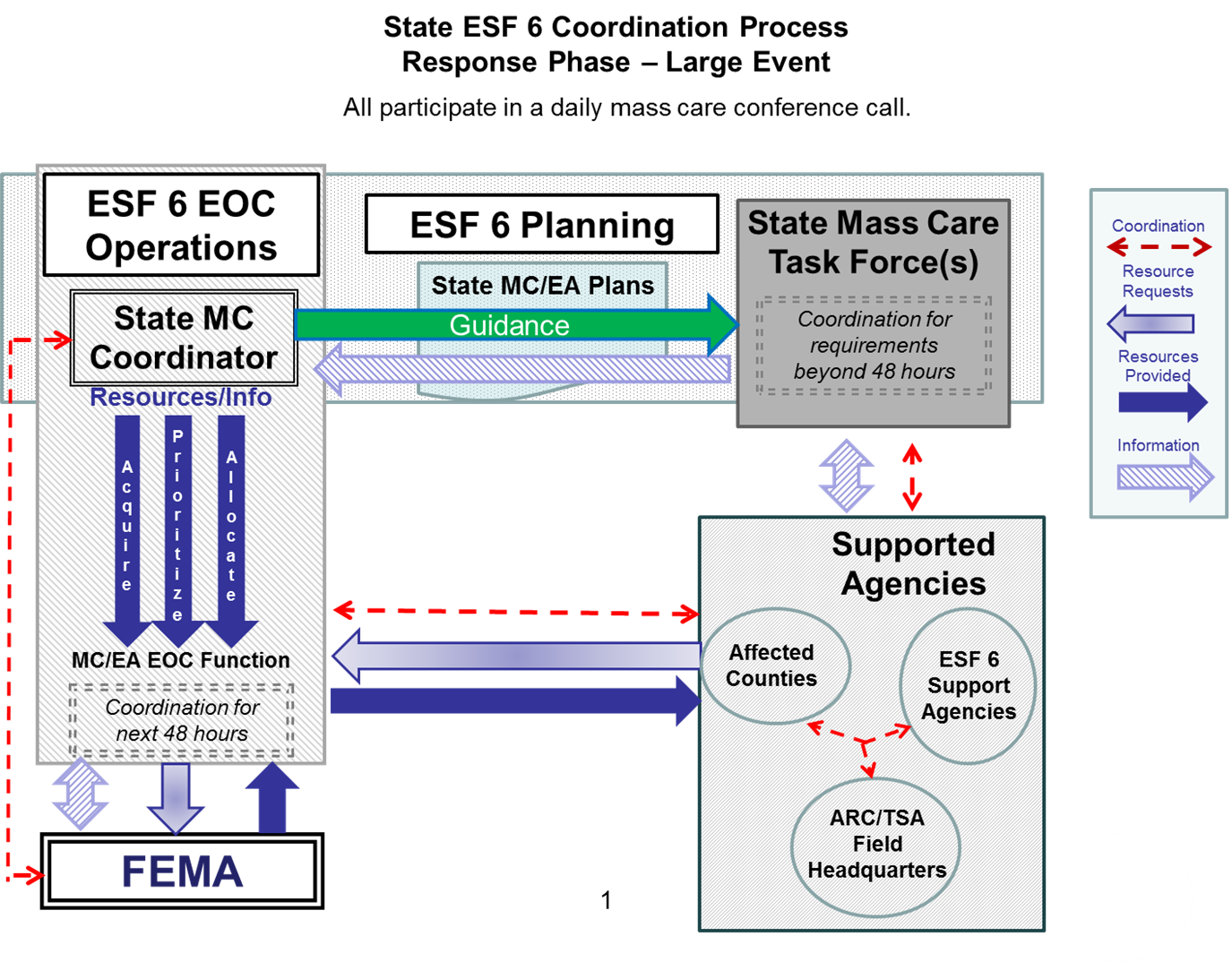
After the recent National Mass Care Exercise, held in Tallahassee in May, we came up with the diagram below to explain the coordination process that we utilized in the exercise. This diagram didn't spring forth from anyone's head fully formed. At least 30 or 40 members of the national mass care community nationwide made comments on various drafts. At first they said to add this and don't forget to include that.  Then they said the damn thing was too complicated and hard to understand. So we simplified the diagram and found someone in FEMA Headquarters who could draw pretty Power Point pictures. This is the result.

At the FEMA Region IV Individual Assistance Conference in Atlanta last week I briefed this diagram to the FEMA, state and voluntary agency attendees. They then broke up into groups and discussed the diagram. Some groups briefed that we needed to add this or include that. Others said that it was too complicated.

But we're making progress. We need to get the diagram out in front of people so that they can talk about it and maybe even think about how they can adopt it in their states.

To me there are a number of important features of the diagram that must be pointed out. First, and most importantly, the diagram establishes the critical role of the State Mass Care Coordinator (SMCC). FEMA has published a Job Title that establishes education and experience requirements for a Type 1 and Type 2 State Mass Care Coordinator. The National Mass Care Strategy recommends that states identify a State Mass Care Coordinator. FEMA needs to encourage this by sending identified State Mass Care Coordinators to training and exercises, like the National Mass Care Exercise.

A second important feature is the concept that the SMCC acquires, prioritizes and allocates resources and information to the supported agencies. In large events the SMCC is assisted in this coordination process through the establishment of Mass Care Task Forces, that operate in accordance with State Mass Care/Emergency Assistance Plans.

Finally, the diagram defines the supported agencies as the affected counties, the Mass Care Voluntary Agencies Field Headquarters (like the American Red Cross Disaster Relief Organization) and those state agencies that perform mass care (like a state Social Services agency that operates shelters). These Supported Agencies request and receive resources from the State EOC.

I am going to do my best to engage the national mass care community with the concepts incorporated into this diagram. The first step in the engagement is to get everyone to understand the existence and importance of the state coordination process. The second step in the engagement is to get everyone to understand the concepts represented in the diagram of the process and how they would apply to a disaster in their state. Finally, I want to get informed analysis and criticism of the diagram so that we can make it better.

Friday, June 21, 2013

What I learned in the 2013 National Mass Care Exercise


The 2013 National Mass Care Exercise, held in Tallahassee, FL from May 20-24, 2013, brought together 60 federal, state, local, nongovernmental (NGO) and private sector mass care practitioners. We struggled to respond to two hurricanes and three impacts on the state. We tried out several well thought through plans and operational procedures. Like last year's exercise, some things worked and some things didn't. 

But because of last year's exercise, we executed our plans and procedures better this year. And next year we will do even better.

A draft of the Exercise After Action Report has been prepared and circulated to the participants for their comments. Our goal is to have the Report finalized and posted to the National Mass Care Strategy web site by July 1.

In the meantime, however, I can let you know what I learned. First, I learned that to write state mass care doctrine, train people to that doctrine, and then exercise that doctrine simultaneously is difficult for the exercise organizers and confusing for the participants. 

In a previous post I talked about creating a state Mass Care Services Doctrine. We've come a long way on the last 10 years toward standardizing the way we coordinate mass care at the state level. FEMA has put some of this process into a course, which I talked about in a previous post, but we need to get this course adopted by EMI and get federal, state, NGO and private sector mass care practitioners trained in the process. The exercise would be more effective if all the participants had the benefit of this course as a common baseline of understanding of the state mass care coordination process. I am going to push to make that happen.

The second big thing I learned in this exercise was how to forecast long term feeding and sheltering requirements for a hurricane. The exciting part about this was that we developed simple and effective formulas to make these estimates, and this process can easily taught and widely adopted in the mass care community. 

Forecasting future mass care requirements is an important part of the state mass care coordination process. The state does not have an on hand inventory of mass care resources that can be doled out to counties and the voluntary agencies when the requests roll in after the disaster. These resources must be either purchased by the state or requested from FEMA, a process that can take days or longer. This delay in fulfilling the request means that survivors on the ground in the impact area are doing without. This means that I can be requesting resources before the storm has even hit.

What? Requesting resources before the storm has even hit? You could order too much or too little. That's wasteful and in efficient. As Craig Fugate taught us many years ago, there are 3 ways to respond to a disaster: Cheap, Efficient or Fast. You have to choose one. Our political leaders and the public want Fast, which is inefficient and expensive. You want Fast? Then you project the type, kind and quantity of mass care resources that will be in short supply after the disaster and order them before the disaster so that they will be on hand when the public needs them.

Doing that has got to be hard. You're right, it is hard. But as a result of the 2013 National Mass Care Exercise we made a lot of progress toward figuring out how to make those forecasts for feeding and sheltering.


Sunday, May 05, 2013

Coordination Complexity & the National Mass Care Exercise

On Friday, August 13, 2004 I was in the State Emergency Operations Center (EOC) in Tallahassee when Hurricane Charley struck Charlotte County on the southwest coast of Florida as a Category 4 Hurricane. The storm plowed through central Florida and exited into the Atlantic Ocean as a Category 1 near Daytona Beach. Twenty five of the state's 67 counties had been struck by hurricane force winds and they all began screaming for help at the same time.

At that time I had been the State Mass Care Coordinator for almost 5 years. This was my first big disaster and I had plenty of time to study the requirements of the job. I thought my intelligence and diligence would leave me prepared for the tasks at hand. I was wrong. I spent the first week of the disaster overwhelmed and confused. With the hindsight of my current experience I realize that I focused on the trivial and overlooked the important areas, not out of disregard, but out of ignorance of their existence.

I did a few things right. I realized that I was overwhelmed and called for help. The Emergency Management Assistance Compact (EMAC)  is a process for states to ask for and receive emergency personnel from other states. I remember filling out an EMAC form asking for "state mass care workers" and then returning to the EMAC desk each day with a hopeful expression. I was so ignorant that I didn't realize the number of state mass care workers in the nation was infinitesimal and I might have had better success asking for kangaroo trainers. 

In my defense there wasn't a single document in the nation in 2004 that even identified the position of State Mass Care Coordinator much less explained how to do the job. Now FEMA's National Integration Center has approved Interim Guidance for the State Mass Care Coordinator Job Title. And the nation will be testing a wealth of documents on how to manage mass care at the state level during the 2013 National Mass Care Exercise to be held in Tallahassee, FL from May 20-23, 2013.

The screen shot below of the old Tracker message system we used in the State EOC in 2004 for the Charley response shows a sample of the resource requests and information messages we received on August 16th. At that time, on Day 3 after the storm, we had already received over 3,300 messages. The works out to about 800 a day, or 35 an hour if you assume that they arrived evenly over the 24 hours in the day. But they didn't arrive evenly. The messages came in gushers and waves during the daylight hours and this inundation overwhelmed our ability to process and understand what was happening in the affected area.


I remember many times during those early days sitting at my desk in the big room of the EOC with a land line in one ear, a cell phone in the other ear, and 3 people standing behind me waiting to ask a question. How much planning and analysis of this wealth of information was being performed by me or anyone else? 

We weren't planning for anything. We were just reacting.

During large disasters the very real situation that I just described is not uncommon. Those of you who have experienced these situations are nodding in agreement. The symptom of overwhelmed EOC workers is caused by under-staffing. Duh. So why aren't we doing something about it?

The reason emergency managers across the country are in the situation I described in August 2004? We don't know what we don't know. I didn't know that the systems that I put in place would be inadequate for the required level of the disaster response. I could not have been expected to divine this, and there was nothing written down that could aid me in arriving at this conclusion.

A Homeland Security Institute document published in February 2009 finally gave me a name to the problem that we were facing: Coordination Complexity. An Appendix to this document, entitled Coordination Complexity, talked about the concept but lamented that FEMA had yet to define the term. With the National Integration Center now in the throes of updating the National Incident Management System manual I want to throw the concept of Coordination Complexity on the table as something that needs to be presented and defined in the new manual. Since for my own purposes I needed a definition now, I throw this out for everyone to criticize:

Coordination complexity is the degree to which the size and nature of an event increases the volume of required agency interactions and degrades the ability of an Emergency Operations Center to function without additional procedures and staff.

The Homeland Security Institute article did list some parameters for coordination complexity which I assembled into the table below.

"Media Attention" is the parameter at the top since it tends to influence actions of the elected leaders who are our bosses. This introduces in some jurisdictions the phenomenon that I call "briefing up," wherein the poor emergency manager is pulled from his/her critical tasks in the EOC to give detailed and lengthy explanations to the elected officials, discussions that would have been more fruitful and less disruptive to the response if they had been conducted before the disaster started. 

An EOC is a facility where response agencies assemble to coordinate their actions. The "Stakeholder Composition" of those agencies is a major determinant of the level of coordination complexity involved in the response. The large number of agencies within the EOC are coordinating with local, state and federal agencies external to the EOC. And the agencies involved in this coordination have varying levels of expertise, experience and skill.

Finally, type and quantity of the tasks performed within the EOC and the number and competency of the staff assigned to execute those tasks affects the level of coordination complexity of the event. My favorite parameter is the "# of follow-up actions required" to complete a task. 

Using these different parameters one can construct a table to determine the Coordination Complexity Level of an event. The table below is just such an example and can be used to assign the Coordination Complexity Level for a mass care response in Florida.

In this table a Level 1 is more complex than a Level 3. Thus a State Mass Care Coordinator can use this table (or a similar one adapted to the jurisdiction) to estimate the Complexity Level before the storm hits and then request the additional personnel required to meet that level of complexity.

What level of capability is required for a given Complexity Level? We are working to answer that question during the National Mass Care Exercise this month. Stay tuned.

Monday, January 21, 2013

Creating a state Mass Care Services Doctrine

I have stumbled through the wreckage and tumult of emergency operations centers as the occupants try, and sometimes fail, to manage a big disaster. A recurring theme in these situations is how the inhabitants sort themselves into categories. There are those who know that they don’t know what they’re doing, who know that they are steering the boat over the falls, but see no other choice but to grip the tiller and await the outcome. The really interesting ones are those who don’t know what they’re doing, and don’t know it. They may even be riding a delusional wave of euphoria, caught up in the excitement of the disaster and think that they are doing well. The ones who know what they are doing, and know that they know what they are doing, are mixed in among the others, camouflaged by their silence, waiting in vain for someone to ask them what needs to be done. They don’t speak up because they know that unsolicited advice will be wasted. The former category can’t absorb the advice because they are already resigned to their fate, while the latter category disregard their words because they think they already have it all figured out.

In August 2004, after almost 5 years in the job, I discovered how little I really knew about coordinating mass care at the state level. Hurricane Charlie plowed into Charlotte County as a Category 4 hurricane, crossed the state and exited into the Atlantic Ocean as a Category 1 near Daytona Beach. At the State EOC we were inundated with requests from over 25 hurricane-impacted counties comprising millions of people. I know that my frantic and frustrating actions included very little productive mass care coordination. And I knew it at the time.


What is sad about this story is how hard I had worked the previous 4 years to get ready for that moment. My problem stemmed from the fact that most of my efforts were focused on procedures to make things run right in the EOC. I know now that I had a role to play in that world outside the building. After 8 storms in 16 months I started to figure out what that role was. What is also sad about this story is that there wasn't a book, manual, document or scrap of paper that explained how to do my job. The role of State Mass Care Coordinator wasn’t defined. There was no state mass care doctrine for me to learn.


One dictionary defines doctrine as “a body or system of teachings relating to a particular subject.” Doctrine could also be defined as “something that is taught.” The new National Preparedness Goal defines Mass Care Services as: “Provide life-sustaining services to the affected population with a focus on hydration, feeding, and sheltering to those who have the most need, as well as support for reunifying families.” At the national level, FEMA and the American Red Cross are responsible for coordinating the implementation of Mass Care Services in a disaster.

The American Red Cross has assembled a doctrine on providing mass care at the local level from the vast history and experience of the organization. The doctrine is written in manuals and disseminated in classroom instruction by local Chapters year round. To borrow a term from the military, this is tactical doctrine. Mass care tactical doctrine explains how trained individuals and resources arrive at the disaster area and feed, shelter and distribute relief supplies to the affected population. This doctrine works fine for the hundreds of smaller emergencies, events and disasters that occur in the nation every year.

The principle voluntary agencies that perform Mass Care Services across the nation (the American Red Cross, the Salvation Army and the Southern Baptists) struggle to deliver the level of service that the public expects during big disasters. These struggles are not necessarily the fault of the voluntary agencies. Their ability to marshal volunteers (which they have trained at their expense), equipment (which they have paid for) and salaried employees from around the nation and employ them in support of local jurisdictions during a disaster is a feat that does not always receive the appropriate recognition. But their resources are not infinite. Their capabilities and the amount of resources that they can deliver in a crisis are dependent on public support and the donated dollar. For this reason, public criticism of their actions or non-actions by elected officials caught up in the emotions of the response is never helpful.

Fortunately, our country doesn’t have to deal with catastrophic disasters very often. For most emergency managers, when the Big One comes it is their first big disaster. For those that have done it before, their previous experience may not provide a good example. And too often the local politicians decide that this event is “important” and requires their uninformed, uneducated and ill-considered usurpation of the roles for which their emergency managers have been training and preparing for a life time. Is it any wonder that we don’t do well?

We have a tactical mass care doctrine that serves us well in all disasters. What we don’t have, and what we need, is an operational mass care doctrine. Borrowing again from the military (and simplifying the concept considerably) operational doctrine is about moving the resources into place so that the tactical doctrine can be executed. We practice operational tasks infrequently. The mass care community has a lot of skilled, dedicated professionals who have worked numerous big disasters. In some cases they are the ones in the emergency operations centers who know what to do, and know that they know what to do. They understand, through harsh experience, the need for operational doctrine, although they may not phrase it in those terms.

The best and most effective way to manage a disaster, especially a Big One, is in a collaborative manner, utilizing the resources of all the agencies available in the community. This is the philosophical basis for the Whole of Community concept now being promoted by FEMA and other agencies. There are some elected officials who, when the disaster strikes, take control of all emergency management actions, arrive at decisions without consultation with their state, federal, nonprofit and private sector partners, issue directives to their partners as if they were subordinates and then micro-manage the execution of these directives. This approach can, and has, caused unnecessary suffering to the survivors who have the misfortune to live in that jurisdiction. We can only shake our heads at such actions and leave any resolution to the electoral process.

For the great, sane, majority in the rest of the nation we need a collaborative, operational Mass Care Services doctrine. The central actor in any such doctrine must be the state government. Why? Because only the Governor of the State can request federal mass care resources on behalf of the local jurisdictions. By definition, operational actions are only necessary when the local jurisdictions are overwhelmed and need additional resources. The voluntary agencies can bring in their own national assets on their own authority and frequently do so. But what if the voluntary agencies are overwhelmed? Then state and federal assets must be committed by a designated State Mass Care Coordinator trained to do the job.

I have written here before about our efforts to create a State Mass Care Coordinator’s Course (see the new State Mass Care Coordinator's Course). And the national mass care community has been able to develop some documents that explain how the collaborative process should work to coordinate mass care at the state level. These documents can be found on the National Voluntary Agencies Active in Disaster website as well as the National Mass Care Strategy website. These documents, which are the first steps towards an operational Mass Care Services doctrine, are: The Multi-Agency Feeding Plan Template, the Feeding Task Force Guidance Document, the Sheltering Guidance Aid, Household Disaster Feeding, and Federal Mass Care Resources Coordination. To further assist this training process FEMA is publishing Mass Care Resource Typing documents (read about this development here).

Finally, in furtherance of the National Mass Care Strategy, we are holding a National Mass Care Exercise annually in order to train present and future State Mass Care Coordinators from around the nation, as well as mass care workers from the federal, state, local, & voluntary agencies and private sector. The first such National Mass Care Exercise was held in Tallahassee, FL in May 2012 (read the after action report). Another National Mass Care Exercise is planned for Tallahassee in May 2013. The intent of these exercises is to give the national mass care community a chance to practice these operational procedures and train in the difficult but essential collaborative coordination processes that are essential to a successful mass care response.

Hopefully, through these actions, we can help some future State Mass Care Coordinator prepare and do a better job than I did during Hurricane Charlie in August 2004.