Tuesday, October 28, 2014

Delivering Mass Care Services to high-rise buildings

With the arrival this week of Halloween, the second anniversary of Super Storm Sandy carries it's own horror show legacy. A YouTube video outlining the plight of the elderly residents of a high-rise apartment building in the Rockaways in Queens, New York City in the weeks after the storm hit is a textbook example of the consequences of not planning for the care of vulnerable populations in multistory buildings in high risk areas.


According to the New York Times, after Sandy the New York City Housing Authority lost electricity and elevators to 402 of its buildings housing 77,000 residents, with most of them also losing heat and hot water. "Around the city, 26 of the housing authority’s basement boiler rooms had flooded, destroying the equipment there, and leaving 34,565 apartments without heat and hot water. "

The reply of responsible officials to the plight of the individuals in these apartments was: "The should have followed the evacuation order." Granted, an elderly, wheelchair bound individual on the 18th floor of a building erected on a scrap of barrier island sand should give careful consideration to heeding an evacuation order in the face of an oncoming hurricane. But some of these individuals, for a variety of reasons, don't heed the order.  And we can't just say, as the Grail Knight in the movie Indiana Jones and the Last Crusade did: "He chose poorly." We have to help them. An ambulance crew called to the scene of a vehicle splattered against a tree doesn't refuse service to the mangled occupant because he got behind the wheel while drunk.

The first and most important step to help these people is through mitigation of the risks. The New York Times reports that the city is using federal, state and local tax dollars to harden the city to the kind of flooding experienced during Sandy. The next step is to develop and rehearse realistic plans. A big mistake made in many emergency management plans is assuming that their informed citizenry will follow the instructions laid out in the plan. 
When the disaster happens some citizens will not only not have read the plan but will have no interest in written or verbal instructions that they perceive to be contrary to their self interest. 

In 2010 Florida completed our first ever statewide hurricane evacuation study. The study generated estimates for every county of how many people would evacuate for a certain category of storms, and how many of those who evacuate would seek shelter. And for each category of storm the study provided not one answer, but two.


The first answer stated how many people would seek shelter if everybody who was supposed to evacuate evacuated, and everybody who WASN'T supposed to evacuate didn't. The other number used behavioral surveys of the populations in the counties to estimate the evacuation numbers and the shelter populations.

I can tell you right now the next time a hurricane hits a densely populated, urban coastal city an elderly, wheel chair bound individual on the 18th floor isn't going to evacuate. And for all the hype over "Superstorm" Sandy, it was big but the intensity was barely a Category 1. The combination of wind, surge, rain, and tornadoes from a major hurricane doesn't leave wreckage but an array of empty concrete slabs. Just getting to the building is going to be a problem, much less climbing to the 18th floor. And that's assuming that you know that someone's there and has a problem.


When I came home to Florida from New York City after Sandy the problem of the wheel chair bound person on the 18th floor was uppermost on my mind. I tried to get other people interested in the problem but life got in the way.

Me at my first Red Cross deployment - Hurricane Sandy in NYC
A Red Cross friend who served in Sandy called me the other day and said, "I've been thinking about all those people in those high rise buildings in New York City. We need to come up with a Service Delivery Plan for those people."

"You're right," I said. "We need to do that."

"I'm going to talk to some smart people I know."

"Me, too," I said. "I know some smart people I can talk to."

Maybe we can come up with something. Maybe we can even get it done before the next storm comes.

Sunday, September 07, 2014

Why we need the Red Cross

Last week I got an email from Jesse Eisinger, a Pulitzer Prize winning reporter from ProPublica. In the email he stated: "We are working with NPR on a story about the American Red Cross’s mass care during Hurricane Sandy. I understand that you were brought in to the NYC EOC after the first few weeks to coordinate the ARC’s mass care for the city."

I responded favorably and the next day we spoke on the phone for almost an hour.

Some people are hesitant to talk to reporters but my Hurricane Sandy experience in NYC was positive and I was eager to talk about it. I also wanted to correct the statement in his email that I was "brought in to the NYC EOC...to coordinate the ARC’s mass care for the city." That statement was not factually correct and exaggerated the role that I did play during my 2 week stint in Manhattan.

During my conversation with Mr. Eisinger I could tell from some of his questions that he was adhering to the dictum given to Watergate reporters Woodward and Bernstein: "Follow the money." The Red Cross received millions of dollars in donations for Hurricane Sandy relief and the question of accountability for how that money was spent is certainly a question that an investigative reporter would find interesting. Happily, I knew nothing about that subject. He said he wanted to talk about mass care in NYC during Sandy and I knew something about that subject. 

Plus, as those of you who know me will attest,  I LOVE to talk about mass care.

To be precise, we didn't talk about mass care as much as we discussed disaster feeding. At least, I talked a lot and he listened and asked occasional questions. I had already sent him links to my blog where I had already documented my experiences in Sandy. The first one was The Transition to Long Term Disaster Feeding in New York City after Sandy. Another one was Disaster Feeding in New York City during Sandy.

I spent some time explaining to him the 3 phases of disaster feeding. Not familiar with the 3 phases? Check out the first blog post I referenced, or read all about it in the source document, the Multi-agency Feeding Plan Template. The 3 phases are Immediate, Sustained and Long Term. When I arrived in the NYC Emergency Operations Center on November 11, 2012 (Veterans Day) we were well into the Sustained Phase.


The NYC EOC at the Brooklyn end of the Brooklyn Bridge
In the 8 days that I was in the NYC EOC I didn't coordinate mass care for the Red Cross. I went there to lend my disaster feeding experitise to what was a complex and difficult situation.  As I told Mr. Eisinger, I was able to make 2 positive contributions. First, we got the NYC Emergency Management to initiate daily conference calls for the Feeding Task Force. Through these conference calls we were able to coordinate the multiple, disparate groups involved in disaster feeding in the city. Second, I initiated the discussion about the transition from the Sustained phase to the Long-term feeding phase. The planning for this transition continued after I left under the steady hand of some good people and was a real success of the operation. You can read more about this in the first blog post I referenced.

I arrived at the NYC Red Cross Chapter on November 6, Election Day. I spent the prior week in Maryland responding to a request from their state. Why did I go to Maryland? They were the only state that asked for me. You can read about it in the blog post Hurricane Sandy's Inundation of Crisfield, Maryland.

When we finished the response in Crisfield I got released from my commitment to Maryland and asked the Red Cross if they would take me as a volunteer. The next day I flew home for 4 hours and then caught a flight the Red Cross booked for me to New York. While in Manhattan I worked 14 hour days doing my regular job while I was on vacation from the State of Florida.

Why? Well, for one thing, most of my friends were already there or in New Jersey. Second, I gained a lot, both personally and professionally. And although this was my 16th hurricane Sandy was the first time that I ever deployed as a Red Cross Volunteer.  I knew how important the Red Cross was to mass care in this country but it wasn't until I deployed as a Volunteer that I learned why we need the Red Cross.

When I arrived at the Chapter I was put to work planning a large distribution of emergency supplies operation that the Red Cross was going to execute during the upcoming 3 day Veterans Day weekend. The entire 4th floor of the Chapter was occupied by the Disaster Relief Operation so I was sent to a 2nd floor conference room. When I arrived I was the only person there.


The 2nd floor conference room at the NYC Red Cross Chapter when I first arrived.
Throughout that day and the next the room filled with volunteers and staff assigned to work on the distribution operation. It was a remarkable time. In my experience, this was the greatest concentration of mass care expertise assembled at one time and place that I had ever seen. Most of the people with the real expertise were Volunteers who left their jobs, homes and families to help out complete strangers. 

"This is amazing," I said to one of the many Volunteers in the room.

She nodded her head and smiled. "Yes, it is, isn't it?"

The 2nd floor conference room 2 days later
We needed that expertise because we were faced with a large task and a challenging mass care environment. It's hard to do anything in New York City on a blue sky day. The City is a system of systems and the storm had disrupted the balance. We had to move lots of commodities, vehicles and  volunteers using an organization equivalent to a pick up basketball team. It helped that the players were really good.

Mr. Eisinger wanted to speak to me about disaster feeding because, as he noted, the Red Cross received a lot of criticism about their feeding operation in the first week. I couldn't comment about the feeding operation during the first week because I wasn't there. But I knew enough about disaster feeding to criticize the critics. 

The first few days after the impact of the storm are the Immediate Phase of disaster feeding. In this Phase local resources are used for feeding until such time as resources external to the jurisdiction are brought in to produce and distribute meals at the level required for the disaster. In 2005 after Hurricane Wilma it took us 3 days to establish the feeding infrastructure and begin the Sustained Phase of disaster feeding. Wilma was the 8th hurricane that we had worked in 16 months and we had the skills that came from lots of practice. 

In NYC after Sandy, in my professional opinion, 4 or 5 days to establish the feeding infrastructure would be a reasonable estimate considering the conditions. People must consider that mass care vehicles aren't the first priority for access to the City after the winds die down. Law enforcement, Search & Rescue, and other life safety resources get first priority. As they should.

To stand in front of the media on Day 2 or 3 after the storm and criticize the Red Cross because they aren't feeding yet is to demonstrate an ignorance of the realities of disaster feeding. There are a lot of advantages to living in a great City like NYC. There are lots of disadvantages. Hurricanes, and big disasters in general, are one.

Criticizing the Institution and the idea of the Red Cross is not constructive. We need the Red Cross. Criticize the individual who made the mistake and not the organization. The Red Cross represents an ideal and we need that ideal. It's the ideal that I saw in the 2nd floor conference room of the Greater NYC Chapter of the American Red Cross during the Hurricane Sandy response.

In my almost 15 year career as the State Mass Care Coordinator for Florida I have heard of a lot of jurisdictions, local and state, who say that they've given up on the Red Cross. They give a lot of reasons. The Red Cross didn't do this. The Red Cross wouldn't do that. I don't see any good reason that a jurisdiction should cast the organization aside because of this. We need the Red Cross.

I'm not going to to criticize Mr. Eisinger for an article that I imagine that he may write. If he's looking for accountability from the Red Cross he should be looking for fraud and abuse. I didn't see any fraud or abuse when I was in NYC during the Sandy response. And I don't think he's going to find any. He may uncover some people doing the very best they could in a difficult situation, and making some mistakes along the way. 


I was there. I made some mistakes. Blame me. Don't blame the Red Cross. We need the Red Cross.

Tuesday, August 26, 2014

A Eulogy for a grand woman

My mother-in-law passed away August 21st and I delivered the following eulogy at her funeral service this morning. Most of the words are mine.

Kathy and Bill Otte


Kathleen Otte was a grand and gracious woman. In the 83 years of her life she was a daughter, sister, friend, wife, mother, grandmother, great-grandmother and widow. She inhabited each of these roles with a courtesy that defined who she was. She was a gentle lady in every sense of the word.

As a woman in a kitchen gathers items in her apron to carry, so did Kathy gather people around her. She gathered family, friends, acquaintances and strangers. She had no need to call them, they were drawn to her. We were all drawn to her. And in their native Wisconsin, Bill Otte was the first one to be captured in her orbit. He, like her Wisconsin family, first knew her as Katie Berg, an outgoing high school girl who was game to try anything – even learning to play the saxophone.

Married in 1954, Katie – now Kathy – took up her role as officer’s wife and mother. In 1964, Captain William Otte’s unaccompanied tour to Okinawa was changed to an accompanied tour. So Kathy found herself boarding a military chartered aircraft in Ft Bragg, N.C with her five young children – Gale, the eldest at 9 years old, Steve a babe in arms, Jeff just a year older and Mark and Greg with baggage in tow. And when the call came to board the plane for the 2 day journey she gathered her baby, not one but two diaper bags, and marched forward dressed, as required for travel in the period, in a hat, dress, hose and heels, reminiscent of Jackie Kennedy.

Sometimes, in her role as an officer’s wife, Kathy gathered people to her that had found their way mistakenly. In the family housing section of Ft. Bragg, N.C during the Viet Nam war a green Army sedan carrying two officers in dress uniform was not a welcome sight – it foretold news of a soldier’s death. When the staff car parked in front of their house, and the two officers came up the walk to their door, she knew the purpose of their visit. She went to the door, listened to the inquiry of the officers, and directed them down the street to the correct house.

In 1977, when Lieutenant Colonel William Otte was the Deputy Post Commander in Schwabisch Hall, Germany, Kathy made their home a gathering place. I certainly gathered there a few times myself. There were 10-14 people eating dinner there every night and only 7 lived in the house. And another always seemed to show up as we were sitting down.

The numerous cookbooks in her home showed her decades-long interest in cooking, and she had plenty of opportunities to practice. Especially in the “Meals for large gatherings” categories. She knew everyone’s favorite dish when they came to visit – from flank steak and German potato salad, to raspberry pretzel goodness and cheesecake.

When Bill and Kathy retired from the Army and moved to Florida, their home in Gainesville became the gathering place. Nearly every Saturday in the fall, extended family and friends would descend on the home for Gator football games. In summer, the whole family gathering transferred to the beach for the 4th of July.

Kathy loved hosting her WOWE friends for bridge. She loved decorating her home for Christmas – ensuring each ornament, light, and piece of tinsel was perfectly placed on the tree. She loved to share her rule of Christmas shopping – buy one present for someone on the list, then one present for you!

Retirement, however, wasn’t all good times. Kathy took up maybe her greatest challenge: caring for the man she loved. When Bill passed away in 2006, Kathy gathered the children and the spouses and the grandchildren and the friends, young and old, to be by her side.

Just as she has done today.

I shall miss her. We all will miss her. She was a remarkable woman in ways that I find difficult to describe. She has gathered herself with Bill, in a place that one day, I hope, she will gather us all together into her apron again.

Saturday, July 26, 2014

For those facing their first, biggest and last disaster

In almost all the disasters that I have worked my overriding concern has been: how much mass care resources do I need? And the corollary question: do we have enough? I say almost because during the earliest disasters I didn't have enough experience to even know that this was something that I should be worried about.

People with a lot of experience have these algorithms in their head. They look at the size of the storm, or the flood or the earthquake and their internal computer spits out how many meals per day or shelter managers they need. If you're lucky you will know and have available for consultation one or more of these guys when the Big One shows up at your door.

But what if you're one of those guys who don't have the algorithms? What if you ain't got no internal computer? What if this is the Big One? What if you've been on the job 5 months and the Big One is your first, biggest and last disaster? What if those guys that you were going to call and consult turned off their cell phones and went on vacation?

Ten years ago next month I was that guy. I was the State Mass Care Coordinator in Florida when Hurricane Charley plowed through the state. I had been on the job for 5 years and not 5 months. Yet I had no real experience, and knew so little about mass care that I didn't even know enough to know how much I didn't know.
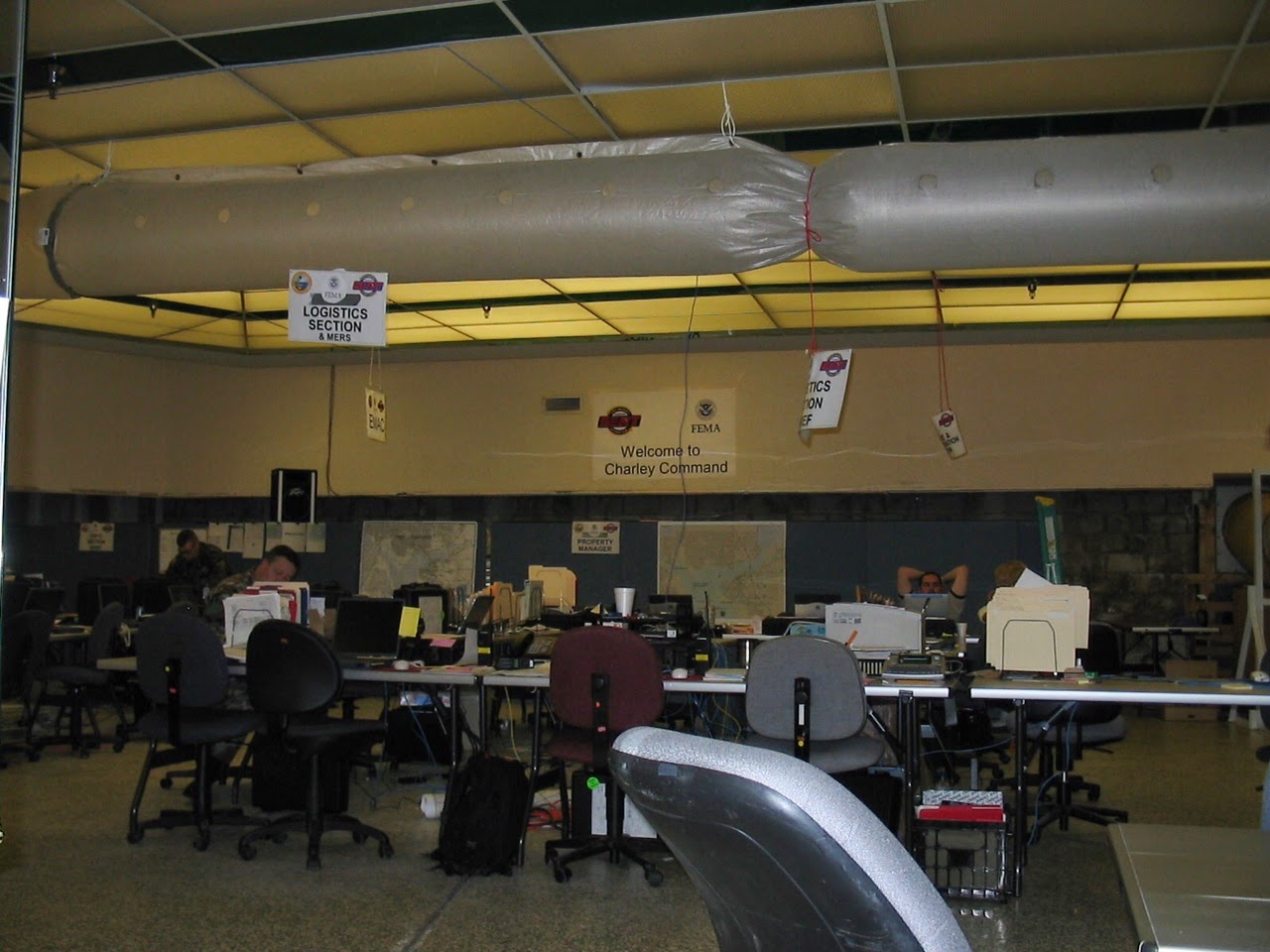
Charley Command in Charlotte County, FL in August 2004

Where is it written down that if the storm or the flood or the earthquake is THIS BIG then you need this many meals/day day and this many shelter managers? You know what? It's not written down anywhere. So, after frantic scrambling to round up resources during the Charley response, and Hurricane Francis bearing on us for another impact, I needed some answers.

I turned to the greatest repository of mass care knowledge in the nation, the American Red Cross. Their liaison to the State EOC was Eric Jones, who I had just met (and is now my good friend).

"How do we know if we've got enough stuff for Francis?" I asked Eric.

Eric gave me his best Red Cross answer that they had lots of smart guys in the field with algorithms and computers in their head but I wanted more detail than that.

"What do you mean?" I asked Eric. "Haven't you guys got this down to a science, yet?"

No, they hadn't. Mass Care response was more art than science.

Thirteen months later I'm standing in Hancock County, Mississippi, 3 days after the eye of Katrina passed over, and with the responsibility of coordinating the Human Services response for the 6 southern counties of the State. The situation was not good.
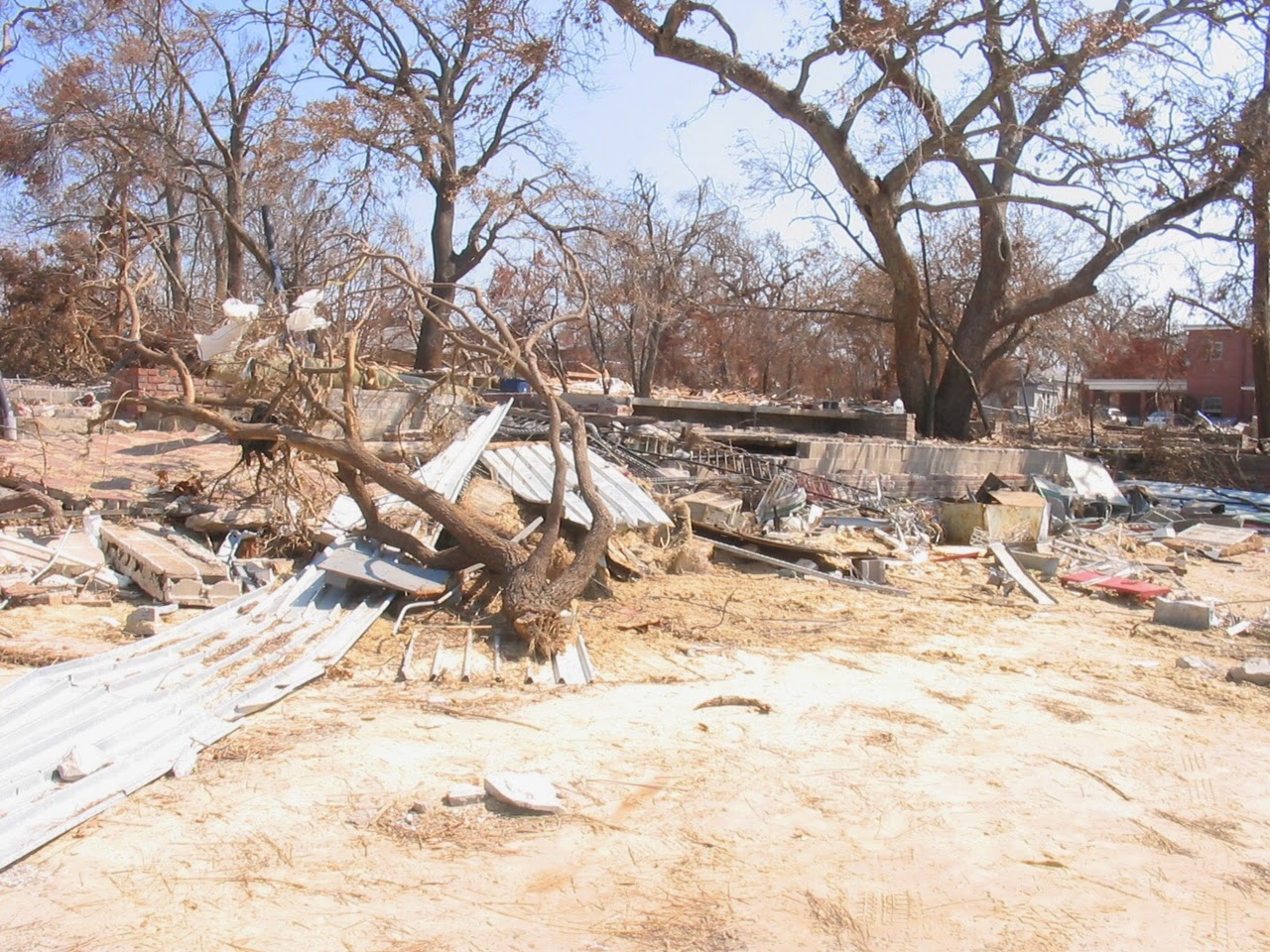
What Bay St Louis, MS looked like when I arrived in Hancock County, MS in September 2005

I walked into a school gymnasium and noted the storm surge marks hallway up the basketball backboards. Boats and cars and houses were blocking the roads. Storm surge muck, a mixture of seaweed, chemicals, sewage, rotting vegetable and animal matter, covered everything from the coast up to the Interstate. People with babies were sleeping on the ground in this stuff because they thought that they had to be at their destroyed homes when FEMA came or they wouldn't get reimbursed. Others created ad hoc shelters in intact buildings because they had no where else to go.

I had not received any training on what to do in this kind of situation. I was smart enough to know that I couldn't fix everything but I had to fix something. Fortunately I guessed right and decided to start by resourcing the shelters. The weather was nice, with blue skies and the first hint of fall in the air, but I was concerned that the first heavy rain would mix with the storm surge muck and drive those in the open into the under-resourced and over crowded shelters. We needed cots to get these people up off the ground.

I was part of the Florida Area Command, an organization of Floridians from municipal, county, and state agencies plus the Florida Guard. Over 6,000 Floridians responded to Mississippi after Katrina. The State EOC in Tallahassee was fully activated and responding to our requests for resources for the people of Mississippi.

When I got there this organization was building but was still in its infancy. The Florida Area Command would end up housed in a building with all the responders sleeping in a tent city erected at the Stennis Space Center there in Hancock County. But when I arrived everything was being coordinated from the SERT Mobile Command Vehicle and I was sleeping on the ground by my car.
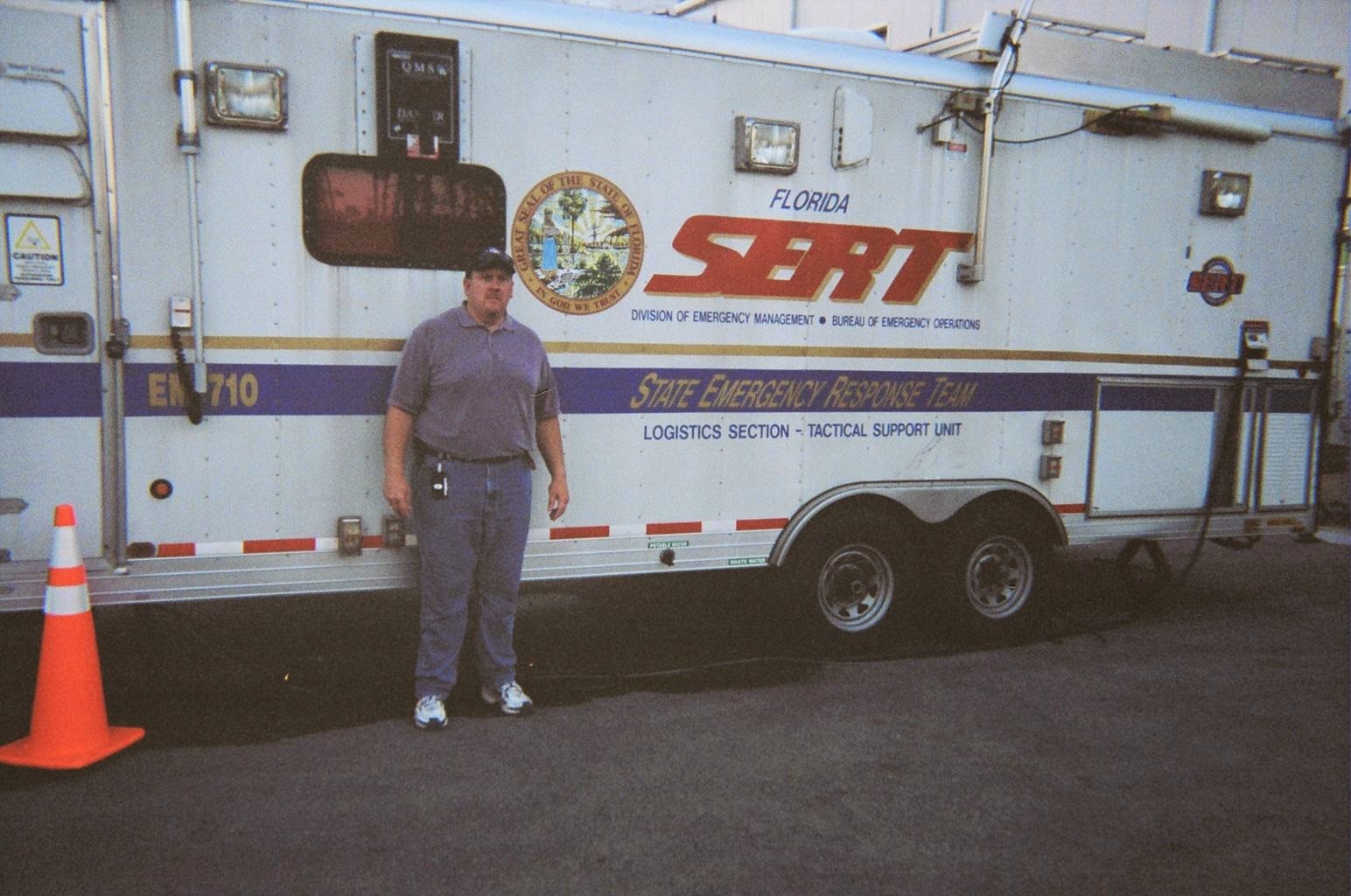
My friend Matt Howard in front of the Mobile Command Vehicle in Hancock County, MS in September 2005

The meeting room in the Command Vehicle had room for 4 people but 8 of us crammed in there for a conference call with the State EOC that first night. I was sitting on the floor, wedged between the table and the passenger seat at the front of the vehicle.

Chuck Hagan, the State Logistics Chief at the EOC in Tallahassee asked me what I needed.

"Cots," I yelled at the conference call phone on the table above my head.

"How many?" he asked.

I had no idea. "Ten thousand," I yelled, giving him the first number that came into my head.

"OK," Chuck replied, and he dutifully filled out an Action Request Form to FEMA for 10,000 cots. Truckloads of cots began arriving at our warehouse a few days later.
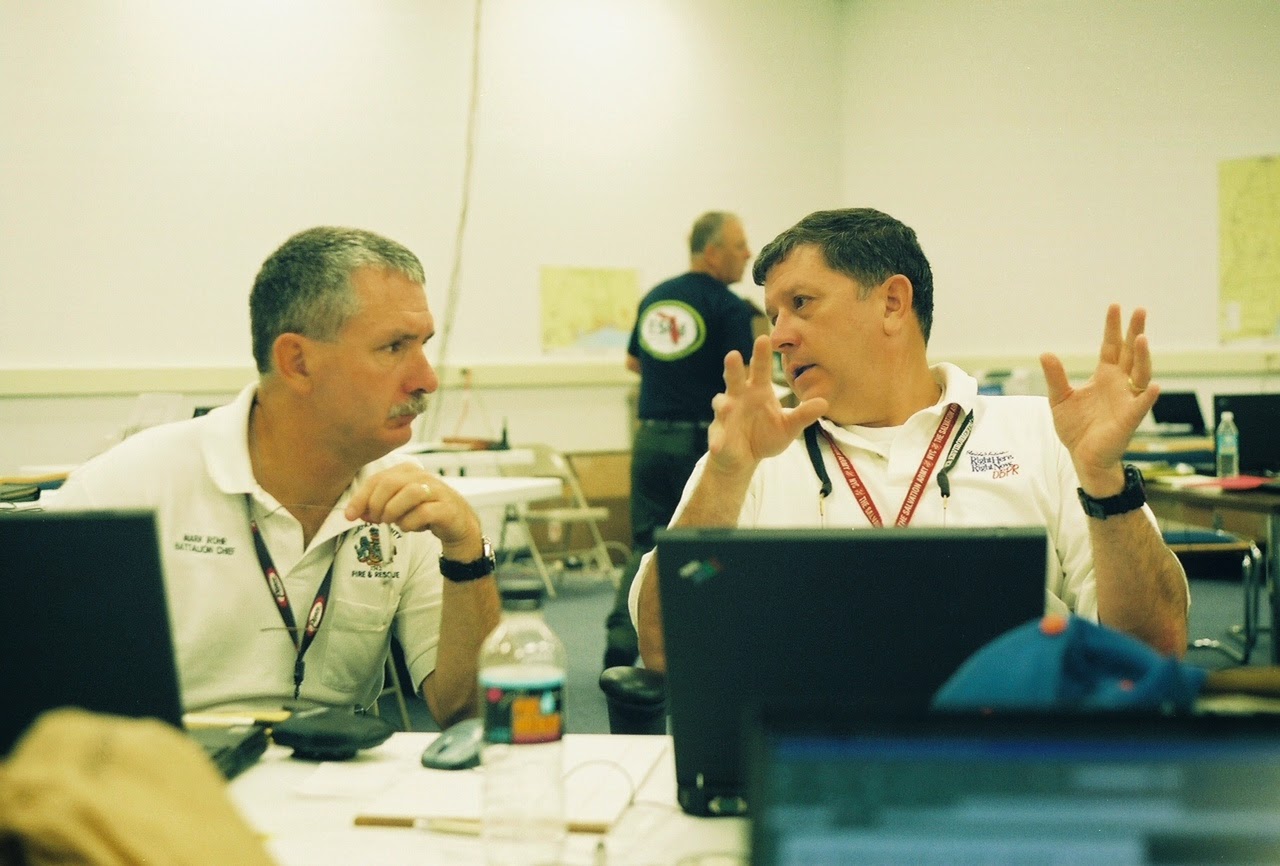
Briefing my replacement, Mark Rohr, a Virginia Fire Chief, at the Florida Area Command in Hancock County, MS in September 2005

This isn't the only example of how, in my ignorance, I was forced to forecast mass care resources by making up a number. And I am sure that there are a number of other people out there who were forced to do the same thing. There has to be a better way.

After 10 years of noodling on this problem I think that we've come up with something. We put together a presentation that demonstrates a mass care resource forecasting process. The process will work in any jurisdiction. In this early stage we can forecast for feeding, sheltering and distribution of emergency supplies for a hurricane, flood or earthquake.

Wow. That's pretty cool stuff. We got some smart guys with algorithms and computers in their heads going over the presentation now. Once we get it ready we're going to send it out to the mass care community to solicit comments/suggestions and socialize the idea. Then we 're going to build a spreadsheet to automate the process.

I'll keep you posted on how we're doing. Maybe we can help those people we don't even know their first, biggest and last disaster is lying in wait for them in the future.

Wednesday, June 25, 2014

How many meals do we need?

The first, critical task of an emergency manager at the beginning of an event is to determine the scale of the disaster. The scale of the disaster determines the resource requirements, which leads to an inventory of resources on hand and identification of what is short. A big first question in mass care is: How many meals do we need?

This is a basic, even fundamental, question for mass care practitioners at the beginning of a disaster. Yet, at the 2014 National Mass Care Exercise we spent an inordinate amount of time and energy on the first day of the exercise trying to answer that question. A lot of the practitioners at the Exercise had gained their knowledge and experience operating at the local level in the impact area. Most of my experience was gained at the State Emergency Operations Center (EOC). This variance in our backgrounds influenced how we viewed both the question and the answer.

The Mass Care Chief at a small disaster addresses the question of how many meals are needed by looking first at how many people are in the shelters. Job #1 in mass care is to resource the shelters. If 50 people are in the shelters then they need 2 meals/day and that's 100 meals. Next step is to address disaster feeding in the community through mobile feeding (Yes, I understand it's more complicated than this but bear with me). A Food Service Delivery Vehicle (check the link for the definition) normally carries 300 meals/trip. Based on our initial estimate of the scale of the disaster we need 300 + 100 meals or 400 meals/day. If the mobile feeding vehicle comes back empty then we send them out the next day on 2 trips and up our requirement to 700 meals/day.

At the State EOC I'm looking at this question in an entirely different way. Ten years ago this summer I worked 4 hurricanes in a 6 week period. I would've been pretty damn stupid if I didn't start figuring out what I was supposed to do after the 3rd or 4th hurricane. I learned pretty quick that my reaction time to a request that I hadn't planned for was at least 48 hours, and was more often 4 or 5 days. If you asked me for something and I had it on hand I could get it to you today or tomorrow.

If I didn't have it in hand I had to go get it and then physics got in the way. First, I had to convince someone else in the EOC that what you needed was both necessary and a priority. Next, if it had to come from FEMA, we had to wait breathless and unknowing while our request circumnavigated the federal approval process. Then, someone not under my control had to buy whatever it was you needed, arrange to load it on a truck somewhere in the United States and then drive it to wherever I had designated as the delivery location.

As you can see, 4 or 5 days sounds about right.

But if you're in the middle of a BIG disaster (and believe me, if you're involved in the disaster and the one making the request, it's BIG) and you ask the State for something you want it delivered yesterday, not in 4 or 5 days. That means that if I want to do a good job then I have to figure out what you need, order it, and have it on hand ready to deliver to you by the time you get around to figuring out that you need it. And you'll still complain that I didn't get it to you yesterday.

As a result of this experience I learned to look at the question of how many meals needed in a different manner. I don't know and don't care how many people we need to feed. I need to know how many meals/day of production and distribution resources are required to meet the estimated scale and scope of the disaster.

Furthermore, we need to estimate this meals/day requirement 24 hours before landfall on a Noticed Event, or within 12 hours on a No-Notice Event. Why so early? Because if we don't have enough we need to give FEMA the 4 or 5 days to get and deliver whatever it us we're short of.

So - how do we estimate the meal requirement before the hurricane has even made landfall? All mass care resource requirements are a function of the size of the population affected, the intensity of the event and the geography of the affected area. When estimating the requirements for a hurricane, for example, we use the Hurricane Center forecast to determine the geography of the affected area and the intensity of the event. The population affected can then be determined using census data.

But everyone affected by the disaster has not been impacted by the same intensity. Some people were hit by Category 4 winds while others by Category 1. Their disaster meal requirements would be different so we need to estimate how many people are affected by different intensity levels. So how do we do that? We looked at different factors associated with Low, Medium and High Intensity and put them in Table 1 below.


Table. 1. Estimating Disaster Intensity for use in
forecasting mass care resources
Intensity Level
Factors
High
  • Structural damage to buildings characteristic of a Category 4/5 hurricane or Mercali Intensity levels of X/XI/XII.
  • Up to 80% or more of customers without power
  • Up to 50% or more of  Potable Community Public Water Systems inoperable
  • Wastewater collection system is NOT providing wastewater treatment in accordance with permit conditions and regulations.
Medium
  • Structural damage to buildings characteristic of a Category 3 hurricane or Mercali Intensity levels of VIII/IX.
  • Up to 50% or more of customers without power
  • Up to 30% or more of  Potable Community Public Water Systems inoperable
  • Wastewater collection system is properly conveying and providing wastewater treatment, but at a compromised capacity.
Low
  • Structural damage to buildings characteristic of a Category 1/2 hurricane or Mercali Intensity levels of VI/VII.
  • Up to 20% or more of customers without power
  • More than 10% or more of  Potable Community Public Water Systems inoperable
  • Wastewater collection system is properly conveying and providing wastewater treatment with limited disruptions.

Once we have determined the population affected by each intensity level using Table 1, we use Table 2 to calculate an estimate of the meals/day in production and distribution capability required.

Table 2. Estimating Disaster Meals/Day required
Intensity
Estimate procedure
Output
Low
Sum of population affected by Low Intensity event X 5%
X
Medium
Sum of population affected by Medium Intensity event X 15%
Y
High
Sum of population affected by High Intensity event X 25%
Z
Estimate of Meals/Day production & distribution capability required
X + Y + Z

These percentages are a crude approximation but they are based on meal counts we collected during the 2004-2005 hurricane season. Experienced mass care practitioners have some version of this algorithm in their head. The result of this estimate process is not the final answer but the starting point of the discussion on the daily state mass care conference call.

The state and the voluntary agencies reach a consensus on the meals/day disaster feeding requirement during the daily state mass care conference not later than 24 hours before a Notice Event or not later than 12 hours after a No-Notice Event. This consensus meal estimate becomes a very powerful tool. Once we agree upon what is required, then we can look at what is available to meet that requirement.

If the requirement is 100,000 meals/day and we have 5 Type II Field Kitchen Units available then we know that we have sufficient production capacity to meet the requirement. Furthermore, if we assume that a Food Service Delivery Vehicle can distribute, on average, 1,000 meals a day then we know that we will need at least 100 vehicles for this event.

As you can see the number of people in shelters and the number of meals that we are feeding each affected person in the community plays no part in my calculations at the state, or macro level. At the micro level, where the Mass Care Chief is preparing a Feeding Plan, those numbers come into play.

Job #1 for the State Mass Care Coordinator is to determine if the voluntary agencies have sufficient resources on hand to meet the consensus meals/day estimate. If the answer is no, then Job #2 is to figure out what is short and go get it. And you better hurry.

Saturday, May 24, 2014

Lessons from the 2014 National Mass Care Exercise

We will write a After Action Report (which we hope to have out to the public by July 4) but I had a number of first impressions:

1) We did better than last year, which was better than the year before. This shows that we are trainable and there's hope.

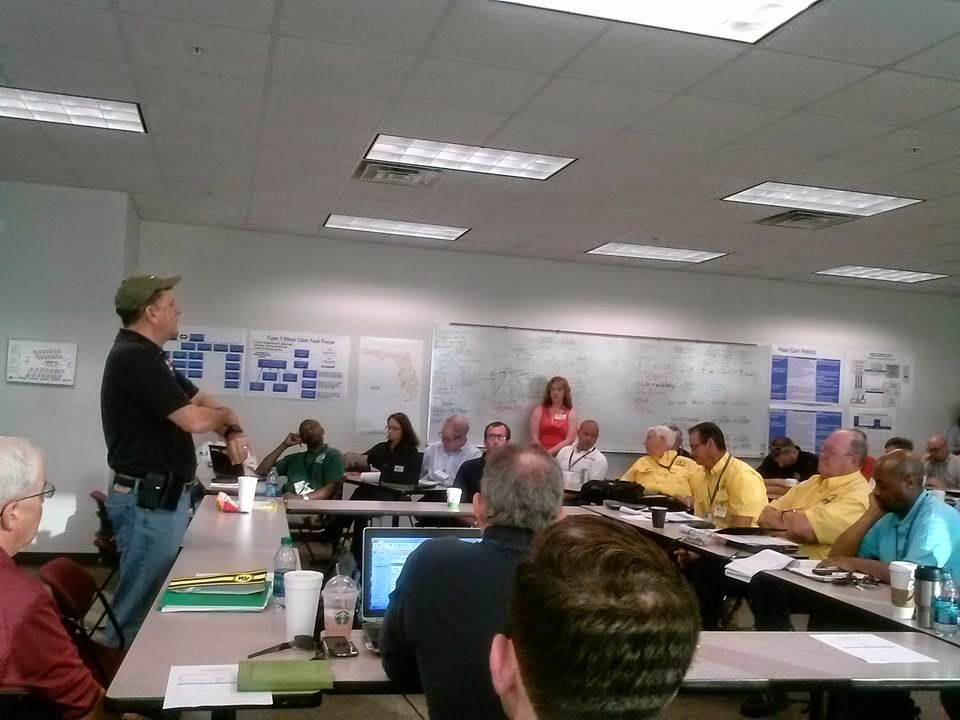
Michael Whitehead, State Mass Care Coordinator for Florida, briefing the 2014 National Mass Care Exercise participants on the morning of the 3rd day.
2) I had a personal goal of not getting overwhelmed during the Exercise and I succeeded. In last year's exercise, as well as the year before, I was called upon to be everywhere at once and solving multiple, complex crisis of misunderstanding within the Mass Care Task Forces. I failed in my ability to simultaneously act as a Player, Controller, Evaluator and Coach. This year a number of people besides myself who understood the Big Picture and were able to step in and resolve these crisis without my direct assistance.

One of many visual displays on the walls of the Shelter Task Force during the 2014 National Mass Care Exercise.
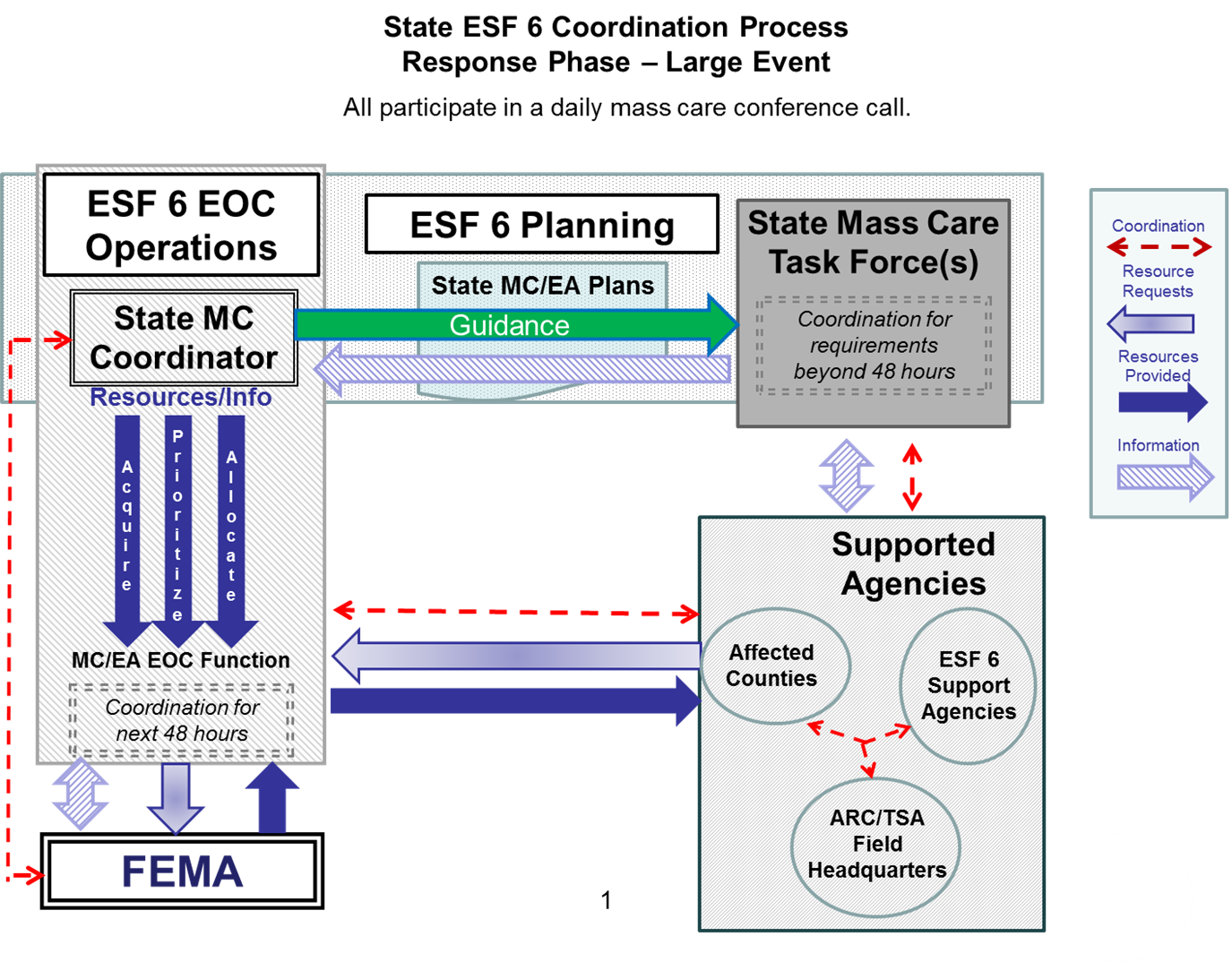
3) We validated the State Mass Care Coordination process (see diagram below). Not everyone even  understands the diagram, much less the process, but that's an education issue. The process works and can work in any state that needs to expand their mass care coordination capability in a large disaster. Doctrine is defined as accepted knowledge that can be taught to others. We now have that accepted knowledge and can go teach others.

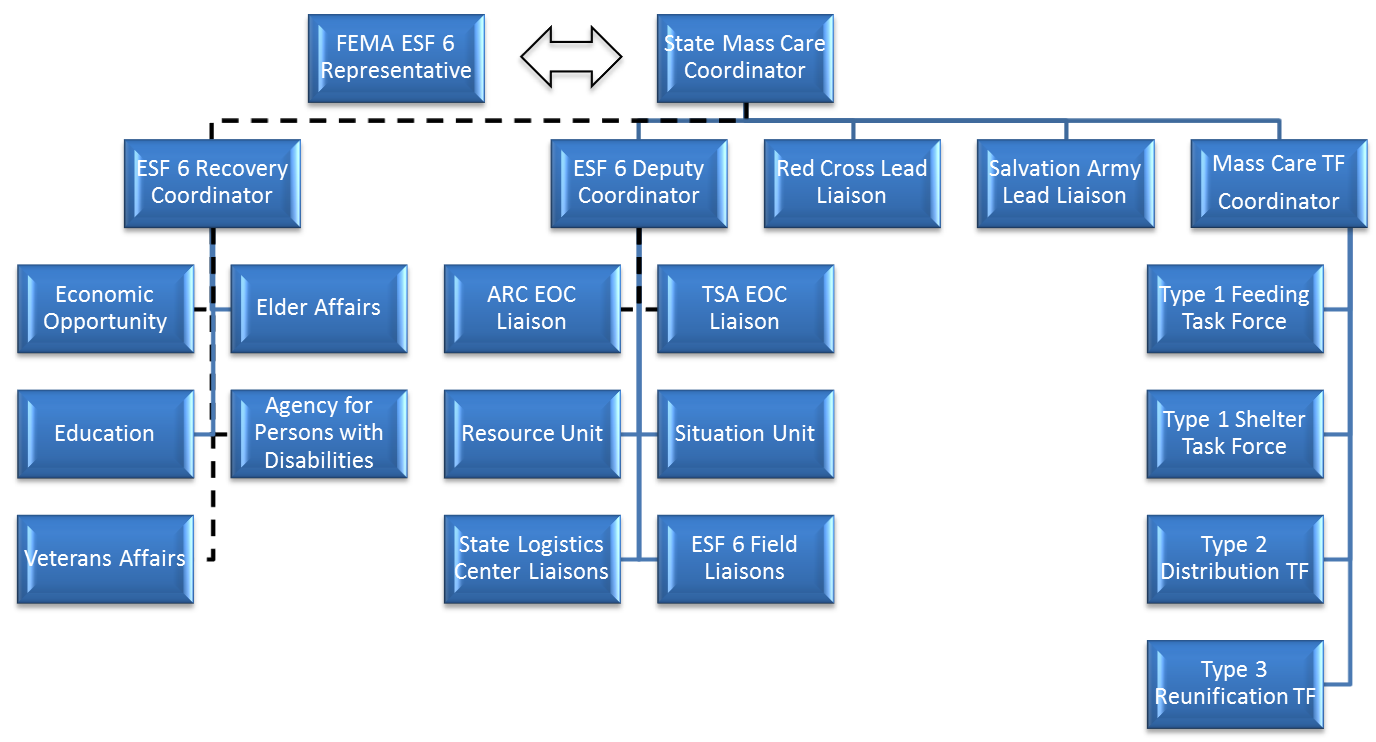
4) The organization that we developed in order to coordinate 4 Mass Care Task Forces at once (see chart below) was not effective. I wrote about this organization in my March 2014 blog post. Everything worked except the part about using a Task Force Coordinator to coordinate with the four Task Forces. Larry Shine, the Texas State Mass Care Coordinator, and I tried to figure out how to coordinate the activities of the 4 Task Forces and we got some things right and, for multiple reasons, we got some things wrong.

Getting things wrong in this Exercise is not a crime. We deliberately tried to stretch the horizon of what we knew so that we could learn what did and didn't work. We found out that this organization didn't work but discovered what we think is the solution. What's the solution? See #5 below.

The Feeding Task Force conducting business during the 2014 National Mass Care Exercise
5) We need more trained Mass Care Planners and more people trained in mass care planning. These are different requirements. The new FEMA Mass Care/Emergency Assistance Planning & Operations Course (which we delivered at the Governor's Hurricane Conference last week) will take care of training more people in mass care planning. We will deliver this course at the National Hurricane Conference in Austin, TX next year, as well as at the Florida Governor's Conference.

Identifying and training Mass Care Planners is another matter. I first identified this problem in my October 2013 blog post. The issue is that in smaller disasters (where we are assisting thousands or tens of thousands of survivors) a failure to adequately plan can be overcome by pouring more resources on the problem. In disasters involving hundreds of thousands or even millions of survivors this isn't possible. The physics of time and distance interfere with our lack of planning.

We need people with the skills to project how many #10 cans of green beans, wheel chairs, and clean up kits we will need in 5 days for a population of 5 million impacted  by a Category 3 hurricane or a Modified Mercali Intensity of X. We can't train people to perform this function until we agree upon a doctrine.  At the 2014 NMCE we advanced the cause in this area and are close to a crude spreadsheet to give us these answers (and by crude I mean better than making up the answers).

The mass care discussions continued on into the evening at the 2014 National Mass Care Exercise
I had a great time at the Exercise and the feedback from the 100+ participants was that they learned a lot. We increased Mass Care Services capability in the nation as a result of this Exercise. Next year in June 2015 Texas will host the Mass Care Exercise in Austin. I can't wait.