Wednesday, June 25, 2014

How many meals do we need?

The first, critical task of an emergency manager at the beginning of an event is to determine the scale of the disaster. The scale of the disaster determines the resource requirements, which leads to an inventory of resources on hand and identification of what is short. A big first question in mass care is: How many meals do we need?

This is a basic, even fundamental, question for mass care practitioners at the beginning of a disaster. Yet, at the 2014 National Mass Care Exercise we spent an inordinate amount of time and energy on the first day of the exercise trying to answer that question. A lot of the practitioners at the Exercise had gained their knowledge and experience operating at the local level in the impact area. Most of my experience was gained at the State Emergency Operations Center (EOC). This variance in our backgrounds influenced how we viewed both the question and the answer.

The Mass Care Chief at a small disaster addresses the question of how many meals are needed by looking first at how many people are in the shelters. Job #1 in mass care is to resource the shelters. If 50 people are in the shelters then they need 2 meals/day and that's 100 meals. Next step is to address disaster feeding in the community through mobile feeding (Yes, I understand it's more complicated than this but bear with me). A Food Service Delivery Vehicle (check the link for the definition) normally carries 300 meals/trip. Based on our initial estimate of the scale of the disaster we need 300 + 100 meals or 400 meals/day. If the mobile feeding vehicle comes back empty then we send them out the next day on 2 trips and up our requirement to 700 meals/day.

At the State EOC I'm looking at this question in an entirely different way. Ten years ago this summer I worked 4 hurricanes in a 6 week period. I would've been pretty damn stupid if I didn't start figuring out what I was supposed to do after the 3rd or 4th hurricane. I learned pretty quick that my reaction time to a request that I hadn't planned for was at least 48 hours, and was more often 4 or 5 days. If you asked me for something and I had it on hand I could get it to you today or tomorrow.

If I didn't have it in hand I had to go get it and then physics got in the way. First, I had to convince someone else in the EOC that what you needed was both necessary and a priority. Next, if it had to come from FEMA, we had to wait breathless and unknowing while our request circumnavigated the federal approval process. Then, someone not under my control had to buy whatever it was you needed, arrange to load it on a truck somewhere in the United States and then drive it to wherever I had designated as the delivery location.

As you can see, 4 or 5 days sounds about right.

But if you're in the middle of a BIG disaster (and believe me, if you're involved in the disaster and the one making the request, it's BIG) and you ask the State for something you want it delivered yesterday, not in 4 or 5 days. That means that if I want to do a good job then I have to figure out what you need, order it, and have it on hand ready to deliver to you by the time you get around to figuring out that you need it. And you'll still complain that I didn't get it to you yesterday.

As a result of this experience I learned to look at the question of how many meals needed in a different manner. I don't know and don't care how many people we need to feed. I need to know how many meals/day of production and distribution resources are required to meet the estimated scale and scope of the disaster.

Furthermore, we need to estimate this meals/day requirement 24 hours before landfall on a Noticed Event, or within 12 hours on a No-Notice Event. Why so early? Because if we don't have enough we need to give FEMA the 4 or 5 days to get and deliver whatever it us we're short of.

So - how do we estimate the meal requirement before the hurricane has even made landfall? All mass care resource requirements are a function of the size of the population affected, the intensity of the event and the geography of the affected area. When estimating the requirements for a hurricane, for example, we use the Hurricane Center forecast to determine the geography of the affected area and the intensity of the event. The population affected can then be determined using census data.

But everyone affected by the disaster has not been impacted by the same intensity. Some people were hit by Category 4 winds while others by Category 1. Their disaster meal requirements would be different so we need to estimate how many people are affected by different intensity levels. So how do we do that? We looked at different factors associated with Low, Medium and High Intensity and put them in Table 1 below.


Table. 1. Estimating Disaster Intensity for use in
forecasting mass care resources
Intensity Level
Factors
High
  • Structural damage to buildings characteristic of a Category 4/5 hurricane or Mercali Intensity levels of X/XI/XII.
  • Up to 80% or more of customers without power
  • Up to 50% or more of  Potable Community Public Water Systems inoperable
  • Wastewater collection system is NOT providing wastewater treatment in accordance with permit conditions and regulations.
Medium
  • Structural damage to buildings characteristic of a Category 3 hurricane or Mercali Intensity levels of VIII/IX.
  • Up to 50% or more of customers without power
  • Up to 30% or more of  Potable Community Public Water Systems inoperable
  • Wastewater collection system is properly conveying and providing wastewater treatment, but at a compromised capacity.
Low
  • Structural damage to buildings characteristic of a Category 1/2 hurricane or Mercali Intensity levels of VI/VII.
  • Up to 20% or more of customers without power
  • More than 10% or more of  Potable Community Public Water Systems inoperable
  • Wastewater collection system is properly conveying and providing wastewater treatment with limited disruptions.

Once we have determined the population affected by each intensity level using Table 1, we use Table 2 to calculate an estimate of the meals/day in production and distribution capability required.

Table 2. Estimating Disaster Meals/Day required
Intensity
Estimate procedure
Output
Low
Sum of population affected by Low Intensity event X 5%
X
Medium
Sum of population affected by Medium Intensity event X 15%
Y
High
Sum of population affected by High Intensity event X 25%
Z
Estimate of Meals/Day production & distribution capability required
X + Y + Z

These percentages are a crude approximation but they are based on meal counts we collected during the 2004-2005 hurricane season. Experienced mass care practitioners have some version of this algorithm in their head. The result of this estimate process is not the final answer but the starting point of the discussion on the daily state mass care conference call.

The state and the voluntary agencies reach a consensus on the meals/day disaster feeding requirement during the daily state mass care conference not later than 24 hours before a Notice Event or not later than 12 hours after a No-Notice Event. This consensus meal estimate becomes a very powerful tool. Once we agree upon what is required, then we can look at what is available to meet that requirement.

If the requirement is 100,000 meals/day and we have 5 Type II Field Kitchen Units available then we know that we have sufficient production capacity to meet the requirement. Furthermore, if we assume that a Food Service Delivery Vehicle can distribute, on average, 1,000 meals a day then we know that we will need at least 100 vehicles for this event.

As you can see the number of people in shelters and the number of meals that we are feeding each affected person in the community plays no part in my calculations at the state, or macro level. At the micro level, where the Mass Care Chief is preparing a Feeding Plan, those numbers come into play.

Job #1 for the State Mass Care Coordinator is to determine if the voluntary agencies have sufficient resources on hand to meet the consensus meals/day estimate. If the answer is no, then Job #2 is to figure out what is short and go get it. And you better hurry.

Saturday, May 24, 2014

Lessons from the 2014 National Mass Care Exercise

We will write a After Action Report (which we hope to have out to the public by July 4) but I had a number of first impressions:

1) We did better than last year, which was better than the year before. This shows that we are trainable and there's hope.

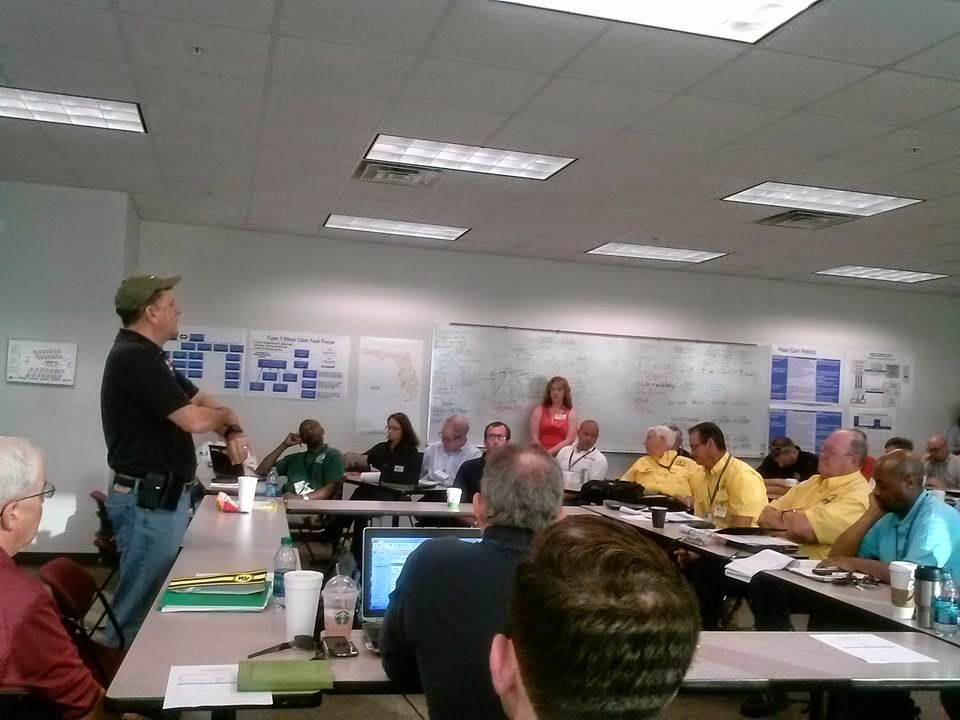
Michael Whitehead, State Mass Care Coordinator for Florida, briefing the 2014 National Mass Care Exercise participants on the morning of the 3rd day.
2) I had a personal goal of not getting overwhelmed during the Exercise and I succeeded. In last year's exercise, as well as the year before, I was called upon to be everywhere at once and solving multiple, complex crisis of misunderstanding within the Mass Care Task Forces. I failed in my ability to simultaneously act as a Player, Controller, Evaluator and Coach. This year a number of people besides myself who understood the Big Picture and were able to step in and resolve these crisis without my direct assistance.

One of many visual displays on the walls of the Shelter Task Force during the 2014 National Mass Care Exercise.
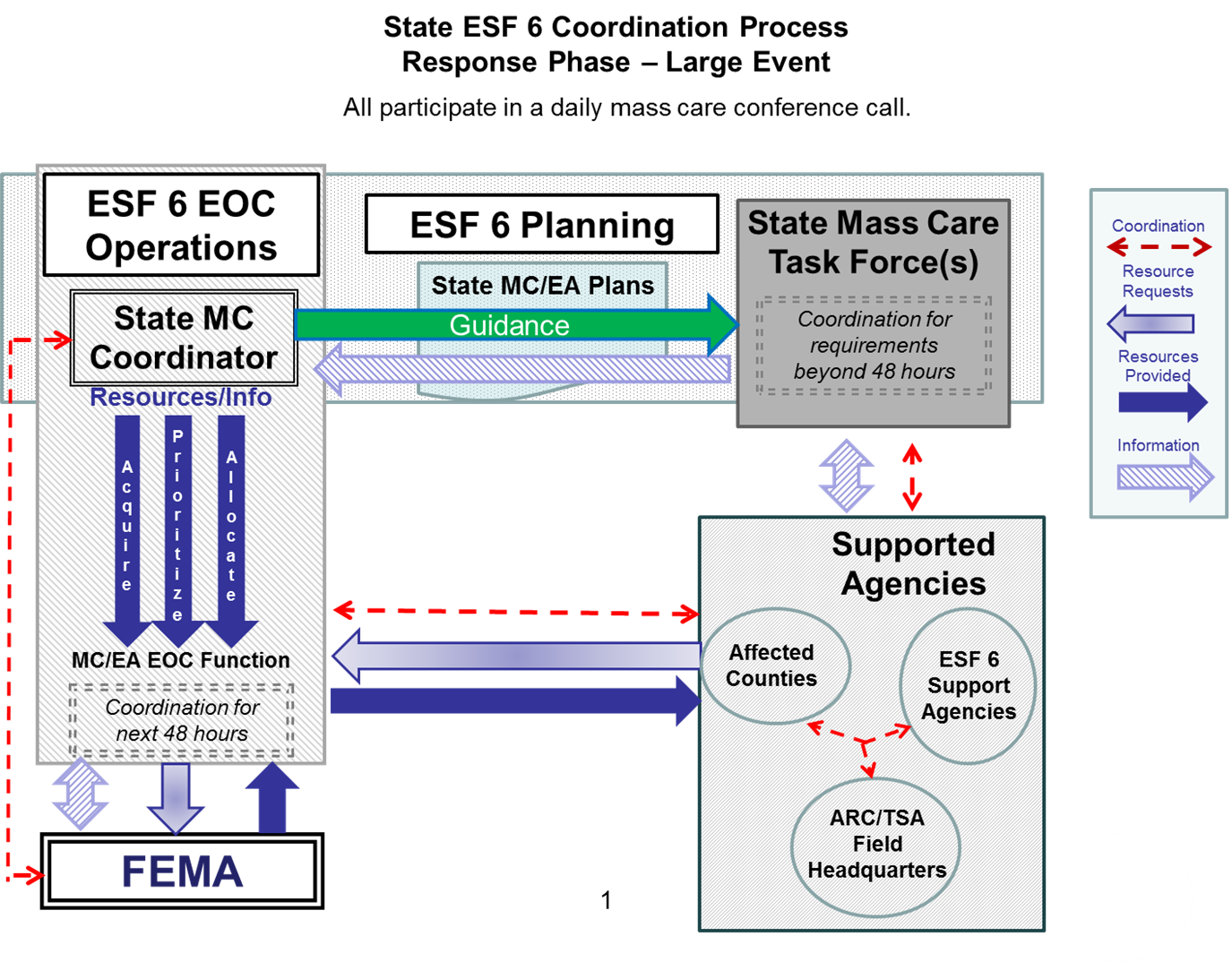
3) We validated the State Mass Care Coordination process (see diagram below). Not everyone even  understands the diagram, much less the process, but that's an education issue. The process works and can work in any state that needs to expand their mass care coordination capability in a large disaster. Doctrine is defined as accepted knowledge that can be taught to others. We now have that accepted knowledge and can go teach others.

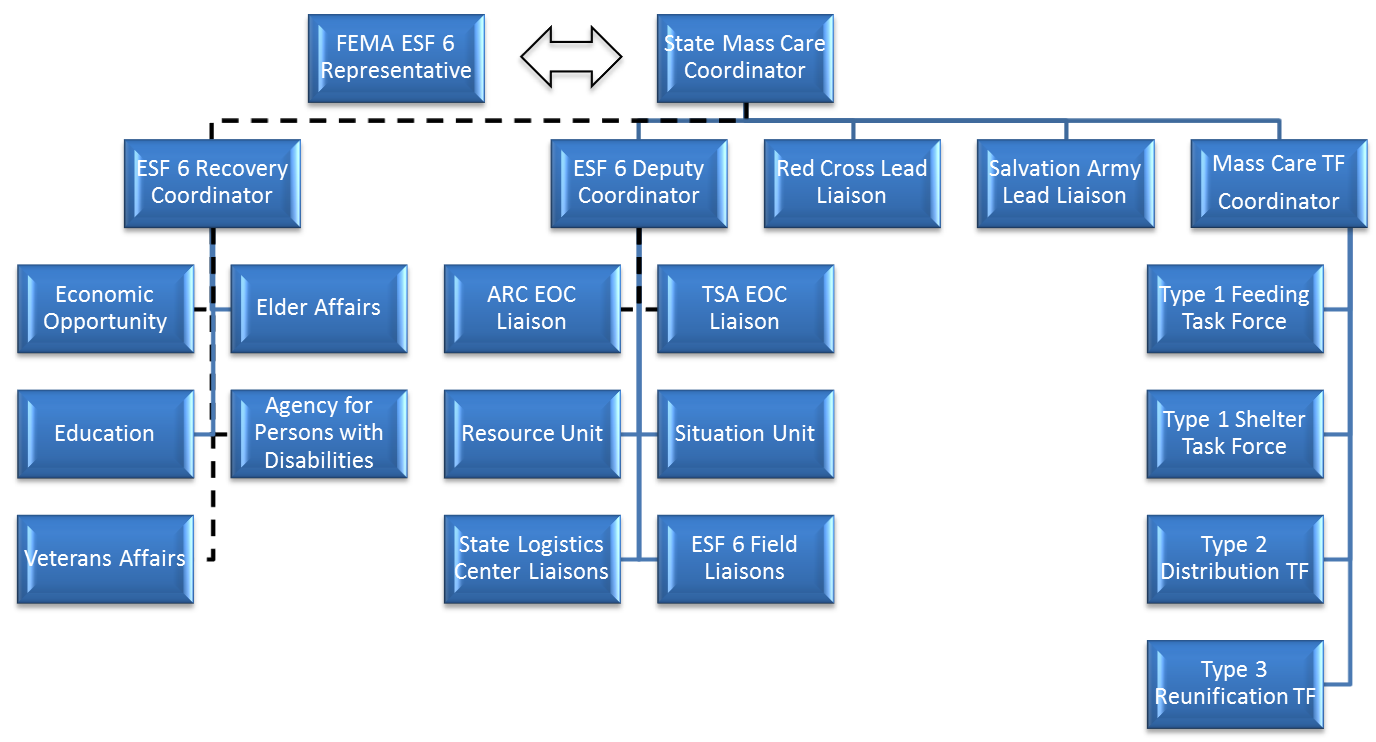
4) The organization that we developed in order to coordinate 4 Mass Care Task Forces at once (see chart below) was not effective. I wrote about this organization in my March 2014 blog post. Everything worked except the part about using a Task Force Coordinator to coordinate with the four Task Forces. Larry Shine, the Texas State Mass Care Coordinator, and I tried to figure out how to coordinate the activities of the 4 Task Forces and we got some things right and, for multiple reasons, we got some things wrong.

Getting things wrong in this Exercise is not a crime. We deliberately tried to stretch the horizon of what we knew so that we could learn what did and didn't work. We found out that this organization didn't work but discovered what we think is the solution. What's the solution? See #5 below.

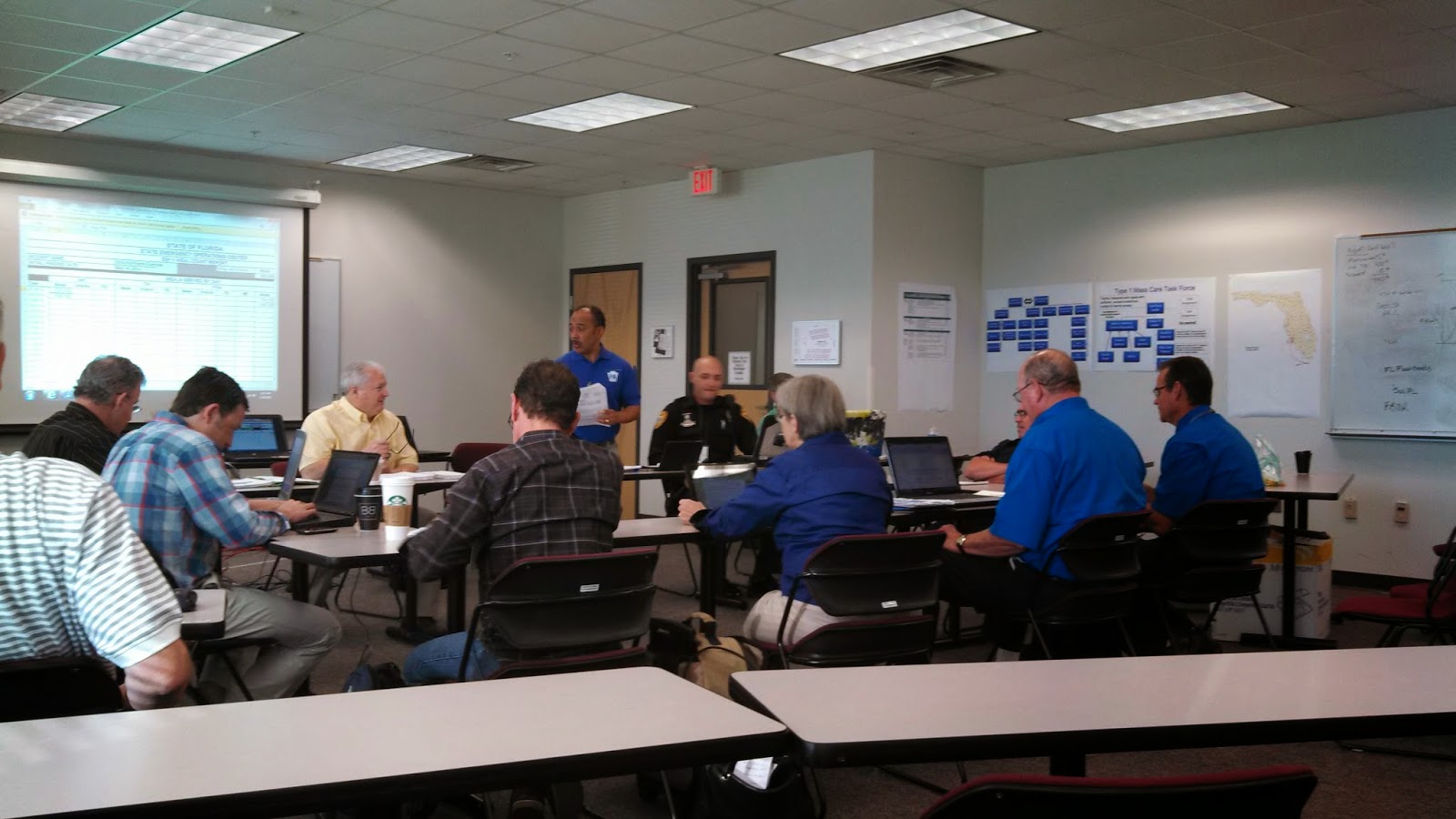
The Feeding Task Force conducting business during the 2014 National Mass Care Exercise
5) We need more trained Mass Care Planners and more people trained in mass care planning. These are different requirements. The new FEMA Mass Care/Emergency Assistance Planning & Operations Course (which we delivered at the Governor's Hurricane Conference last week) will take care of training more people in mass care planning. We will deliver this course at the National Hurricane Conference in Austin, TX next year, as well as at the Florida Governor's Conference.

Identifying and training Mass Care Planners is another matter. I first identified this problem in my October 2013 blog post. The issue is that in smaller disasters (where we are assisting thousands or tens of thousands of survivors) a failure to adequately plan can be overcome by pouring more resources on the problem. In disasters involving hundreds of thousands or even millions of survivors this isn't possible. The physics of time and distance interfere with our lack of planning.

We need people with the skills to project how many #10 cans of green beans, wheel chairs, and clean up kits we will need in 5 days for a population of 5 million impacted  by a Category 3 hurricane or a Modified Mercali Intensity of X. We can't train people to perform this function until we agree upon a doctrine.  At the 2014 NMCE we advanced the cause in this area and are close to a crude spreadsheet to give us these answers (and by crude I mean better than making up the answers).

The mass care discussions continued on into the evening at the 2014 National Mass Care Exercise
I had a great time at the Exercise and the feedback from the 100+ participants was that they learned a lot. We increased Mass Care Services capability in the nation as a result of this Exercise. Next year in June 2015 Texas will host the Mass Care Exercise in Austin. I can't wait.

Sunday, April 20, 2014

The 2014 National Hurricane Conference

The 2014 National Hurricane Conference is over and now I will have to wait until next year in Austin, TX to see all my mass care friends again. Actually, that's not true, since the Florida Governors Hurricane Conference is in 3 weeks and the National Mass Care Exercise is the week after that. April and May has abundant opportunities for the renewal of mass care friendships.

There was something missing from the 2014 NHC. As Gregg O'Ryon, Vice President for the American Red Cross, pointed out to me, the NHC wasn't helped by the movement of the GHC from Ft. Lauderdale to Orlando this year. The result was 2 hurricane conferences with 4 weeks of each other and both in hotels within spitting distance of each other on International Drive.

There was a drop in the number of Red Cross people at the NHC. The Florida Red Cross people will all be going to the GHC. There also seemed to be a shortage of Femites at the Conference (although Craig Fugate made it and gave a good speech). I could understand the shortage last year because of the sequester but we needed more FEMA mass care people at the conference. I think the reason for the continued absence of FEMA people is the lingering effects of last year's IRS Conference scandal. Getting approval to attend a conference if you're a federal employee is a giant pain in the you-know-what.

A big piece of what was missing at the NHC this year compared to the last 2 years was the absence of a hurricane impact the previous season. The 2012 NHC was filled with enthusiastic North-easterners detailing their newfound knowledge and wisdom gained from battling Tropical Storm Irene. At the 2013 NHC some of the same North-easterners returned, somewhat chastened and wiser, to recount their struggles with Hurricane Sandy (I refuse to call it a superstorm).

The big event last year was the floods in Colorado. We would have all benefited if we could have gotten some people from Colorado to talk about their sheltering issues and maybe some Red Cross people to give us a report on how their new Disaster Relief Operation structure worked out.

But we couldn't invite them because the disaster wasn't a hurricane. There's something wrong with this picture. We had Salvation Army people from Oklahoma at the NHC, and they haven't had any hurricanes there in a while, or maybe ever.

What we need at the NHC, or at least the mass care portion of the NHC, are training and workshops on the latest techniques and best practices in mass care, regardless of whether the techniques and best practices  were learned in a Rocky Mountain Flood or the National Mass Care Exercise.

I think the mass care community might be able to do something about that.


Tuesday, March 25, 2014

How to manage 4 Mass Care Task Forces at once

A FEMA friend who works in mass care emailed me recently with her comments about the Mass Care Task Force White Paper. "This is all very interesting," she said, "but none of the states in my Region have the personnel to set up even one of these Task Forces."

I saw from her comment that she had failed to grasp a key tenet of the White Paper. No state has the organic capacity to set up one or even multiple mass care task forces in a large disaster: not even Florida. As the White Paper clearly states on page 3, "Additional staff must be requisitioned prior to a Noticed Event or immediately after a No-Notice Event." And people with the necessary skill sets are only available out-of-state.

Which is why one of the objectives of the National Mass Care Exercise that we are holding in Tallahassee May 19-22, 2014 is to practice bringing in mass care staff from other states and integrating them into our State mass care operation. This year we are bringing to the Exercise mass care practitioners from multiple states, Femites from multiple Regions, and mass care voluntary agency staff from across the nation. Our Goal is to practice and refine the State Mass Care/Emergency Assistance process that I have outlined in a prior blog.

In fact, we have so many people coming we are going to establish 4 mass care task forces for the exercise: Sheltering, Feeding, Distribution of Emergency Supplies and Reunification. A big question for this exercise will be how the State Mass Care Coordinator (that would be me) will be able to coordinate the activities of the 4 Task Forces. As an experiment, we came up with the organization chart below.


This chart is NOT a hierarchy of command but a diagram showing the recommended flow of information (up & down). In modern parlance, the State Mass Care Coordinator only has so much bandwidth. The information flowing to/from the State Mass Care Coordinator must be controlled so that he/she doesn't become overwhelmed.

When we expanded to 4 task forces we created a Mass Care Task Force Coordinator position. Yes, we have that power. This new position will manage the flow of information between the SMCC and the 4 Task Force Leaders. We will have to see how it works.

As I said when I first showed this chart to the planning team: At the end of the exercise we will be able to say: "Well, at least we now know THAT way doesn't work."

Saturday, February 22, 2014

On Draining the Swamp

"When you're up to your ass in alligators, it's hard to remember that your original objective was to drain the swamp."


State of Florida EOC at the opening of the 2013 National Mass Care Exercise
I plan to make this quote the unofficial motto of the 2014 National Mass Care Exercise that will be held in Tallahassee May 18-22, 2014. I also may have to re-phrase it a bit in deference to whatever tender ears may be in attendance.

The central focus of the exercise will be testing the concepts laid out in the White Paper on Mass Care Task Forces that was published in December 2013. And the White Paper is all about developing a doctrine for the state mass care coordination process. I know, for some people the word "doctrine" is a dirty word, but they have to get over it. Doctrine is simply a commonly understood way of doing something that is taught to other people. And the mass care community (the states, the voluntary agencies, the feds, even the private sector) need to have a common understanding of the state mass care coordination process so that when we are all assembled in an affected state during a big disaster we can work together more effectively.

Regular readers of this blog will have noticed that I obsess on the big, even large and at times catastrophic disasters. I focus on these disasters because those are the ones with the complex problems, the biggest consequences and that are the least understood because they happen so infrequently. In Florida, disasters have to be big to elevate to the state level because our counties and voluntary agencies are capable. The state doesn't get involved in any serious manner unless they are overwhelmed.

When the disaster grows big the mass care staff at the state Emergency Operations Center (EOC) get overwhelmed trying to fight all the alligators. The State Mass Care Coordinator needs to expand the staff to meet the increased number and complexity of the coordination tasks that they must complete. Staff with the training and experience to step in and help us aren't hanging out in Tallahassee waiting for an opportunity: they must be identified and brought in at the time of the disaster. We must have a structure and processes constructed, in place and in writing for these new arrivals. This structure is the mass care task force. When they get there the people in the task forces work on draining the swamp.

We've been trying to figure out how mass care task forces are supposed to drain the swamp since 2009, when we set up a Feeding Task Force for the Hurricane Suiter exercise (Craig Fugate's last State Exercise before he became a Femite). In 2012 we set up 3 TF's: Feeding, Sheltering and Distribution. In 2013 we had 2 TF's: Feeding and Sheltering. In what turned out to be a trial and error process we had lots of trials and even more errors.


The Shelter Task Force in operation during the May 2013 National Mass Care Exercise in Tallahassee.
The crux of the issue was that this was a complex problem and nobody really knew how these task forces were supposed to work. Oh, we THOUGHT we knew. Last year I thought I was so smart and had this problem ALL figured out and then 2 hours into the exercise I told myself, "Well, this isn't going to work, either." And we had plenty of criticisms from the participants. Read the After Action Reports, here and here.

But we're getting better. And the best part is that all these mistakes we're learning from are happening in an exercise and not a disaster. The really best part is the Exercise this year will show that we've got it all figured out.

Maybe.

Sunday, January 19, 2014

On the value of being afraid

In the Cycle of Life of an emergency manager in Florida there are 3 seasons: Hurricane season, the Christmas holiday season, and Getting Ready for Hurricane season. There is comfort in this cycle, in the repetition of tasks, and orientation to a new purpose. If this is January then it's time to get ready for June 1st.

As I have in the last half-dozen years, I entered this particular season with a sense of foreboding and even fear. What if this is the year the Big One hits Florida? Am I ready? Is the SERT ready? Is the national mass care community ready? And if the answer to any one of these questions is NO, then what must I do to get them ready?

To give you a sense of what I'm talking about, to relieve your concern that I am being overly dramatic, let me say that my idea of the Big One is a storm equivalent in size and intensity to the one that pulverized the Philippines last year. And my nightmare is that this storm strikes the 6.5 million people in southeast Florida. I will leave details of such a disaster to your imagination. I have been in enough disasters to have developed a vivid picture of everything such a disaster would entail.

Of all the worrying questions that spring to my mind as the Cycle turns to January I can only control one: Am I ready? And the answer I give myself every time is that I am more ready this year than I was the year before. Whatever that means. As for the other questions, those that involve people and organizations that I cannot control but only influence, I can only wonder if they are as scared as I am.

In Kuwait, on my way home, the Army asked me if I had ever been scared during the ten months that I had spent in Iraq. I said no. I was wrong. There were a number of times that I was scared in Iraq. Fear is a rational response to real or perceived risk. Being afraid focuses the mind and can improve performance.

So why did I give the wrong answer? I have thought about this a lot. Was it the myth that Real Men don't get scared? Was it the fact that I had not engaged in direct combat with the enemy, been subjected to the many horrors of warfare, and thus had no right to say that I had ever been scared? No. Rather, I believe that I misinterpreted the question. I perceived the question to be, not whether I was scared (although that was the word used in the sentence I read), but whether I was terrified. Terror is an irrational response to a real or perceived risk and degrades performance, sometimes to the point that one is ineffective at almost any task. I had been scared, but never terrified. I cannot say, if circumstances had been different, whether I would have ever been seized with terror. I like to believe that the answer to that is no, but I have never subjected my vivid imagination to such a test.

I am afraid of the Big Hurricane hitting my state, and me being in a position of responsibility to do something about it, and to be prepared for the eventuality. There's value in being afraid of some things.

But I'm not terrified: at least, not now.